We care about this because we have watched too many leadership teams misdiagnose the same problem. The dashboard flattens. Search clicks stop climbing. Views per post soften. The instinct is immediate and predictable: publish more, spend more, optimise harder, ask the team why momentum has disappeared.
That response is often a waste of perfectly capable effort.
A company whose traffic has stalled does not automatically have a content problem. It may have a ceiling problem: a structural limit created by relying on one channel, one content format, or one version of the customer. More effort inside that same structure does not reliably produce more reach. It simply makes the organisation better at pressing against its own limit.
This distinction matters now because the old assumption that traffic cleanly reflects content value is breaking down. AI Overviews are changing search behaviour in U.S. Google. When an AI Overview is displayed, people click a result about 8% of the time, versus 15% when there is no Overview. Only 1% click a link within the Overview itself.
That is not a minor optimisation issue. It changes the available click pool before a company has written a title tag, adjusted a bid, or published another article. Leaders who still treat traffic as a simple reward for output will keep drawing the wrong conclusion from the same numbers.
Traffic ceilings are structural, not effort-based
Our position is straightforward: when traffic stops responding to increased output, the answer is rarely “work harder on the dominant channel.” The answer is to identify the structure that has stopped producing marginal returns, then redesign the distribution model around it.
Content is not distribution. Search visibility is not an audience. A high-performing format is not a growth system. And a company that receives more than 80% of its traffic from one channel does not have a reliable engine; it has a dependency.
That dependency can look healthy for a long time. Google Search can deliver efficient discovery. A successful Instagram format can create a steady stream of attention. LinkedIn can make a founder look omnipresent in a specific professional circle. YouTube can build meaningful depth with the right audience.
But the moment the channel shifts, the format tires, the audience segment is exhausted, or the platform changes what it rewards, the company discovers that its apparent growth system was really a single point of failure.
Single-channel growth is fragile because the business has outsourced too much of its visibility to one gatekeeper. The company may own the content, but it does not own the route people take to find it.
Key takeaways
- Traffic that rises slowly with more output is stagnation. Traffic that plateaus while views per post and click-through rates decline is saturation.
- If more than 80% of traffic comes from one channel, the business is exposed to a structural dependency-not protected by a proven strategy.
- AI Overviews make raw search traffic a less reliable proxy for content value because fewer searchers click through when the Overview is present.
- The practical response is not generic “post more” advice. It is to add distribution paths, formats, and audience entry points that reduce dependence on the first channel.
The first ceiling: one channel
The most common ceiling is channel concentration. It is also the one companies are most reluctant to admit because the dominant channel usually built the first phase of growth.
Search is the clearest example. A company builds useful pages, earns rankings, and begins to associate traffic growth with publishing. That association is understandable. It is also dangerous when it becomes the entire strategy.
Google Search remains a major discovery route, but it is no longer a neutral field where every useful page has the same chance to turn attention into a visit. AI Overviews alter the journey. When a result is presented alongside an AI Overview, the click rate falls from about 15% to about 8%. The result may still be visible. It may still contribute to awareness. But visibility and a site visit are no longer interchangeable.
This is why traffic needs to be interpreted more carefully than it was in the era when a ranking was assumed to produce a predictable click. A page can retain relevance while generating fewer visits. A brand can become more visible in search while receiving less measurable referral traffic. A leadership team looking only at sessions can conclude that content is failing when the actual change is in how discovery is being mediated.
That does not make search worthless. It makes search insufficient as the entire answer.
The same principle applies to paid acquisition. Performance Max and Smart Bidding can improve decisions inside an auction, but they cannot manufacture a larger pool of willing clicks. When AI-driven search behaviour and brand dynamics reduce the click pool before the auction, endless bidding adjustments become an increasingly narrow answer. Higher CPC pressure is not always a sign that the campaign team needs another lever. It can be a signal that the available attention has become more constrained.

Companies need post-click systems and alternative discovery routes because the auction is not the whole market. It is simply one place where companies compete for access to demand.
The second ceiling: one format
A channel ceiling often hides inside a format ceiling. A company may technically be active on several platforms while repeating one idea in one form for one type of consumption.
Consider the familiar model: publish a written article, optimise it for Google, share it once, then measure whether it generated clicks. The company calls this multi-channel because the link appeared in more than one place. It is not multi-channel distribution. It is a single asset asking every platform to behave like a referral machine.
Platforms do not create attention in the same way. YouTube supports depth and sustained explanation. TikTok and Instagram create different forms of fast discovery. LinkedIn provides a context for professional visibility and authority. Meta can create additional routes to reach. Google Search serves people already expressing intent. Treating all of them as places to paste the same link is a refusal to adapt to the actual mechanics of discovery.
The point is not to flood every platform with output. That is just manual effort disguised as a strategy. The point is to build formats that let one useful idea travel through multiple environments without requiring every audience to discover it in exactly the same way.
A written explanation can become a video argument. A video insight can become a short-form point of view. A recurring question can become a useful search asset. A strong perspective can become a sequence of platform-native pieces that reinforce the same authority from different angles.
This is how visibility compounds. The work is no longer dependent on a single publication event or one algorithmic decision. Each expression of the idea can create another route into the company’s expertise.
Companies that only produce one format eventually confuse format fatigue with audience disinterest. Their audience may not be exhausted by the subject. It may be exhausted by encountering the subject in the same shape, on the same surface, from the same predictable angle.
The third ceiling: one persona
The least discussed ceiling is audience concentration. Many companies keep pursuing traffic growth after they have already reached most of the readily available people who fit the one persona their content was designed for.
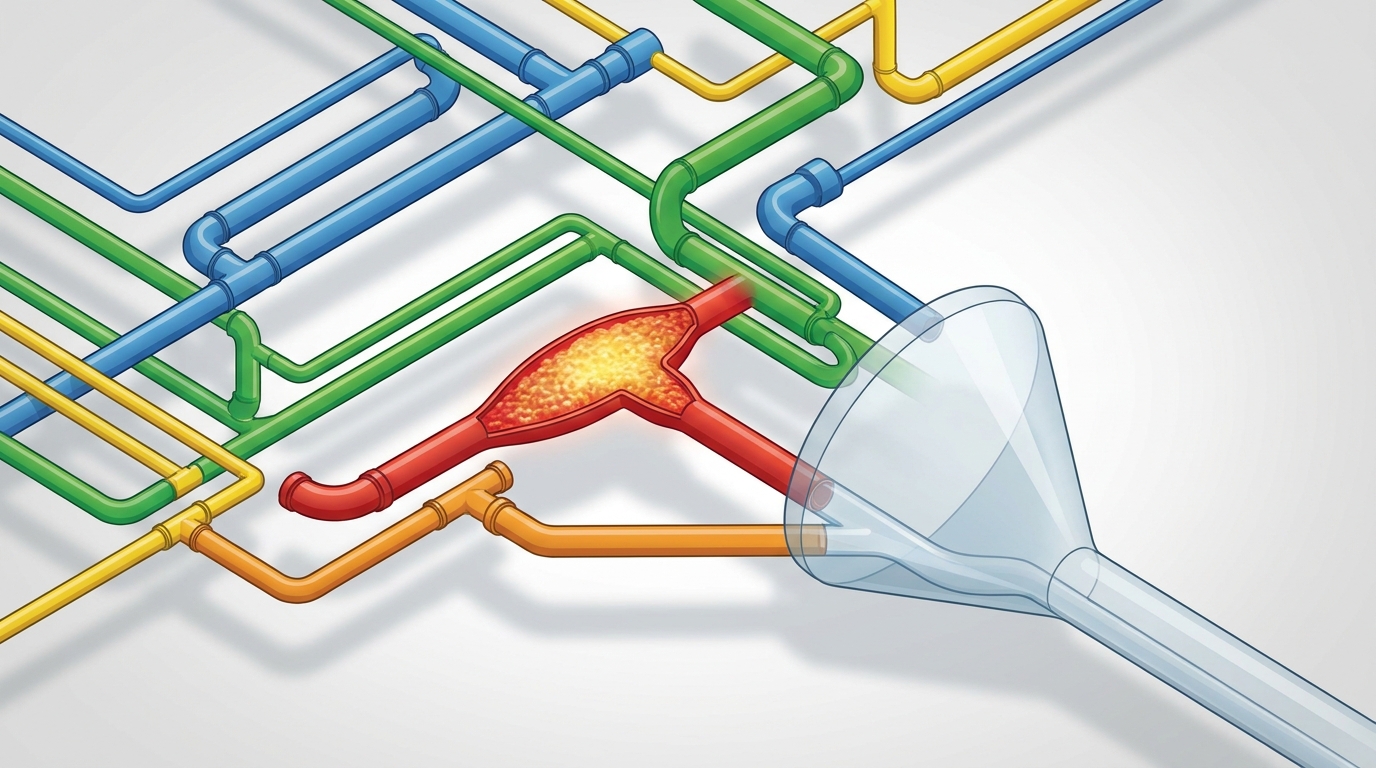
The initial persona is often useful. It gives the company focus. It makes early content easier to produce. It helps the team decide what language to use and which problems to address. But a persona can become a cage when it is treated as the whole market rather than the first doorway into it.
A company may be speaking only to the person who executes the work while ignoring the person who approves the budget. Or it may be speaking only to the buyer who is already searching for a solution while ignoring the operator who influences the decision earlier. It may produce content for existing experts while failing to create entry points for people who are only beginning to recognise the problem.
The result is familiar: more content, more internal pressure, and less return. The team keeps asking the same narrow segment to provide more attention than that segment can realistically give.
This is not an argument for vague messaging. It is an argument for designing more than one legitimate path into the company’s authority. Different people need different levels of explanation, different proof, different formats, and different reasons to care. A business that only has one audience entry point will eventually encounter an audience ceiling.
How to tell which ceiling you have hit
The diagnosis starts by separating stagnation from saturation.
Stagnation is when traffic grows slowly but consistently as output increases. This is not necessarily a broken system. It may mean the existing channel still works, but its capacity is limited. The company is gaining ground, just not at a rate that supports its ambitions.
Saturation is more serious. Traffic plateaus despite increased output, while engagement metrics such as views per post and click-through rates decline. That is the moment to stop congratulating the team for producing more and start asking whether the structure itself has run out of room.
High dependency is the warning signal that makes both conditions dangerous. When more than 80% of traffic comes from one channel, a plateau is not just a performance issue. It is an exposure issue. The company’s visibility is too closely tied to a platform it does not control.
Google Search Console can reveal the tension between impressions and clicks. A company should not look at clicks alone when AI Overviews are changing click behaviour. It should examine whether visibility is holding while click-through rates change, whether certain pages are no longer earning the same visit volume, and whether a large portion of discovery rests on a narrow set of search routes.
On social platforms, the comparable signal is not merely whether a post had a good day. It is whether the company’s visibility depends on one repeated format, one platform pattern, or one shrinking audience response. Falling views per post and softer click-through rates alongside increased publishing are not a rallying cry for volume. They are evidence that the company should reconsider the model.
FinalBoss did not break through by pushing the first channel harder
The clearest proof of the principle is FinalBoss: 8.7 million impressions and 66,047 Google clicks came from adding channels, not from pushing the first one harder.
That is the strategic lesson leaders should keep. Growth did not come from treating Google as an infinitely expandable pipe. It came from expanding the surface area through which people could encounter the brand and its ideas.

This matters because leaders often expect a mature channel to deliver the next phase of growth simply because it delivered the first one. That expectation leads to the worst kind of operating behaviour: teams are pushed to create more of the same while everyone quietly wonders why each additional asset does less than the last.
Adding channels is not an excuse for scattered activity. It is a decision to make discovery a business function. It means building a deliberate presence across the places where relevant people already pay attention, while ensuring each channel does a distinct job in the visibility system.
Google can support high-intent discovery. YouTube can carry depth. Instagram and TikTok can create repeated exposure and reach people before they begin a search. LinkedIn can establish operator-level authority. Meta can add another distribution path. No single platform must carry the entire burden of growth.
Stop using traffic as the only verdict on content
Traffic still matters. It remains a useful observable signal. But it is no longer enough to treat it as the final verdict on whether a company’s ideas are useful, visible, or influential.
AI Overviews make that especially clear. If a person sees a company’s information in search but does not click, the company has not necessarily created zero value. It has created a form of visibility that raw session counts do not fully capture. The same applies when people encounter a useful argument through a short-form video, an Instagram post, a YouTube explanation, or a LinkedIn perspective before they ever search for the company directly.
The discipline is to measure what can actually be observed without pretending that every meaningful interaction becomes a click. Impressions, click-through rates, views per post, channel concentration, Google Search Console trends, and the difference between visibility and visits all provide evidence. Together, they create a more honest picture than a single traffic line on a dashboard.
The company that understands this can make better decisions. It can recognise whether its problem is insufficient output, declining distribution efficiency, audience saturation, or excessive dependence on one platform. Most importantly, it can stop punishing a content team for a structural limitation that content volume alone cannot solve.
TL;DR
Traffic plateaus are often blamed on insufficient publishing, weak execution, or a team that needs to optimise harder. That diagnosis is frequently wrong. The real problem is usually structural: one dominant channel, one overused format, or one exhausted audience persona.
AI Overviews make this impossible to ignore. In U.S. Google, people click a result about 8% of the time when an AI Overview is displayed, compared with 15% without one, and only 1% click a link inside the Overview. The click pool can shrink before a company’s SEO or paid-search work even begins.
The answer is not to publish more of the same and call it a strategy. It is to redesign distribution: build multiple discovery routes, adapt ideas into formats that fit each channel, reach more than one audience entry point, and reduce dependence on any platform the company does not control.
FinalBoss reached 8.7 million impressions and 66,047 Google clicks by adding channels rather than pushing the first one harder. That is the model worth copying. Visibility compounds when a company builds a system for discovery. It stalls when it mistakes one channel’s limits for a lack of effort.
Leave a Reply