Category: Uncategorized

  • The Indexing Mistake That Cost Us a Quarter of Our Google Visibility

    The Indexing Mistake That Cost Us a Quarter of Our Google Visibility

    We run our visibility systems on our own property, at our own risk. That matters because there is nowhere to hide when a technical decision damages performance. No client handover. No agency report that explains away a decline with vague language about volatility. No convenient story about an algorithm update.

    When our Google visibility dropped by roughly a quarter, the problem was not that we had stopped publishing. It was not a content-quality issue. It was not a mysterious penalty. We had created an indexing conflict between our root domain and a subdomain used in our headless CMS setup.

    In plain terms, we allowed one body of content to exist across two hosts without enforcing a single, reliable version for search. Google had multiple paths into substantially the same content ecosystem. Our architecture had split the signals that should have compounded in one place.

    That is the failure. We own it.

    We treated an indexing architecture problem as a publishing problem

    The most expensive SEO mistakes are often boring. They are not dramatic hacks or reckless link schemes. They are the quiet infrastructure errors that sit underneath a publishing operation while everyone celebrates a better site build, a faster workflow, or a cleaner CMS implementation.

    Headless systems can create exactly this kind of blind spot. They give teams flexibility. Content can be managed separately from the front end. Different systems can serve different purposes. A business can move faster without forcing every workflow through one traditional publishing stack.

    But flexibility is not the same as coherence.

    Search does not care whether a split architecture felt elegant to the team that built it. Google sees URLs, hosts, internal links, canonicals, sitemaps, redirects, rendered HTML, and repeated signals over time. If those signals disagree, the business has a discovery problem.

    And discovery is a business function. It is not an implementation detail to be delegated indefinitely to whoever happens to own the CMS or whoever last touched Search Console.

    Our mistake was allowing the subdomain and root domain to behave as competing homes for content that should have reinforced one domain-level authority system. The subdomain was not merely an internal technical component. It had become visible to crawlers and indexation systems in ways that weakened consolidation.

    The result was predictable in hindsight. Instead of building one increasingly clear set of search signals around the root domain, we had distributed them across two hosts. That fragmentation cost us roughly a quarter of our Google visibility before recovery began.

    Key takeaways

    • Search visibility compounds only when pages, metadata, canonicals, sitemaps, and redirects reinforce one authoritative domain.
    • A subdomain can become a competing indexation surface if it is crawlable, discoverable, or allowed to publish conflicting signals.
    • Canonical tags alone are not a strategy. They must be absolute, consistent, rendered in the raw HTML, and supported by redirects and sitemap logic.
    • Search Console is not a reporting destination. It is an operational control point for discovering whether Google is seeing the site you believe you have built.

    The real mistake was splitting authority

    There is a lazy version of this story that says subdomains are bad for SEO. That is not the lesson.

    The lesson is that a subdomain is a separate surface in the eyes of search systems, and it must be treated with that level of seriousness. If it is part of a deliberate strategy, it needs a clear role. If it is only a technical by-product of a CMS architecture, it should not be allowed to become an alternate version of the business in search.

    Our root domain was supposed to be the source of authority. That was where the public-facing experience belonged. That was where our content was meant to accumulate relevance, links, internal connections, and recognition over time.

    But the headless CMS arrangement created another host that could participate in indexing. This is the kind of failure that can look harmless at first. A few pages surface unexpectedly. A canonical is missing on a template. A sitemap points somewhere it should not. Metadata is generated in more than one place. An old URL remains reachable. A crawler gets a response from the subdomain when it should have been sent cleanly to the root domain.

    None of those failures needs to be catastrophic on its own. Together, they create ambiguity. And ambiguity is expensive when your business depends on discovery.
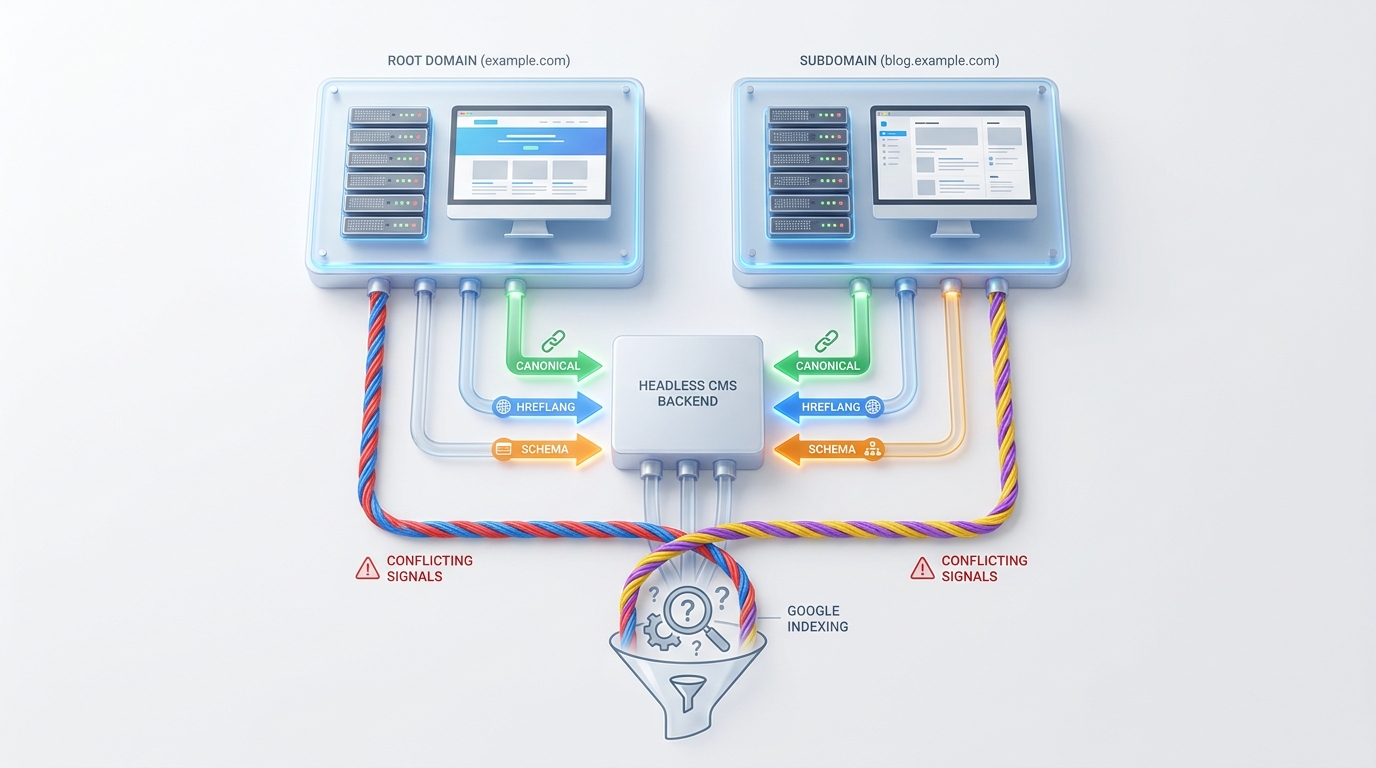
    Diagram of split metadata/indexing signals between root domain and subdomain in a headless CMS setup.
    Diagram of split metadata/indexing signals between root domain and subdomain in a headless CMS setup.

    SEO teams often discuss ranking signals as if they are independent levers. Publish better pages. Improve internal links. Earn mentions. Build topical depth. Those things matter. But they lose force when the technical foundation cannot answer a basic question consistently: which URL, on which host, is the definitive version of this page?

    Every answer should have been the root domain. Ours was not reliably doing that.

    Why this hurts more than a temporary traffic dip

    A decline in Google visibility is never just a chart problem. It interrupts a compounding system.

    Organic discovery is valuable because it can create repeated exposure without requiring a fresh payment for every visit. A useful page earns a place in search, attracts attention, supports brand recognition, creates paths into the rest of the site, and can continue doing that work long after publication.

    That is why authority is an asset. It is not merely an SEO score. It is accumulated proof that the market can find you, understand you, and return to you through a reliable owned surface.

    When signals split across a root domain and a subdomain, the loss is bigger than a ranking position. The business weakens the machine that makes visibility compound. Search engines have less clarity. Link equity has less certainty about where it belongs. Content relationships become harder to interpret. Pages that should reinforce one another may be treated as parallel or competing assets.

    That is exactly what makes this class of failure so frustrating. The content team can still be doing good work. The editorial calendar can be full. The pages can be genuinely useful. Yet the distribution layer has been compromised beneath them.

    Content is not distribution. Publishing more while an indexation conflict remains unresolved is just adding inventory to a warehouse with the wrong address.

    What we changed to recover

    Recovery required a consolidation effort, not cosmetic SEO work.

    First, we implemented automated canonical logic so every page had one absolute canonical URL pointing to the root domain. Not relative canonicals. Not a mix of environment-specific outputs. Not a template-level assumption that a CMS dashboard appeared to be doing the right thing. Every indexable page needed to state the same answer clearly in the rendered HTML.

    That absolute canonical rule matters because technical systems drift. Content models change. New templates appear. A preview environment gets exposed. A different publishing workflow generates metadata. If canonical logic is manual or inconsistently controlled, the site eventually produces exceptions. At scale, exceptions become the architecture.

    Second, we consolidated sitemap logic. We created a sitemap index file at the primary root domain and used it to reference the individual sitemaps generated by the CMS. We submitted only that root-domain sitemap index in Google Search Console.
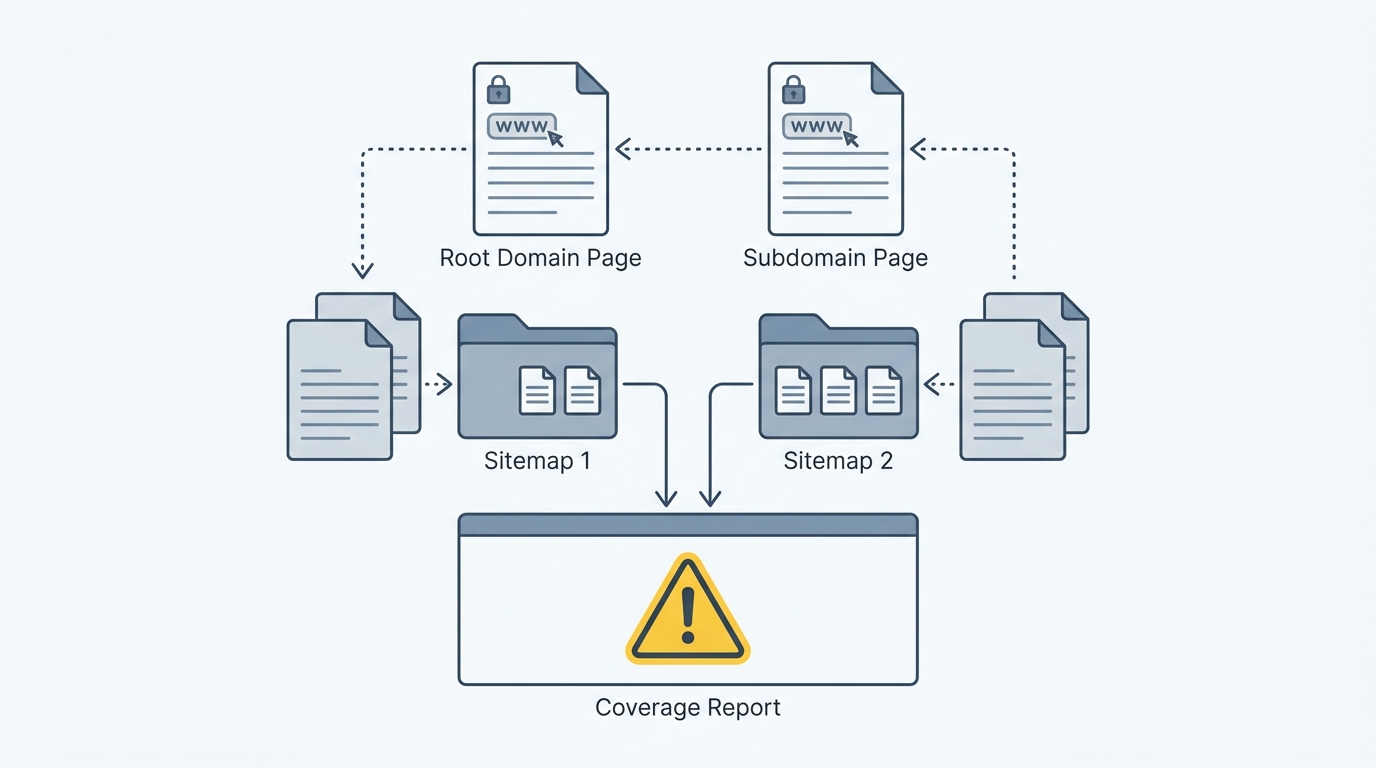
    Visualization of canonical misconfiguration and sitemap fragmentation creating duplicate indexing.
    Visualization of canonical misconfiguration and sitemap fragmentation creating duplicate indexing.

    This sounds administrative. It is not. A sitemap is an instruction about what you consider part of the site’s indexable inventory. When sitemap structures point in different directions, they create another layer of ambiguity. The root domain needed to become the obvious, consistent center of gravity.

    Third, we implemented redirects at the edge. Old subdomain URLs automatically redirect to their corresponding root-domain URLs before Googlebot touches the origin server for redirected content.

    This was critical. A canonical tells a search engine which version you prefer. A redirect removes the choice for a user agent arriving at the old destination. When the business has already decided that the root domain is the only public home for the content, the system should enforce that decision as early and as cleanly as possible.

    Fourth, we designated one source of truth for metadata. Multiple CMS instances should not be allowed to independently decide titles, descriptions, canonical URLs, hreflang output, or indexation directives. That is not redundancy. It is governance failure.

    Finally, we audited what the crawler could actually see. Not what a CMS interface claimed to generate. Not what a deployment configuration was supposed to do. We checked the raw HTML output for canonicals, hreflang, metadata, and indexation signals.

    This is a discipline more teams need. Dashboards are not the website. The rendered response is the website.

    Search Console showed the consequence, but the architecture caused it

    It is tempting to treat Search Console as the place where SEO issues are discovered and fixed. That is only half right.

    Search Console can expose the symptoms: unexpected URLs, indexing patterns, canonical selections, sitemap problems, and visibility changes. It gives the operator an essential view of how Google is interacting with the site.

    But Search Console cannot compensate for a business that has not made an architectural decision. It cannot decide which host should own the authority. It cannot impose a metadata governance model. It cannot make competing systems stop generating conflicting signals.

    The painful part of this incident was not that the warning signs were impossible to find. It was that our system had not been designed around the principle that every public page needs one durable, authoritative home.

    Rendering/latency mismatch causing delayed or inconsistent indexing between hosts.
    Rendering/latency mismatch causing delayed or inconsistent indexing between hosts.

    That is the operational standard now. Every site change, CMS change, template change, and publishing change needs to preserve that singular answer.

    This matters even more as discovery fragments

    Google Search is still central, but it is no longer the only surface through which a company is discovered. People encounter brands through YouTube, ChatGPT, Gemini, AI Overviews, direct recommendations, and branded search journeys that begin somewhere else entirely.

    That does not make technical SEO less important. It makes it more foundational.

    Generative search systems and AI Overviews increase the value of clean source material. If a business wants its owned pages to be the durable reference point for its expertise, positioning, and reputation, it cannot afford an incoherent web presence. Old or duplicate surfaces can persist. Competing URLs can confuse not only classic search indexing but the wider discovery environment built on crawlable, retrievable web content.

    For leaders, the implication is straightforward: do not measure content only by what gets published. Measure whether every published asset strengthens a single owned authority system.

    The strongest companies do not build visibility by creating more disconnected pages across more systems. They build a clear center of gravity, then make every channel, page, and technical decision feed it.

    What we would do differently now

    We would treat indexation governance as a launch requirement, not a cleanup task.

    • Define the one public host that owns the brand’s search authority before a headless implementation goes live.
    • Make absolute root-domain canonicals automatic for every relevant page type.
    • Maintain one root-domain sitemap index and submit that single index through Search Console.
    • Redirect obsolete subdomain URLs at the edge, rather than allowing crawlers to reach an origin that should no longer be public.
    • Give one system ownership of metadata, canonical rules, hreflang, and indexation directives.
    • Audit raw HTML regularly, especially after CMS, template, deployment, or routing changes.

    This is not glamorous work. It will not produce a flashy presentation slide. It does not feel as satisfying as launching a new content series or redesigning a homepage.

    But systems outperform manual effort. A correct publishing architecture protects every future article, page, and asset. An incorrect one taxes every future investment in content.

    TL;DR

    We lost roughly a quarter of our Google visibility because our root domain and a headless CMS subdomain were allowed to split ranking and indexing signals. The failure was architectural, not editorial.

    We recovered by forcing consolidation: absolute canonicals to the root domain, a root-domain sitemap index, edge-level redirects from old subdomain URLs, one source of truth for metadata, and audits of raw HTML rather than CMS dashboards.

    The lasting lesson is bigger than one technical incident. Visibility compounds only when the business gives search systems one clear version of reality. Build one authoritative home for your content, enforce it through systems, and do not let a convenient technical setup fracture the asset you are trying to compound.

  • You Built the App. Distribution Was the Second Product You Forgot

    You Built the App. Distribution Was the Second Product You Forgot

    Across the companies we study, the same expensive mistake keeps repeating: a founder spends months building an app, polishing the interface, tightening onboarding, and preparing for launch-then discovers that launch is not a distribution strategy.

    That discovery usually arrives after the product is live. The App Store listing is published. A launch post goes up on LinkedIn. A few friendly users sign up. Then the graph flattens. The founder has built software, but not a reliable way for the right people to find it, trust it, adopt it, return to it, and tell someone else about it.

    Our stake in this argument is practical. We work in the part of company-building where attention, discovery, authority, and demand determine whether a useful product becomes a business. We have watched technically capable teams treat distribution as a task for the week before launch, then act surprised when their product enters a market where nobody was waiting for it.

    That approach is no longer merely incomplete. In an AI-driven software market, it is a category error.

    Distribution is the second product, and it has to be built before launch

    The old founder sequence was simple: build the thing first, then work out how to get it into people’s hands. It made some sense when software took serious capital, long development cycles, and deep technical scarcity to create. In the capital-and-technology era, deployments could take 12 to 24 months. Companies needed multi-year capital to build, sell, and deploy software. Product scarcity created room to figure out demand later.

    That room has disappeared. AI has pushed the cost of building software close to zero-and, more importantly, pushed the cost of copying software down with it. A useful feature can be replicated. A clean interface can be imitated. A workflow can be recreated. Even a product category can be crowded before its first serious company has learned how customers actually buy.

    The durable advantage now lives somewhere less glamorous: in how efficiently a company earns attention, turns that attention into adoption, keeps customers engaged, and becomes the default name people remember when the category comes up.

    That is distribution. It is not “marketing after product.” It is a product in its own right: one with users, onboarding, retention, feedback loops, channels, constraints, and compounding value.

    Key takeaways

    • Launch-day marketing is a category error. A launch is an event. Distribution is an asset built over time.
    • AI made product execution cheaper, not customer attention cheaper. The easier software becomes to build and copy, the more valuable audience ownership becomes.
    • Adoption is part of distribution. Decisions about onboarding, UX, integrations, and user behavior determine whether attention turns into active use.
    • Pre-launch runway matters more than launch-day noise. A company should enter the market with discovery already compounding, not with an empty audience and a deadline.

    Launch day is not the beginning of distribution

    Founders often talk about launch as though it is the moment a product becomes real. It is usually the moment the company finds out whether it did the work that made a product discoverable.

    A LinkedIn announcement, an iOS release, and an App Store submission can create a brief spike in awareness. None of them creates a durable route to demand on its own. They do not establish why a buyer should care. They do not create familiarity. They do not explain the problem in language customers already use. They do not build trust before the moment of purchase. They do not solve the adoption gap after someone signs up.

    The mistake is treating launch as a distribution mechanism rather than what it actually is: a deadline inside a distribution system.

    Before launch, a founder should already know where attention comes from, what message earns it, which users are most likely to adopt, what stops them from adopting, and what makes the product easy to share or integrate into existing behavior. Those are not promotional questions. They are product questions because they determine whether the product has a path into the market.

    When those answers are deferred, the build phase quietly hard-codes the wrong assumptions. Onboarding may assume users understand a problem they do not yet recognize. UX may ask for effort before delivering clarity. The product may require a behavior change that the distribution plan never accounted for. The app may be technically impressive but impossible to explain in one useful sentence.

    Distribution shown as a parallel product surface to the app itself.
    Distribution shown as a parallel product surface to the app itself.

    Then the founder calls the problem “marketing.” It is often not marketing. It is a product that was built without a route to adoption.

    The real moat is becoming the default brand before competitors arrive

    The Distribution Era thesis is blunt: the moat is shifting from the product itself to the audience and the distribution system around it. The winning company is increasingly the one that becomes the default brand in a category before interchangeable competitors can occupy the same space.

    This is why authority is not a vanity project. It is an operating asset. When a company is repeatedly associated with a problem, a category, or a useful point of view, it lowers the cost of being chosen. Buyers arrive with context. They understand the company’s framing. They have seen evidence of competence. They are less likely to begin the relationship from total indifference.

    That advantage compounds. A useful explanation can create discovery. Discovery can create an audience. An audience can create feedback. Feedback can improve positioning, onboarding, and product decisions. Better product decisions can create adoption. Adoption can create stronger proof, clearer messaging, and more discovery.

    That is a system. And systems outperform manual effort because they do not require a founder to restart from zero every time the company needs customers.

    The opposite is also true. A founder who depends on a launch post, a single App Store listing, or one burst of paid attention is operating a fragile growth model. Single-channel growth is fragile because the company does not own the underlying demand. It rents access to it.

    The fresh-domain result is the pre-launch runway founders should respect

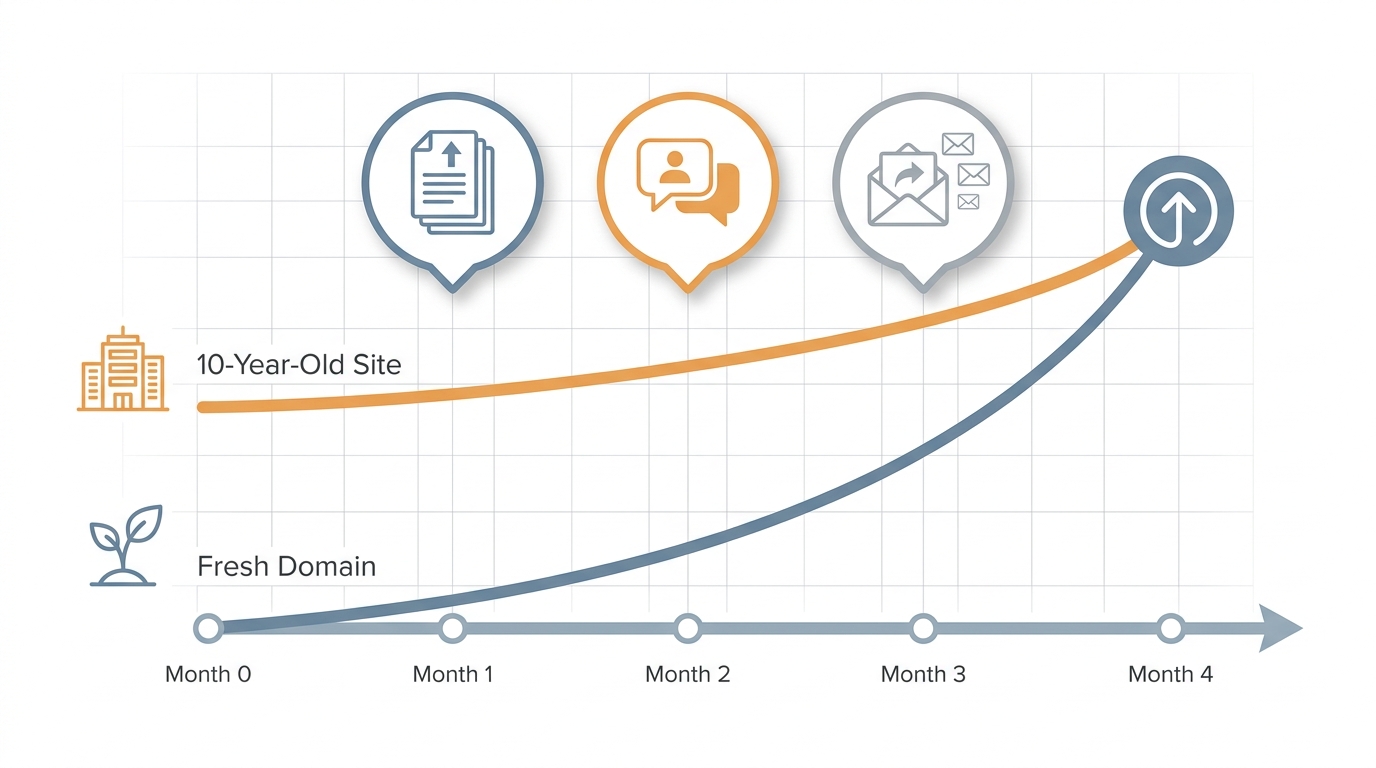
    One fresh-domain study makes the case more clearly than most launch stories do: a new site reached parity with a 10-year-old site in four months.

    The important lesson is not that every new company will repeat that result. The lesson is that visibility can move faster than founders assume when it is treated as a deliberate pre-launch asset rather than a post-launch emergency.

    Four months is not a footnote. It is a planning horizon. It is enough time to build a body of useful category-level thinking, test how the market describes its problem, identify the language that creates recognition, and develop a base of discovery before the product asks the market for anything.

    Visual proof metaphor for pre-launch compounding distribution.
    Visual proof metaphor for pre-launch compounding distribution.

    Most founders spend that same window building features in private. They emerge with a product and no visibility, then give themselves a few days to create demand. That is not lean. It is backwards.

    Pre-launch runway should be treated with the same seriousness as product runway. If a company expects to ship in four months, it should ask what will compound during those four months besides code. What category association will exist? What audience will exist? What language will have been validated? What adoption objections will have surfaced early enough to influence the product?

    If the answer is “we will post when we launch,” the company does not have a go-to-market plan. It has a hope disguised as a calendar date.

    Product-led growth worked because distribution was built into the product

    The strongest product-led growth stories are often misunderstood. Slack reached a $1 billion valuation before hiring a sales representative. Figma followed a similar playbook. The lazy interpretation is that product quality eliminated the need for distribution.

    The opposite is closer to the truth. Product-led growth is distribution designed into the product experience. The product is not merely useful after purchase; it creates a path for people to encounter, adopt, and spread it. Its growth model is inseparable from the way users receive value.

    That distinction matters because too many founders build a conventional product, call it PLG, and assume a free tier or an App Store listing will do the rest. It will not. Product-led growth is not the absence of go-to-market. It is go-to-market embedded in the product’s route to adoption.

    The same standard applies to AI products. Model quality alone is not the business. People already use AI on their own, often outside formal company systems. This shadow AI economy proves that demand for capability exists. The hard problem is integration and adoption: turning scattered personal behavior into a trusted, repeatable, useful workflow.

    That is why the winners will not simply be the companies with access to capable models. They will be the companies that make the new behavior understandable, adoptable, and easy to repeat inside the environments where work already happens.

    Adoption friction is a distribution failure, not just a UX problem

    There is a habit in software teams of separating product, design, growth, and go-to-market into neat functions. Customers do not experience the company that way. They experience one continuous journey: discovery, understanding, trust, signup, onboarding, first use, repeat use, and recommendation.

    Every break in that journey weakens distribution.

    A product that is difficult to explain will struggle to be discovered. A product that promises one thing and asks users to do another will struggle to be adopted. A product that creates value only after substantial effort will struggle to retain attention. A product that cannot fit into existing workflows will struggle to become habitual, even if its underlying technology is excellent.

    Zapier offers a useful example of clarity as an adoption strategy. CEO Wade Foster’s 2023 “AI Code Red” company-wide challenge did not treat AI as a feature announcement. It treated AI as a company-wide behavior and an operating priority. That is the difference between shipping access to a capability and creating the conditions for people to use it.

    Framework visualization for distribution-first planning.
    Framework visualization for distribution-first planning.

    Founders should take that lesson seriously. A distribution strategy is not complete when it gets somebody to a landing page. It is complete only when the right user gets to durable value with enough clarity to continue.

    Building before validating distribution is how companies build for nobody

    The statistic is uncomfortable because it exposes how preventable the problem can be: 42% of startups fail because they build something nobody wants. That failure is often framed as a product-market-fit issue, but it is also a distribution-first failure.

    A company that has not built proximity to its market has less chance of understanding what people want, how they describe the problem, what they already use, what triggers a search for a solution, and what makes switching feel worthwhile. It is trying to make strategic product decisions from inside the building.

    Distribution-first validation changes that. It forces the company to earn attention before it assumes demand. It creates contact with the words, objections, and behaviors that should shape product choices. It reveals whether an idea is merely possible to build or genuinely compelling to adopt.

    This does not mean founders should wait for an enormous audience before building. It means they should stop treating audience development as unrelated to product development. The two should inform each other from the beginning.

    What app founders should build alongside the app

    Founders who have already built the product do not need a lecture about missed timing. They need a more useful operating model: distribution becomes the second product from this point forward.

    • Build category clarity. Define the problem and the company’s point of view in language the market can recognize and repeat.
    • Build owned attention. Create an audience the company can reach without depending entirely on the App Store, LinkedIn distribution, or a single rented channel.
    • Build discovery systems. Make useful ideas, useful language, and useful proof consistently findable over time.
    • Build adoption into product decisions. Design onboarding and user behavior around the reality of how people discover, evaluate, and integrate a new tool.
    • Build feedback loops. Let market response improve the product, and let product learning improve the company’s distribution.

    None of this is a substitute for a good product. It is the condition that allows a good product to become visible enough to matter.

    The central shift is simple: stop asking how to market the app after it is done. Start asking what distribution asset the company is compounding while the app is being built.

    TL;DR

    AI has made it cheaper to build software and easier for competitors to copy it. That makes product alone a weaker moat. The defensible advantage is increasingly the company’s ability to earn attention, own an audience, create adoption, and become the default brand in its category.

    Launch-day marketing is not a strategy. It is a late-stage event inside a much larger system. The app is one product. Distribution is the second product-and founders who build both before launch give themselves a chance to compound visibility instead of chasing it.

  • Bing Went From 101 to ~3,500 Monthly Clicks on Our Site. Stop Ignoring the Second Channel.

    Bing Went From 101 to ~3,500 Monthly Clicks on Our Site. Stop Ignoring the Second Channel.

    Our stake in this is practical, not theoretical. FinalBoss is one of our portfolio properties, which means the result lands directly on our own distribution system: Bing organic traffic grew from 101 monthly clicks to roughly 3,500. That is a 35x increase on a channel most B2B teams still treat as an afterthought.

    The lazy response is to call that a nice extra. It is not. It is a warning about how fragile single-channel growth has become.

    Too many companies have built their entire discovery strategy around one assumption: if Google is handled, search is handled. That assumption was already narrow. AI Overviews, zero-click search, AI Mode, declining organic click-through, and a more expensive attention market have turned it into a business risk.

    Google still matters enormously. But Google cannot be the whole plan, especially for a B2B company trying to reach buyers, build authority, and create durable demand. A company that relies on a single discovery engine does not have a growth system. It has a dependency.

    Bing is not a side project. It is the cheapest diversification B2B teams keep skipping.

    The FinalBoss result changed how we think about Bing. Not because Bing suddenly replaces Google. It does not. The point is more important than that: a neglected discovery surface can produce material growth when competitors are all fighting for the same Google rankings, the same paid inventory, and the same shrinking pool of clicks.

    That is the opportunity. Most SEO programs are built around Google’s rules, Google’s reporting, and Google’s definitions of success. As a result, Bing sits in a low-competition corridor. Many companies publish useful B2B content, optimize it for Google, and leave obvious Bing gains on the table simply because no one has made Bing a real operating priority.

    On FinalBoss, that neglect created room. We went from 101 to roughly 3,500 monthly Bing clicks. The 35x increase is not an argument for chasing a vanity metric. It is an argument for recognizing that distribution opportunities are often hiding inside channels everyone has collectively decided are too small to deserve attention.

    That is how operators get trapped. They look only at the channel with the biggest headline volume, then compete where competition is most intense. They ignore the smaller channel where their content can earn visibility faster, develop non-branded discovery, and reach a different slice of the buying market.

    Key takeaways

    • Bing grew from 101 to roughly 3,500 monthly clicks on FinalBoss, a 35x increase that turned a neglected search engine into a meaningful discovery channel.
    • B2B companies should build a three-channel discovery mix rather than treating Google as the entire acquisition strategy.
    • Bing’s different ranking priorities create a lower-competition route for content that is already being produced for Google.
    • In an AI Overview and zero-click environment, clicks alone are no longer enough. Visibility, retrieval, branded demand, engagement, and conversions matter more.

    The Google-only strategy is breaking for reasons that have nothing to do with your content quality

    There is a habit inside marketing teams that needs to die: interpreting flat traffic as proof that content is weak.

    Traffic can be flat because the work is weak. It can also be flat because the search environment now answers more queries before a click happens. Those are radically different diagnoses, and treating them as the same leads companies to make bad decisions.

    In the first four months of 2026, 68% of U.S. Google searches ended without a click, up from 60% in 2024. That is not a minor product adjustment. It is a structural change in the economics of discovery.

    When an AI Overview appears, people click a result about 8% of the time, compared with 15% when no overview is displayed. Only 1% click a link inside the Overview itself. The top traditional result also takes a hit: an early estimate that AI Overviews reduced its click-through rate by 34.5% was later revised to a 58% forecast.

    None of that means search is dead. It means the old measurement model is dead. Search visibility still affects who gets discovered, remembered, trusted, and approached later. But a business that evaluates its content only through direct Google clicks is using a dashboard built for a market that is disappearing underneath it.

    Illustrate the 35x Bing growth visually (generic, non-branded dashboard).
    Illustrate the 35x Bing growth visually (generic, non-branded dashboard).

    Google also does not clearly separate AI-surface clicks from traditional-result clicks in a way that gives operators a clean view of what is happening. That makes a Google-only reporting model even weaker. If you cannot fully see how one increasingly important search surface is distributing attention, it is reckless to concentrate all discovery effort there.

    This is why Bing matters now. Not because it is fashionable. Not because every company should pivot away from Google. Bing matters because resilience is valuable, and a second organic discovery channel is one of the least expensive ways to build it.

    Why Bing can move faster than Google

    Bing is not Google with a smaller logo. It evaluates websites differently enough that companies can see a meaningful gap between their Google performance and their Bing performance.

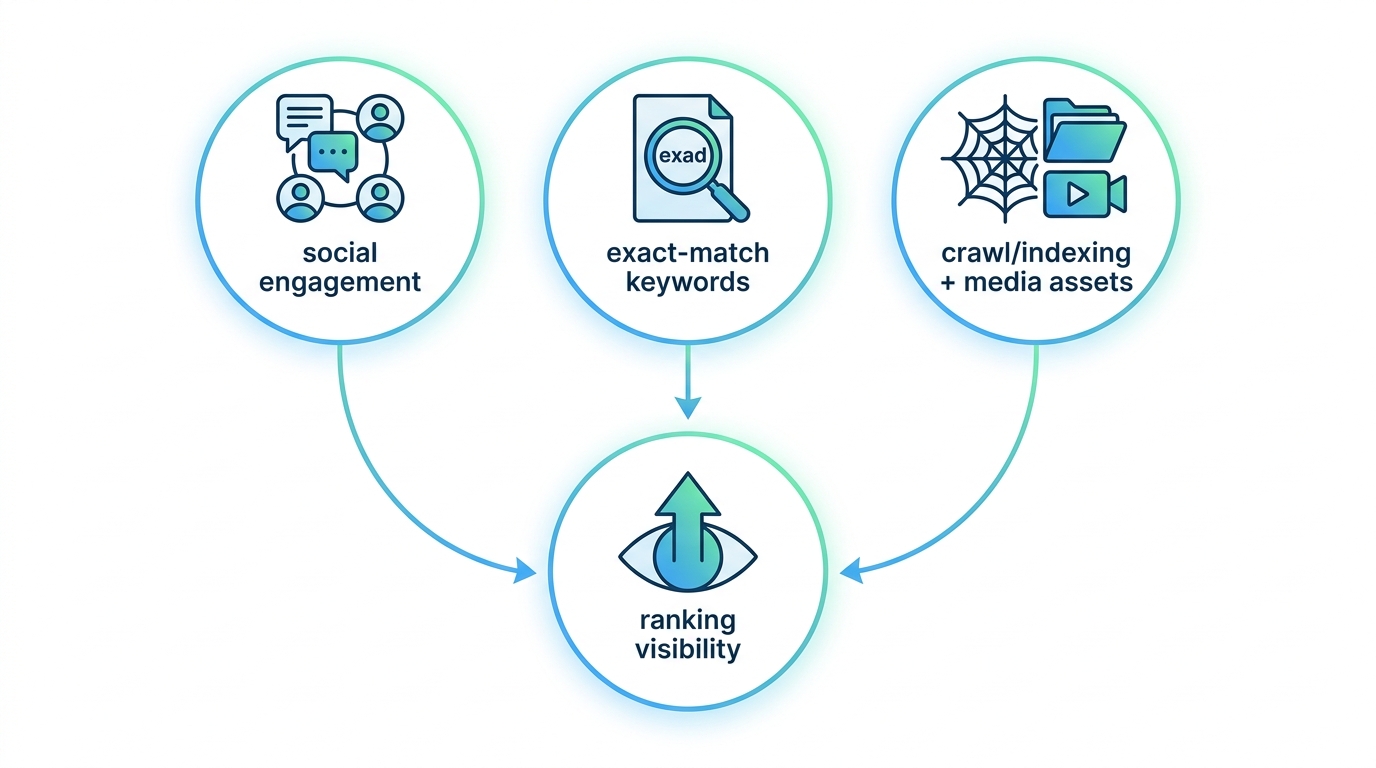
    Its approach puts more weight on signals many Google-first SEO programs underuse: social activity as an indicator of trust and reputation, exact-match keyword relevance, and domain age. The result is not a loophole. It is a different set of incentives.

    For B2B companies, that matters because a serious publishing operation should already be doing much of the underlying work: developing specific topical language, building a credible body of content, earning distribution through social channels, and making expertise easy to identify.

    The mistake is assuming that publishing is the work. Publishing is the input. Distribution is the work.

    A company writes one useful article, posts it once, waits for Google, and calls that content marketing. That is not a system. That is a hope-based workflow. The companies that win build content so it can be discovered repeatedly across search engines, social platforms, video, newsletters, direct visits, and increasingly answer engines.

    Bing rewards the company that treats content as a distributed asset rather than a blog post with a publication date. That is one reason the channel is especially useful for B2B: buyers are not always conducting a broad consumer-style search on a phone. Desktop search remains a meaningful environment for professional research, vendor discovery, and problem evaluation.

    The Google-only team sees one search engine. The operator sees a portfolio of discovery surfaces, each with different competition, buyer behavior, measurement limits, and compounding potential.

    Show the algorithmic feedback loop conceptually.
    Show the algorithmic feedback loop conceptually.

    The real answer is a three-channel discovery mix

    We would not advise replacing Google dependence with Bing dependence. That would simply recreate the same mistake on a smaller platform.

    The better model is a three-channel discovery mix: Google, Bing, and an audience-building channel where your company can earn repeated attention rather than rent every visit from a search result.

    For many B2B businesses, that third channel will be LinkedIn. For others, it may be YouTube, a newsletter, Reddit, or a founder-led distribution engine. The exact channel varies. The principle does not: discovery should come from more than one place, and at least one of those places should move the company closer to audience ownership.

    • Google remains the largest search opportunity and a major authority surface, even as AI Overviews reshape click behavior.
    • Bing offers a lower-competition organic route, particularly when your competitors have treated it as irrelevant.
    • An owned or repeatable distribution channel turns visibility into a relationship instead of a one-time visit.

    This is not channel diversification for its own sake. It is a way to reduce exposure to one platform’s product decisions. A company that has Google rankings, Bing visibility, LinkedIn reach, and a direct audience is harder to disrupt than a company that gets 90% of its non-paid discovery from a single search engine.

    That matters even more as paid media gets harder. AI has made it cheaper to generate creative assets. It has not created more buyer attention. B2B teams can now produce more ads, more landing-page variants, and more campaign concepts than ever. The constraint is not production volume. The constraint is access to qualified attention.

    When attention is limited, creative volume is not a moat. Better targeting, persona-specific channel choices, and serious measurement become the advantage. Incrementality and holdout thinking matter more than endlessly rearranging attribution models. And organic discovery matters because it creates another path into the market that does not depend on winning every auction.

    Bing visibility is also part of the answer-engine problem

    AI answers have made one thing clear: being useful is no longer enough. Your company also needs to be retrievable.

    That means building pages that state a clear point of view, answer specific questions, use language buyers actually use, and demonstrate enough authority that platforms have reason to surface them. The game is no longer just “rank number one and get the click.” It is “be present where the market forms an answer.”

    Bing gives companies another observable route to that presence. It expands the set of places where your expertise can be indexed, discovered, and measured. That is useful in a market where answer engines reshape how people reach conclusions before they ever visit a website.

    What should not happen is the usual AI-era mythology. No one should promise that an SEO signal becomes a permanent fingerprint inside every AI system, or claim that optimizing for Bing guarantees inclusion in any given AI-generated answer. That is not a credible operating model.

    The practical model is simpler: create authoritative material, distribute it where buyers and retrieval systems can encounter it, measure visibility where measurement exists, and connect that visibility to downstream demand. Bing is valuable because it broadens that system. It is not valuable because it is a magic shortcut.

    Depict Bing’s desktop-heavy B2B audience.
    Depict Bing’s desktop-heavy B2B audience.

    What we would do differently if we were starting a B2B discovery system today

    We would stop organizing search around a single dashboard and start organizing it around market presence.

    • Track Google and Bing separately. Do not collapse them into one organic-search line item and lose the channel-level learning.
    • Build pages around specific buyer problems and exact language, not broad “thought leadership” themes that say nothing distinctive.
    • Distribute every serious piece through a repeatable social or owned channel, rather than assuming publication itself is distribution.
    • Measure branded and directed demand alongside traffic, especially when AI Overviews reduce direct clicks.
    • Track on-page engagement and conversions so the business can distinguish reduced click volume from reduced content value.
    • Review where the company appears in AI surfaces and retrieval contexts, without pretending that every answer engine provides perfect measurement.
    • Treat Bing growth as a strategic signal: it can reveal non-branded demand and content-market fit before Google authority fully catches up.

    This is the operator’s version of SEO. It is less obsessed with a single ranking report and more focused on whether the company is becoming easier to find, easier to trust, and harder to ignore.

    Authority is not a decorative layer on top of demand generation. Authority is an asset that lowers the friction of discovery across every channel. When a buyer encounters your company in Google, Bing, LinkedIn, YouTube, or an AI-generated answer, prior visibility changes the outcome. Familiarity changes the click decision. Credibility changes the conversion decision.

    The companies that ignore Bing are not being strategic. They are being habitual.

    There is no prize for concentrating every discovery bet on the channel everyone else already optimizes for. There is only more competition, more exposure to platform changes, and less clarity when the click pool shrinks.

    FinalBoss going from 101 to roughly 3,500 monthly Bing clicks is not a promise that every B2B company will reproduce a 35x outcome. It is evidence that the second channel can become far more meaningful than conventional wisdom allows.

    The bigger lesson is that modern visibility compounds when it is designed as a system. Google can create reach. Bing can create additional non-branded discovery. LinkedIn, YouTube, newsletters, and other repeatable channels can turn one-time attention into familiarity. Together, they create a company that is discoverable from multiple directions.

    That is the standard B2B leaders should hold their growth model to. Not whether the company has published enough content. Not whether a single channel has a good month. Whether the business can still be found if one platform changes the rules.

    TL;DR

    Bing grew from 101 to roughly 3,500 monthly clicks on FinalBoss, our portfolio property. The 35x increase matters because it exposes a costly B2B habit: treating Google as the only search channel worth operating.

    Google remains essential, but AI Overviews and zero-click behavior have made clicks a weaker proxy for content value and made single-channel dependence more dangerous. The answer is not to abandon Google or chase Bing as a gimmick. It is to build a three-channel discovery mix: Google, Bing, and a repeatable channel that builds direct audience access.

    Distribution beats publication. Visibility compounds. And a company that can be discovered from several directions has more leverage than one waiting for Google to send the next click.

  • Consistency Isn’t a Discipline Problem. It’s an Infrastructure Problem.

    Consistency Isn’t a Discipline Problem. It’s an Infrastructure Problem.

    Across the companies we study and work alongside, the same conversation repeats itself whenever publishing slows down: the founder concludes that the team needs more discipline. More accountability. More urgency. More people “taking content seriously.”

    That diagnosis is usually wrong.

    We know because we have had to prove the alternative on the sites we run ourselves. Our systems have kept a weekly publishing cadence across that portfolio for 18 months without missing a week. That was not a prolonged burst of inspiration. It was not a heroic editorial team waking up every Monday with limitless motivation. And it was certainly not the result of treating a publishing calendar like a moral test.

    It was infrastructure.

    That distinction matters because founders keep trying to solve an operational problem with encouragement. They add a Monday meeting. They set a higher monthly target. They ask someone to “own content.” They hire a talented writer and assume a pipeline now exists. Then a launch intervenes, a key person gets overloaded, approvals stall, priorities shift, and the calendar goes dark again.

    The team did not suddenly lose its discipline. The business exposed the fact that its publishing depended on individual effort rather than a system designed to survive normal business conditions.

    Publishing cadence is a system property, not a personality trait

    The most damaging belief in content operations is that consistency belongs to the category of personal habits. It does not.

    Individuals can be disciplined. A company’s publishing operation must be dependable. Those are different things.

    A disciplined founder can write one strong article after a difficult week. A dependable publishing operation can continue moving when the founder is in meetings, the subject-matter expert is unavailable, the product roadmap changes, and a campaign demands attention. The first is a personal achievement. The second is an organizational capability.

    Founders who publish irregularly often have no shortage of ideas. They have the opposite problem: too many ideas trapped in an unreliable path from insight to published asset. Topics live in chats, voice notes, half-finished documents, sales calls, and the heads of people who are already busy running the business. Nobody knows which ideas deserve development, who needs to contribute, what “done” means, where approval sits, or how the finished work should be distributed and measured.

    That is not a creative drought. It is a missing production environment.

    Operators understand this instinctively in other parts of the business. Nobody would run fulfilment through a founder’s memory. Nobody would manage payroll through occasional bursts of discipline. Nobody would accept a customer-support system built around hoping the right person remembers to reply.

    Yet companies routinely treat publishing, one of their most visible routes to discovery and authority, as the one function that can be held together with reminders and goodwill. Then they wonder why visibility arrives in bursts and disappears just as momentum begins to build.

    Key takeaways

    • Inconsistent publishing usually reveals missing workflows, accountability, quality gates, and measurement rather than insufficient ambition.
    • Humans should provide judgment, expertise, and supervision. Systems should carry the recurring operational burden of maintaining cadence.
    • Publishing more without governance creates a larger quality-control problem, not a stronger distribution engine.
    • Consistency becomes commercially useful only when every published asset can be discovered, distributed, evaluated, and improved over time.

    Most content calendars fail before the first article is drafted

    The visible failure is a missed publishing date. The actual failure usually happened much earlier.

    It happened when a company created a calendar without defining the path that feeds it. It happened when content ideas were treated as a backlog rather than decisions. It happened when no one established who can approve an article, what evidence supports a claim, how a subject-matter expert contributes without becoming the bottleneck, or what quality standard prevents rushed work from reaching the site.

    A calendar is not infrastructure. A calendar is an output of infrastructure.

    Founders often buy the visual artifact first because it feels like progress. A board appears. Dates appear. Titles appear. The business briefly feels organized. But a board cannot resolve competing priorities, turn expert knowledge into useful material, prevent revision loops, or decide what happens when a piece is delayed. Without those decisions, the calendar is merely a public record of unresolved work.

    That is why the familiar cycle is so predictable. The company announces a new cadence, publishes energetically for a few weeks, hits the first period of operational pressure, and abandons the schedule. Leadership then blames execution. The team blames capacity. Both miss the structural issue.

    Cadence breaks when every article is treated as a fresh negotiation.

    It is a negotiation over the topic. A negotiation over the point of view. A negotiation over who supplies the details. A negotiation over tone. A negotiation over whether the article is “good enough.” A negotiation over whether it can go live without one more edit. This is not an editorial process. It is a recurring interruption machine.

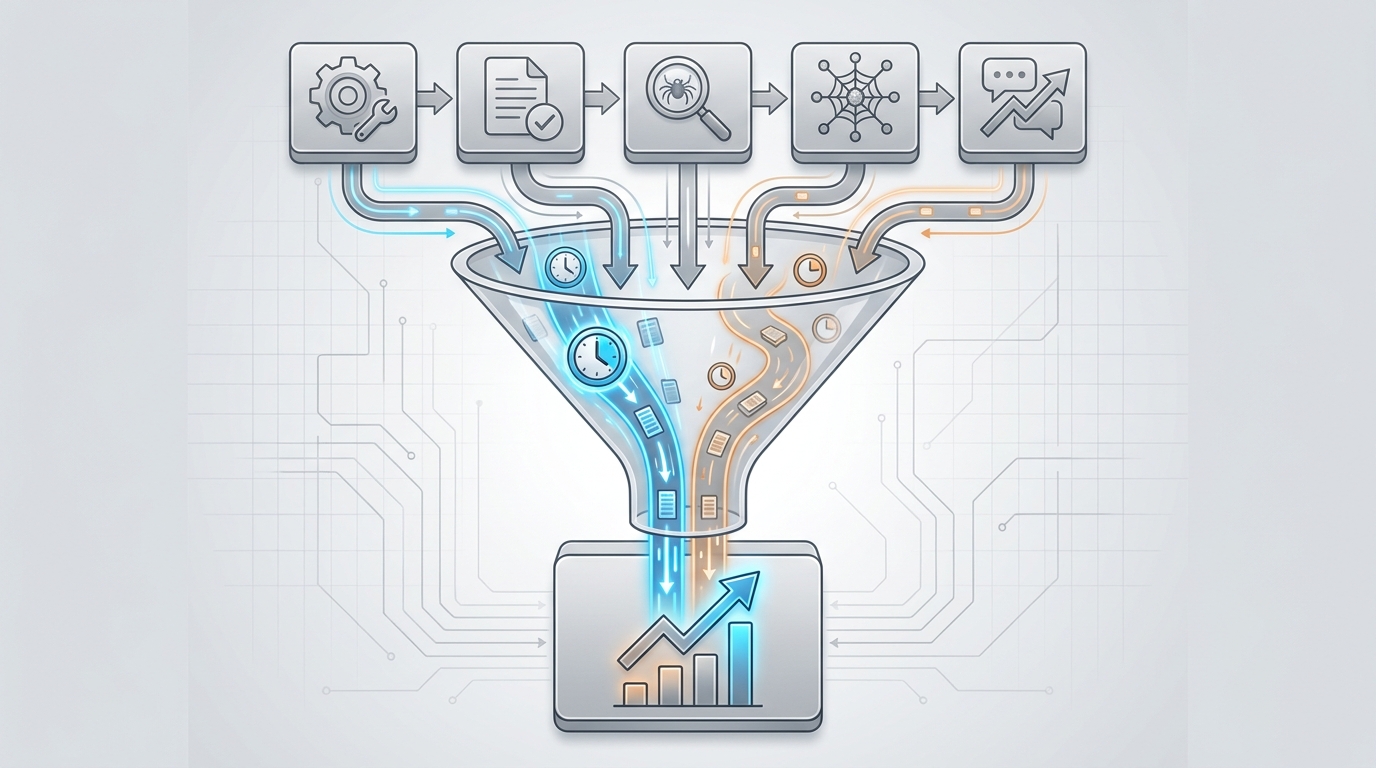
    Publishing workflow infrastructure diagram showing governance, automation, and auditing.
    Publishing workflow infrastructure diagram showing governance, automation, and auditing.

    The companies that sustain output remove avoidable negotiations before work begins. They document how ideas enter the system, who makes the editorial call, what each stage requires, where quality is checked, and how completed work moves into distribution. They do not eliminate human judgment. They stop wasting human judgment on decisions that should already be settled.

    More output without governance is not scale

    There is a second mistake founders make after recognizing that irregular output is a problem. They respond by chasing volume.

    Volume is not the point. A company can publish constantly and still build very little authority. It can create pages that repeat themselves, make weak claims, drift from the brand’s actual expertise, or fail to answer the questions its buyers are already asking. At that point, content is not an asset. It is inventory with no reliable demand signal.

    We have watched content operations work at small scale on editorial instinct alone. A small team can keep standards high when a handful of people share context, hold the whole operation in their heads, and review work closely. That model becomes fragile as the volume rises. Once output reaches sustained high frequency, economics, systems, tagging, quality expectations, and performance measurement must remain aligned. If they do not, the operation starts generating work faster than it can govern it.

    That failure is often disguised as growth. The publishing count rises. The dashboard fills. The site expands. But the business has no dependable mechanism for identifying quality drift, understanding which content creates useful discovery, or correcting the system when the output becomes less valuable.

    Publishing at scale requires governance-grade thinking. That means clear standards, defined ownership, visible handoffs, and measurements that can expose deterioration before a weak process becomes a large library of weak assets.

    This is not bureaucracy for its own sake. It is how a company protects authority while increasing throughput.

    Quality gates are not the enemy of speed

    Founders sometimes hear “process” and imagine slower work, endless approvals, and content trapped in review. That is a valid fear when process is badly designed. But the answer to bad process is not no process. It is a process that removes friction where friction adds nothing and keeps scrutiny where scrutiny protects the asset.

    The most useful operating principle is simple: humans should supervise; systems should sustain.

    Humans should decide what the company believes, which audience problem matters, what evidence is strong enough, and whether a piece carries the authority of the business. Humans should bring taste, expertise, and direct feedback from customers and users. As production becomes easier to automate, those judgment calls become more valuable, not less. Differentiation moves toward selecting the right problem, curating the available options, turning taste into explicit constraints, and keeping contact with real human feedback.

    Human oversight on top of automated infrastructure for steady cadence.
    Human oversight on top of automated infrastructure for steady cadence.

    Systems should make sure the brief exists, the relevant inputs are collected, the work has an owner, review happens at the right time, the published asset is correctly structured, and performance data returns to the editorial process. Those responsibilities are repetitive. Repetition is where systems earn their keep.

    The same principle already appears in mature design operations. A design-system contract can define a component in a single plain-data specification, such as JSON or YAML, then generate corresponding Figma and code outputs from that shared contract. A checker can compare the contract, design library, and code to identify mismatches. The value is not the file format. The value is eliminating drift between the intended standard and the distributed versions of that standard.

    Content needs the same mindset. Not identical tooling, but the same refusal to let critical standards exist only in someone’s memory. If a business cares about a claim being evidenced, a page being complete, a category being accurately tagged, or a piece being reviewed before publication, those requirements must be part of the workflow. Otherwise they are aspirations, not controls.

    Measurement belongs in the system before publication, not after disappointment

    Publishing consistency is not merely the ability to keep a schedule. It is the ability to keep learning.

    Too many teams measure content only after it is live, and often only when someone asks why the work has not generated immediate pipeline. This is the same operational error that damages creator marketing programs. Teams frequently configure tracking after a campaign has already begun, which means they never captured the baseline needed to demonstrate lift. Last-click measurement then misses the delayed influence of the work and the organization declares the channel unprovable.

    Content suffers from the same lazy accounting. A founder wants a direct, immediate conversion from a single article while ignoring the more durable work content performs: creating discovery, strengthening understanding, giving sales teams credible material, supporting buyer research, and building a library that remains available after the day it is published.

    That does not mean measurement is optional. It means measurement must fit the work. Track the data that allows the team to assess distribution and quality over time: sessions, revenue or value measures where relevant, tagging, page completeness, and the relationship between editorial decisions and performance. Use that information to identify drift and improve the operating system.

    The new discovery environment makes this discipline more important. Search answers can vary across repeated runs, which makes simplistic ranking claims unreliable. In one set of 30 platform-topic tests, the number of cited answers needed before a ranking became reliable ranged from 33 to 94; three tests did not reach that point even after the available runs. The lesson is not to abandon measurement. It is to stop pretending that one screenshot or one isolated result represents a stable visibility position.

    Likewise, discovery increasingly rewards technical completeness. In product-feed environments, missing or inaccurate attributes create problems as channel requirements change. Creative copy still matters, but it cannot compensate for incomplete information where systems depend on structured attributes to understand and surface an offering.

    Founders should take this seriously. Publishing is no longer only a writing function. It is part of the company’s discovery infrastructure. That means content, data, distribution, and measurement cannot operate as separate afterthoughts.

    Tool choice is less important than operational ownership

    Another recurring distraction is the search for the one tool that will make content consistent. The answer is never a single platform.

    Automated consistency scanning and audits prevent brand drift.
    Automated consistency scanning and audits prevent brand drift.

    Businesses can use Google, YouTube, Figma, Gemini, Perplexity, or any other platform in a serious publishing operation. None of them substitutes for defined ownership, clear quality standards, a measured distribution plan, or a durable archive of decisions. Tools can reduce friction. They cannot create accountability where the business refuses to assign it.

    The build-versus-buy debate often makes this worse. Companies overestimate the value of owning a custom tool and underestimate the fully loaded cost of maintaining it. Licensing costs are easy to see. Maintenance, evolution, knowledge retention, and opportunity cost are harder to see, so they are routinely excluded from the decision. That is not a serious cost calculation.

    Use the tool that supports the system you need. Do not build a complicated system to justify a tool decision. The goal is not technical purity. The goal is reliable execution without losing editorial judgment.

    What founders should change now

    The practical shift is to stop asking whether the team is motivated enough to publish. Start asking whether the company has designed publishing to survive ordinary work.

    A credible publishing infrastructure needs a documented route from idea to distribution. It needs an accountable decision-maker at every critical handoff. It needs defined quality gates so that standards are not renegotiated with every piece. It needs a clear distinction between work that requires senior judgment and work that should move through a repeatable process. And it needs measurement that feeds learning back into the system rather than merely producing a retrospective dashboard.

    Most importantly, it needs a distribution mindset. Publishing is not complete when an article goes live. A page sitting alone on a site is not a growth system. The asset must be structured for discovery, connected to the company’s broader body of work, and used across the channels where customers encounter the business.

    Distribution beats content in the narrow sense that a strong asset without a distribution system is underused. But distribution also depends on content worth distributing. The durable advantage comes from the combination: a dependable engine that creates useful work, preserves standards, makes it discoverable, and keeps compounding the company’s authority.

    That is why consistency matters. Not because weekly publishing is aesthetically pleasing, and not because a calendar looks productive. Consistency matters because visibility compounds when a company can keep showing up with substance. The business becomes easier to find, easier to trust, and less dependent on a single campaign, a single platform, or a founder’s available time.

    TL;DR

    Irregular publishing is usually not a discipline problem. It is evidence that the company has no infrastructure capable of turning expertise into consistent, governed, measurable, and distributed assets.

    We sustained a weekly cadence across our own sites for 18 months because cadence was built into an operating system, not demanded from individual willpower. Founders who want durable visibility should stop treating content as a recurring act of motivation. Build the workflows, ownership, quality gates, and measurement that let the business publish when life gets busy.

    Authority is an asset. Like every valuable asset, it needs infrastructure behind it.

  • A 4-Month-Old Domain Matched a 10-Year-Old Site in Google. The Data, Month by Month.

    A 4-Month-Old Domain Matched a 10-Year-Old Site in Google. The Data, Month by Month.

    An anonymized Google Search Console comparison shows a four-month-old domain generating more clicks than a 10-year-old site. The lesson is not that new domains have a shortcut. It is that execution cadence, search intent, and distribution systems outperform the passive advantage founders assign to tenure.

    A Four-Month-Old Site Did Not Wait for Permission to Compete

    The domain-age excuse is one of the most expensive stories a founder can tell themselves. A site hits an organic traffic ceiling, the pipeline slows, and the explanation arrives almost automatically: competitors have been around longer. They have more history. Google trusts them more. The company then waits, publishes intermittently, and mistakes inactivity for patience. This comparison between two anonymized sites makes that logic difficult to defend. One domain was four months old. The other had existed for 10 years. At the four-month mark, the newer site had matched and slightly exceeded the older one on the metric that matters most to an operating business: clicks from Google.

    [INFO_TABLE]
    Product/Service: Organic discovery system
    Comparison: Two anonymized websites
    New domain age: 4 months
    Established domain age: 10 years
    Source of truth: Google Search Console
    Price: Execution cadence, not domain tenure
    [/INFO_TABLE]

    This is not an argument for treating domain age as irrelevant context. A ten-year-old site can have accumulated brand recognition, links, historic content, direct traffic, and institutional knowledge that a new business has not earned. It is an argument against confusing age with a growth system. A domain that has sat online for a decade without a clear discovery strategy is not automatically more useful than a new property built around demand, relevance, and repeatable publishing decisions.

    Google has been unusually direct on this point. Google Search Advocate John Mueller’s answer to whether older domains receive a ranking advantage was simple: “No, domain age helps nothing.” Google does not treat a registration date as a ranking signal. It also evaluates a site’s age from discovery and crawling rather than the date printed in a WHOIS record. Founders buying old domains for perceived SEO authority are often buying a narrative instead of an advantage.

    The Google Search Console Snapshot

    Google Search Console metric 4-month-old domain 10-year-old domain
    Clicks 3.56K 3.35K
    Impressions 87.6K 113K
    Click-through rate 4.1% 3.0%
    Average position 8.4 9.3
    Both sites are anonymized. The first figure in each row belongs to the four-month-old domain.

    The newer site had fewer impressions: 87.6K versus 113K. That matters, because impressions represent the available search surface. The older site was shown more often. But it converted less of that visibility into visits. The four-month-old domain generated 3.56K clicks against 3.35K, with a 4.1% CTR versus 3.0%. It also held a stronger average position, 8.4 compared with 9.3. This is what a better discovery system looks like before it becomes an obvious traffic gap: less total exposure, more effective exposure.

    Founders regularly overvalue impressions because they are large, comforting numbers. Impressions tell you that Google is testing, surfacing, or recognizing pages across queries. They do not tell you that the searcher found the result compelling enough to visit. A business does not pay salaries with impressions. It earns the right to build a durable acquisition channel when visibility converts into qualified attention. The newer domain did that more efficiently.

    Average position deserves equally careful treatment. It is not a permanent ranking assigned to the whole site, and it is not a promise that every keyword ranks in the same place. It is a blended Search Console measure across the queries and impressions in the reporting period. Still, the direction is clear. The newer site was not merely receiving accidental exposure. It was earning enough relevance across its query set to hold a better aggregate position and attract more clicks.

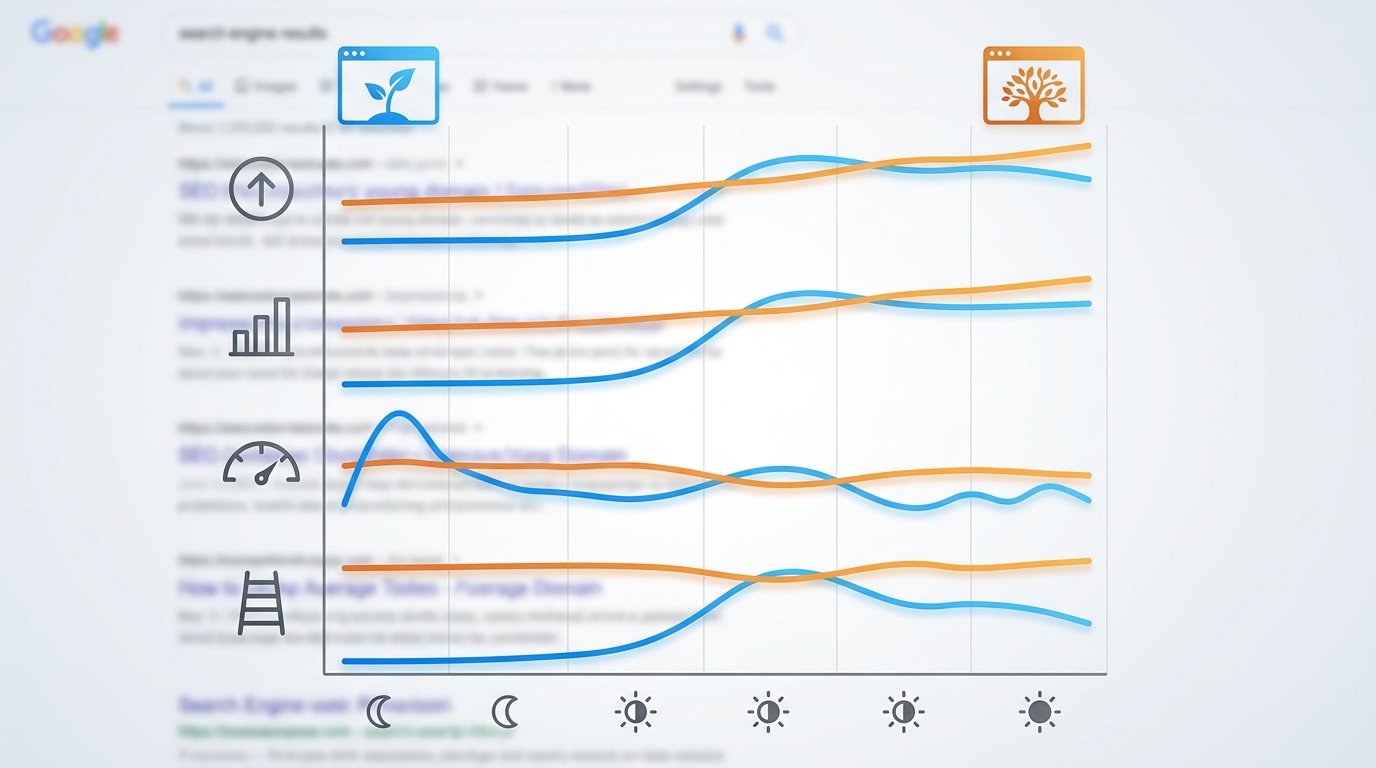
    Month-by-month performance infographics comparing young vs old domains.
    Month-by-month performance infographics comparing young vs old domains.

    The Four-Month Operating Sequence That Matters

    The data establishes the outcome, not a fictionalized diary of every page, keyword, or backlink behind it. Publishing invented month-by-month traffic totals would add false precision and teach the wrong lesson. The useful month-by-month view is operational: what a company must establish in the first four months if it intends to give Google a coherent, useful, and commercially relevant body of work to surface.

    Month Operating priority What the business is building
    Month 1 Discovery foundation A clear topic structure, technically accessible pages, and a measurement baseline in Google Search Console.
    Month 2 Intent coverage Useful pages tied to real customer questions, commercial problems, and category language.
    Month 3 Internal distribution Connections between related pages so authority and attention can move through the site.
    Month 4 Feedback and refinement CTR, impressions, position, and query patterns turned into the next publishing and optimization decisions.
    This is an operating framework for interpreting the first four months, not a claim of unpublished monthly metrics for either anonymized site.

    Month one is where many companies sabotage themselves. They launch a polished homepage, a few broad service pages, and perhaps a news announcement, then wait for Google to infer the company’s relevance. Google cannot build a category map from a brand slogan. The first month should establish a crawlable, coherent knowledge base around the problems the business intends to own. That does not mean publishing for the sake of volume. It means deciding which searches the company should be discoverable for and giving each important subject a durable place on the site.

    Month two is about intent coverage. Most stalled sites have content, but their content is too generic, too detached from buying decisions, or too repetitive to create meaningful differentiation. A founder should be able to look at every important page and identify its job: capture a demand signal, educate a high-value prospect, support a product decision, establish category authority, or move a visitor to the next relevant page. If the answer is “it is good for SEO,” the page does not have a job. It has a hope.

    Month three is where a collection of pages becomes a system. Internal links are often treated as housekeeping. They are more important than that. They tell search engines and visitors how the company’s expertise connects. A strong explanation page should lead naturally to the deeper implementation page. A category page should route attention toward product proof. A product page should not be isolated from the educational material that creates demand for it. This is distribution inside the asset you own, not a pile of disconnected articles competing for attention.

    Execution-cadence model showing why younger domains can catch up.
    Execution-cadence model showing why younger domains can catch up.

    By month four, the company should stop debating abstract SEO theory and start reading its own feedback loop. Google Search Console shows whether pages are being surfaced, whether searchers choose them, and where the gap between visibility and clicks is opening. Ahrefs can help teams map the broader keyword terrain and competing content surface, but Search Console remains the operating record for what Google is actually showing from the business’s own site. The goal is not to celebrate a dashboard. The goal is to choose the next action with less guesswork.

    Why the Older Site Did Not Automatically Win

    The older site’s 113K impressions show that tenure can create a larger search footprint. But a footprint is not a strategy. If that visibility is spread across weakly aligned queries, poorly differentiated pages, or results that fail to earn the click, the business has reach without leverage. The newer domain’s stronger CTR is the important signal here. It suggests a tighter fit between what searchers wanted and what Google chose to show. Relevance is not a decorative quality. It is the mechanism that turns discovery into traffic.

    This is also why content volume alone is a misleading growth metric. Publishing more pages can increase impressions while lowering the strategic quality of the site’s search presence. Teams then celebrate visibility, even as click-through rates flatten and commercial pages remain invisible. The company has built output, not distribution. The better question is whether every new page strengthens a topic, earns a specific query set, and gives the reader a logical path toward the next useful action.

    Do Not Replace the Domain-Age Myth With a New-Domain Myth

    The four-month result does not mean every new domain will outrank every established competitor. It does not mean founders should abandon proven brands, ignore authority, or expect Google to reward a new site simply for moving quickly. It means that age is not the deciding system variable many operators pretend it is. New sites still need a clear proposition, a technically sound foundation, useful content, internal distribution, and disciplined measurement. What they do not need is permission from the calendar.

    That distinction matters because it changes the budget conversation. A business with a traffic ceiling can spend months pursuing cosmetic SEO work, buying an old domain, or commissioning broad content that nobody is accountable for distributing. Or it can build an operating cadence: identify search demand, publish the best available answer for a defined commercial problem, connect it to the wider site, measure the response, and improve the next decision. One approach purchases activity. The other compounds visibility.

    Dashboard-style visual mockup for the comparative metrics.
    Dashboard-style visual mockup for the comparative metrics.

    Search Is One Discovery Layer, Not the Entire Growth System

    Google Search remains a critical discovery channel, including traditional results, AI Overviews, and AI Mode. But founders should not build a company whose entire visibility depends on one surface. ChatGPT, Gemini, Perplexity, YouTube, Google Search, and direct audience channels all shape how buyers encounter and evaluate a brand. A self-promotional page may secure an AI citation, particularly for a new brand that closely fits a prompt, without earning a durable recommendation or reliable traffic. Citation visibility is useful evidence of discoverability. It is not a substitute for an owned audience or a measured acquisition path.

    This is where audience ownership matters. Every search visit should have a next step that reduces future dependence on the algorithm: an email subscription, a product trial, a useful resource, a direct relationship, or a return path to the brand. Organic search can create the first encounter. The company’s own system must create the second and third. Single-channel growth is fragile, even when the channel is working. Search visibility compounds best when it feeds assets the business controls.


    ✓ PROS


    • +
      Proves domain age is not a ranking moat

    • +
      Prioritizes clicks and CTR over vanity impressions

    • +
      Creates a measurable four-month discovery cadence


    ✗ CONS


    • –
      Does not guarantee outcomes for every new domain

    • –
      Requires consistent publishing and measurement discipline

    • –
      Search alone cannot replace an owned audience

    The Operator Verdict


    9/10
    VERDICT

    Build on execution cadence, search intent, and audience ownership-not the belief that an older domain deserves to win.

    The most useful takeaway from this head-to-head is not that a young site beat an old one. It is that the older site was beatable at all. A four-month-old domain produced 3.56K clicks against 3.35K because Google rewarded the quality of the current search experience, not the age printed on a domain record. For founders stuck at a traffic ceiling, that should be clarifying. The constraint is rarely that the domain has not existed long enough. The constraint is that discovery is not yet being run as a business function with a system behind it.

  • How We Would Launch a New Domain in 2026: A Four-Month Plan

    How We Would Launch a New Domain in 2026: A Four-Month Plan

    A new domain is not a website project. It is a discovery, legitimacy, and distribution project that happens to begin with a website.

    The mistake we see most often is treating the domain launch as a single moment: choose a name, publish a polished site, post an announcement, then wait for search traffic or referrals to arrive. That approach creates a clean-looking property with no meaningful reason for the market, search engines, AI systems, or third parties to discover and trust it.

    In 2026, that gap is more expensive. AI Overviews can answer informational searches before a prospective customer clicks. Search visibility increasingly depends on whether a company is understood, cited, mentioned, and connected to credible third-party signals-not merely whether it has published a set of pages. A new domain therefore needs more than content. It needs evidence of demand, a clear point of view, technically sound foundations, and a distribution system that compounds after launch week.

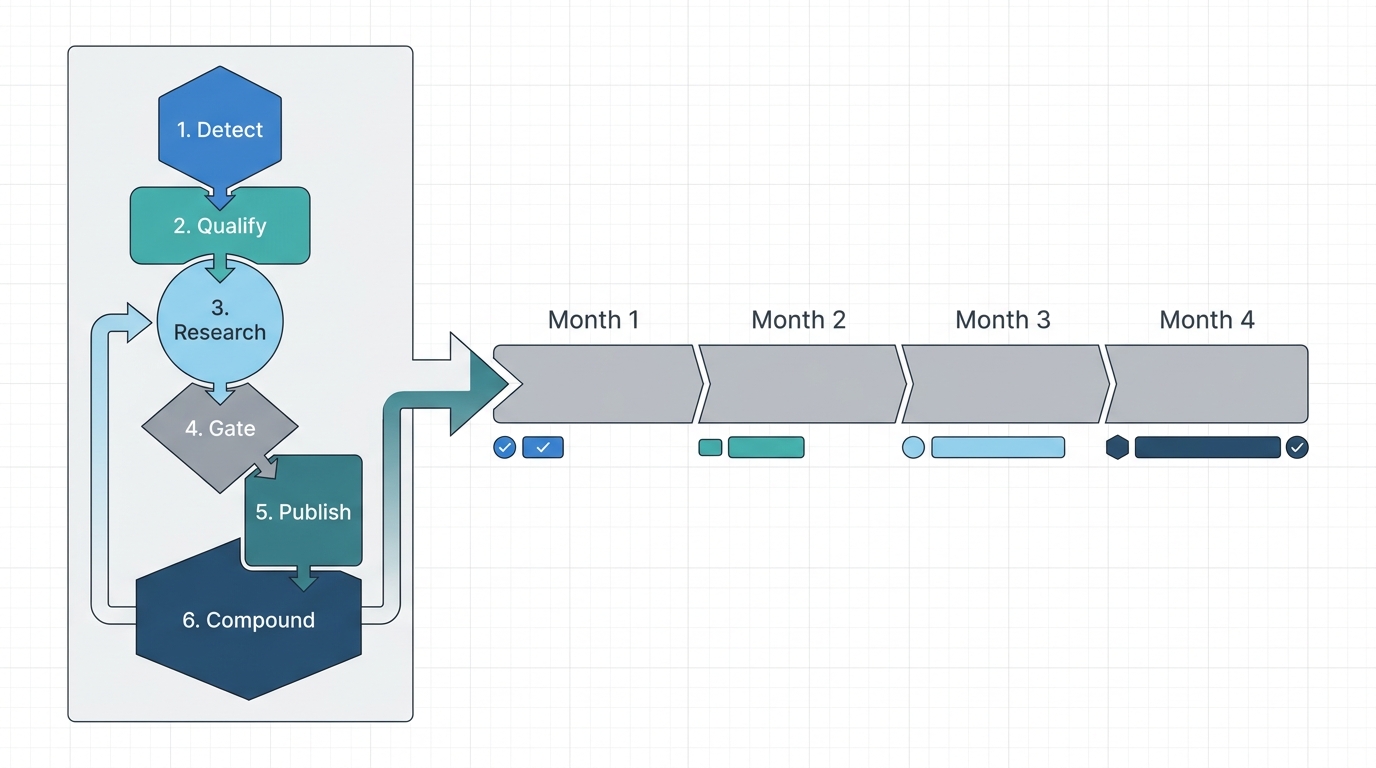
    Our recommendation is to launch through a five-stage engine: Detect -> Qualify -> Research -> Gate -> Publish and Compound. The work spans four months, but the sequence matters more than the calendar. Each stage removes a different form of risk before the business commits more time, brand equity, and operating attention.

    This is the approach we ran for an anonymized property entering an established problem category. The four-month outcome was not “instant authority” or a promise of equivalent rankings to older competitors. It was parity in operating readiness: the new domain had a validated market position, an indexed and credible site foundation, a publishing rhythm tied to real demand, and multiple discovery paths beyond a one-time announcement. At that point, the domain was no longer a speculative launch asset. It had become a functioning distribution asset.

    What You Are Actually Trying to Build

    Founders often frame a new domain as a branding decision: “What should we call this product?” The harder and more valuable question is: “Can this domain become a credible destination for the people and problems we intend to serve?”

    A domain can be technically available and still be strategically weak. It may be difficult to say aloud, confusing to spell, too close to an existing brand, or disconnected from how customers describe the problem. It may also be built around a topic with plenty of search volume but little commercial urgency.

    We would not green-light a domain until it can support three jobs at once:

    • It gives the business a distinct and credible identity.
    • It gives prospective customers a clear reason to understand what the company does.
    • It gives search engines, AI systems, partners, and publishers enough context to classify the business accurately.

    That third job is the one founders underestimate. Discovery is now a business function. If your company cannot be easily understood by a customer, a crawler, an AI assistant, or a potential partner, the brand has a distribution problem before it has a marketing problem.

    The Five-Stage Engine for a Fresh Domain

    The four-month plan is not a linear content calendar. It is a set of gates. We earn the right to move forward by proving that the previous decision was sound.

    1. Detect: confirm there is genuine demand before building too much.
    2. Qualify: make sure the name and domain can carry the company safely.
    3. Research: define the audience, market language, and content targets.
    4. Gate: prepare the technical and operational foundation before public distribution.
    5. Publish and compound: launch with coordinated assets, then turn visibility into a repeatable system.

    Most weak launches reverse this order. They publish first, discover the market language later, and try to repair trust after the domain has already created confusion. That is backwards. The domain should enter the market with a clear reason to exist and a system behind it.

    Month One: Detect Demand Before You Build the Site

    Difficulty: Medium. The first month is for evidence, not production. Before investing in a large site, a visual identity, or a full editorial plan, we would test whether the problem is real enough to justify a dedicated domain.

    The fastest useful signal is not broad market enthusiasm. It is whether people use specific language to describe a problem, whether other companies visibly serve that demand, and whether the problem connects to a real budget.

    Start with exact-phrase searches around the job the customer is trying to complete. The purpose is not to chase a keyword list. It is to see whether the market already has language for the pain, the desired outcome, and the category of solution.

    Then look for competitor presence. Competition is not automatically bad news. For a fresh domain, visible competitors can validate that buyers understand the category and that the problem is important enough to attract commercial attention. The real concern is entering a category with no clear demand signal and no evidence that anyone allocates budget to solve the problem.

    Our working standard would be:

    • People can describe the problem in words close to the words you plan to use.
    • Existing companies, products, or services indicate that the category is commercially active.
    • The problem is connected to a meaningful operational, financial, or strategic cost.
    • The domain can support a durable point of view beyond one launch announcement.

    Do not build a large content library to manufacture demand. A new domain cannot compensate for a weak market signal by publishing more articles. Content without distribution is expensive inventory. Content without demand is even worse: it trains the team to confuse output with traction.

    The decision at the end of this stage is simple: proceed only if the domain is attached to a problem customers already recognize and a market the business can credibly serve.

    Six-stage launch engine mapped onto a four-month plan.
    Six-stage launch engine mapped onto a four-month plan.

    Month One: Qualify the Name Before It Becomes Expensive

    The name is not a creative flourish added after strategy. It is infrastructure. A poor name creates friction in every future channel: direct traffic, word of mouth, sales calls, PR, creator mentions, search behavior, email, and referrals.

    We would qualify a candidate name against three practical risks before committing to the domain.

    1. Trademark risk: A name that collides with an existing brand can become a legal and operational distraction after the business has already invested in the identity.
    2. Pronunciation risk: If a founder says the name once and the listener cannot repeat or spell it, the domain will lose value in conversations that should create direct demand.
    3. Existing .com occupancy risk: The .com is not the only valid domain, but an occupied .com can introduce confusion, misdirected attention, and credibility friction. It deserves a deliberate decision, not an afterthought.

    The usual mistake is using availability as the qualification standard. Availability only tells you that a string can be registered. It does not tell you whether the market can remember it, whether the company can own the meaning around it, or whether it will be confused with another entity.

    We would choose the name that makes the company easier to discover and easier to trust-not the name that merely sounds clever in an internal meeting.

    Month Two: Research the Audience Before You Publish

    Once demand and naming are qualified, the next job is to translate market evidence into a publishing and positioning system. This is where the new domain stops being a label and starts becoming a useful destination.

    Research should clarify three things:

    • The ICP: who has the problem, who owns the budget, and who needs proof before acting.
    • The market: what language the category uses, what alternatives customers compare, and where credibility comes from.
    • The content targets: which pages, tools, evidence, and explanations will help the business become discoverable for real customer intent.

    We would not begin with an arbitrary target number of blog posts. That produces a content plan shaped by publishing capacity rather than by customer demand. The better approach is to map the domain around the decisions a buyer must make.

    That includes the commercial pages that explain the offer, the evidence pages that establish legitimacy, and the problem-solving assets that meet users where they are. In some markets, a free single-purpose tool-a calculator, converter, generator, or template—can be more useful than another informational article because it answers a “do” query directly.

    We would treat those tools as distribution assets, not novelty features. A useful tool creates a concrete reason to visit, return, share, and mention the domain. It also gives the business an asset that is harder to replicate than generic commentary.

    That said, do not build a tool simply because free tools can perform well. The tool must solve a real, recurring task connected to the buyer’s problem and the company’s authority. A calculator that does not lead naturally into the product, service, or expertise is an isolated traffic experiment, not a growth system.

    This stage must also account for AI search. AI Overviews and SEO AI workflows reward clear, structured, evidence-led explanations. The domain needs pages that make its claims understandable, not pages that hide value behind vague category language. A founder should be able to point to any core page and answer: “What is the claim, what supports it, and why should someone trust us?”

    Month Two: Gate the Launch With Technical Readiness

    A domain should not be publicly pushed until the technical basics support the business you are about to create. This is not glamorous work, which is exactly why teams skip it and pay later.

    Gate month—DNS and email authentication readiness.
    Gate month—DNS and email authentication readiness.

    The launch gate has two parts: site readiness and communication readiness.

    • Site readiness: the core site is live, the company proposition is clear, and search systems can access the pages intended for discovery.
    • Communication readiness: DNS and email authentication are prepared before the business depends on outreach, partner communication, or launch-related email activity.

    Google Search Console belongs in this stage because a new domain needs an operating view of search visibility from the beginning. The goal is not to obsess over daily movement. The goal is to make sure the company can observe whether its core pages are being discovered and whether indexing or technical issues require attention.

    Do not use launch week as a technical test. If the first meaningful audience encounters broken site paths, unclear messaging, or email delivery problems, the business wastes the attention it worked to earn. New domains do not get unlimited second chances with the first people willing to pay attention.

    The judgment call here is firm: delay the public push rather than distribute a property that cannot yet represent the company properly. A few extra days of preparation are cheaper than trying to rebuild credibility after a poor first impression.

    Month Three: Publish a Controlled Distribution Burst

    Launch day should not be a single social post or a single announcement. It should be a coordinated burst of assets that make the domain useful, understandable, and referable from multiple angles.

    The core principle is that PR and SEO should not operate as separate activities. Both are authority-building systems. Shared research can become clear on-site pages, credible external commentary, expert quotes, reviews, backlinks, brand mentions, and press releases. These signals reinforce each other when they are coordinated around the same market position.

    Press releases deserve more strategic respect than they often receive. A well-formed release can exist as a standalone crawlable asset and contribute to the evidence surrounding a company. Press release citations in LLMs grew fivefold between July and December 2025, which makes the quality and clarity of these assets more important than simply sending an announcement into the world.

    The important distinction is between publishing a release and building legitimacy. A release without a meaningful claim, useful evidence, or coordinated distribution is just another page. The asset becomes valuable when it helps third parties and AI systems understand why the company matters, what it does, and where its authority comes from.

    For the anonymized property, the launch burst focused on establishing a coherent footprint rather than chasing a spike. The domain had to present the same core story across its site, its externally visible materials, and the conversations designed to create third-party signals. That consistency is what makes a fresh brand easier to recognize and cite.

    Do not bet the launch on one channel. A single platform can create attention, but it cannot create a durable discovery system by itself. Single-channel growth is fragile because platform conditions, reach, and audience behavior can change without warning. The domain must be able to earn visibility through search, referrals, citations, owned email, direct visits, and credible third-party mention.

    Months Three and Four: Compound Instead of Restarting Every Week

    The launch itself is not the system. The system begins after launch, when the business has enough live material to learn from and improve.

    For lean teams, we prefer a disciplined weekly review rather than a sprawling SEO program that never receives founder attention. A time-boxed routine can focus on four decisions:

    • Review the organic pulse in Google Search Console.
    • Improve the pages closest to commercial value.
    • Fix one technical or indexing issue that could block discovery.
    • Add internal links that make important pages easier to find and understand.

    This is not busywork. It is how a new domain turns scattered assets into a connected system. Internal links are not merely navigation details; they communicate which pages matter and how the company’s ideas fit together. Improving money pages matters because visibility without a credible path to the offer does not build a business.

    Publish and compound—indexation, backlinks, and channel iteration.
    Publish and compound—indexation, backlinks, and channel iteration.

    The same discipline applies to authority work. Each new piece of research, customer insight, tool, quote, review, or external mention should strengthen the existing narrative. The point is not to accumulate activities. The point is to make the domain increasingly easy to discover, understand, and trust.

    By the end of month four, parity means the domain can be run as an operating asset. It has a clear customer-facing position, a usable set of core pages, a technical monitoring loop, a repeatable authority approach, and more than one way to reach the market. It does not mean the work is complete. It means the work has moved from launch mode into compounding mode.

    Where New-Domain Launches Usually Break

    The failure modes are predictable. Most are not caused by a lack of effort. They are caused by effort being applied in the wrong order.

    Failure Point: Building Before Demand Is Clear

    If the team is debating page volume, design details, and launch copy before it can explain the problem-budget fit, the project is too far downstream. Return to exact-phrase demand, competitor presence, and the economic importance of the problem. A beautiful domain cannot rescue a weak reason to exist.

    Failure Point: Treating the Domain Name as a Cosmetic Choice

    If the name is difficult to pronounce, carries avoidable trademark risk, or creates confusion around an existing .com, fix it before the launch creates more dependencies. Renaming later costs more because it affects every page, mention, conversation, and authority signal already created.

    Failure Point: Publishing Content Without a Distribution Role

    Every major asset should have a reason to exist: capture a commercial decision, solve a practical task, establish expertise, support a third-party mention, or connect visitors to the next useful page. If an asset does none of those things, it is likely content for content’s sake.

    Failure Point: Measuring Only Clicks

    AI Overviews change the relationship between visibility and clicks. A company still needs to care about traffic, but it also needs to care about whether it is understood, cited, and present around the problems it wants to own. Authority is an asset precisely because it creates opportunities that do not always show up as a single direct click.

    Failure Point: Launching Without an Operating Cadence

    A launch without a weekly review becomes a one-time campaign. The team loses the connection between what customers search for, what the site communicates, what search systems index, and what needs to improve. Systems outperform manual effort because the work continues even when launch excitement fades.

    The Advanced Move: Turn Every Launch Asset Into Evidence

    The better way to think about a new domain is as an evidence engine. The site should not only state what the company believes; it should organize the proof that supports the company’s right to be believed.

    That means using shared research across the site, authority assets, and distribution efforts. It means creating useful resources rather than publishing generic commentary. It means making sure a press release, a product page, a free tool, a review, and an expert quote reinforce a common position instead of telling five unrelated stories.

    This is the difference between launching a domain and launching a visibility system. The first produces a URL. The second produces a business asset that becomes more discoverable and more credible over time.

    TL;DR: The Four-Month New-Domain Plan

    • Month one: detect real demand through exact market language, competitor presence, and problem-budget fit; then qualify the name for trademark, pronunciation, and .com risk.
    • Month two: research the ICP, market, and content targets; build the core site around commercial clarity, useful problem-solving assets, and evidence.
    • Before launch: gate the domain with site readiness, DNS and email authentication, and Google Search Console visibility.
    • Month three: launch through a controlled distribution burst that coordinates on-site assets, authority signals, credible mentions, and crawlable materials.
    • Month four: compound through a weekly operating rhythm: review organic visibility, improve money pages, address one technical issue, and strengthen internal links.
    • The strategic rule: do not treat the domain as a publishing destination. Treat it as owned infrastructure for discovery, authority, and distribution.

    Done right, a new domain does not depend on one announcement, one platform, or one lucky ranking. It becomes a system the company owns—and visibility compounds from there.

  • You Don’t Have a Traffic Problem. You Have a Ceiling Problem.

    You Don’t Have a Traffic Problem. You Have a Ceiling Problem.

    We care about this because we have watched too many leadership teams misdiagnose the same problem. The dashboard flattens. Search clicks stop climbing. Views per post soften. The instinct is immediate and predictable: publish more, spend more, optimise harder, ask the team why momentum has disappeared.

    That response is often a waste of perfectly capable effort.

    A company whose traffic has stalled does not automatically have a content problem. It may have a ceiling problem: a structural limit created by relying on one channel, one content format, or one version of the customer. More effort inside that same structure does not reliably produce more reach. It simply makes the organisation better at pressing against its own limit.

    This distinction matters now because the old assumption that traffic cleanly reflects content value is breaking down. AI Overviews are changing search behaviour in U.S. Google. When an AI Overview is displayed, people click a result about 8% of the time, versus 15% when there is no Overview. Only 1% click a link within the Overview itself.

    That is not a minor optimisation issue. It changes the available click pool before a company has written a title tag, adjusted a bid, or published another article. Leaders who still treat traffic as a simple reward for output will keep drawing the wrong conclusion from the same numbers.

    Traffic ceilings are structural, not effort-based

    Our position is straightforward: when traffic stops responding to increased output, the answer is rarely “work harder on the dominant channel.” The answer is to identify the structure that has stopped producing marginal returns, then redesign the distribution model around it.

    Content is not distribution. Search visibility is not an audience. A high-performing format is not a growth system. And a company that receives more than 80% of its traffic from one channel does not have a reliable engine; it has a dependency.

    That dependency can look healthy for a long time. Google Search can deliver efficient discovery. A successful Instagram format can create a steady stream of attention. LinkedIn can make a founder look omnipresent in a specific professional circle. YouTube can build meaningful depth with the right audience.

    But the moment the channel shifts, the format tires, the audience segment is exhausted, or the platform changes what it rewards, the company discovers that its apparent growth system was really a single point of failure.

    Single-channel growth is fragile because the business has outsourced too much of its visibility to one gatekeeper. The company may own the content, but it does not own the route people take to find it.

    Key takeaways

    • Traffic that rises slowly with more output is stagnation. Traffic that plateaus while views per post and click-through rates decline is saturation.
    • If more than 80% of traffic comes from one channel, the business is exposed to a structural dependency-not protected by a proven strategy.
    • AI Overviews make raw search traffic a less reliable proxy for content value because fewer searchers click through when the Overview is present.
    • The practical response is not generic “post more” advice. It is to add distribution paths, formats, and audience entry points that reduce dependence on the first channel.

    The first ceiling: one channel

    The most common ceiling is channel concentration. It is also the one companies are most reluctant to admit because the dominant channel usually built the first phase of growth.

    Search is the clearest example. A company builds useful pages, earns rankings, and begins to associate traffic growth with publishing. That association is understandable. It is also dangerous when it becomes the entire strategy.

    Google Search remains a major discovery route, but it is no longer a neutral field where every useful page has the same chance to turn attention into a visit. AI Overviews alter the journey. When a result is presented alongside an AI Overview, the click rate falls from about 15% to about 8%. The result may still be visible. It may still contribute to awareness. But visibility and a site visit are no longer interchangeable.

    This is why traffic needs to be interpreted more carefully than it was in the era when a ranking was assumed to produce a predictable click. A page can retain relevance while generating fewer visits. A brand can become more visible in search while receiving less measurable referral traffic. A leadership team looking only at sessions can conclude that content is failing when the actual change is in how discovery is being mediated.

    That does not make search worthless. It makes search insufficient as the entire answer.

    The same principle applies to paid acquisition. Performance Max and Smart Bidding can improve decisions inside an auction, but they cannot manufacture a larger pool of willing clicks. When AI-driven search behaviour and brand dynamics reduce the click pool before the auction, endless bidding adjustments become an increasingly narrow answer. Higher CPC pressure is not always a sign that the campaign team needs another lever. It can be a signal that the available attention has become more constrained.

    Illustration of a traffic plateau (ceiling) and breakthrough after adding a new channel.
    Illustration of a traffic plateau (ceiling) and breakthrough after adding a new channel.

    Companies need post-click systems and alternative discovery routes because the auction is not the whole market. It is simply one place where companies compete for access to demand.

    The second ceiling: one format

    A channel ceiling often hides inside a format ceiling. A company may technically be active on several platforms while repeating one idea in one form for one type of consumption.

    Consider the familiar model: publish a written article, optimise it for Google, share it once, then measure whether it generated clicks. The company calls this multi-channel because the link appeared in more than one place. It is not multi-channel distribution. It is a single asset asking every platform to behave like a referral machine.

    Platforms do not create attention in the same way. YouTube supports depth and sustained explanation. TikTok and Instagram create different forms of fast discovery. LinkedIn provides a context for professional visibility and authority. Meta can create additional routes to reach. Google Search serves people already expressing intent. Treating all of them as places to paste the same link is a refusal to adapt to the actual mechanics of discovery.

    The point is not to flood every platform with output. That is just manual effort disguised as a strategy. The point is to build formats that let one useful idea travel through multiple environments without requiring every audience to discover it in exactly the same way.

    A written explanation can become a video argument. A video insight can become a short-form point of view. A recurring question can become a useful search asset. A strong perspective can become a sequence of platform-native pieces that reinforce the same authority from different angles.

    This is how visibility compounds. The work is no longer dependent on a single publication event or one algorithmic decision. Each expression of the idea can create another route into the company’s expertise.

    Companies that only produce one format eventually confuse format fatigue with audience disinterest. Their audience may not be exhausted by the subject. It may be exhausted by encountering the subject in the same shape, on the same surface, from the same predictable angle.

    The third ceiling: one persona

    The least discussed ceiling is audience concentration. Many companies keep pursuing traffic growth after they have already reached most of the readily available people who fit the one persona their content was designed for.

    Structural limit in a single channel and relief through network redesign.
    Structural limit in a single channel and relief through network redesign.

    The initial persona is often useful. It gives the company focus. It makes early content easier to produce. It helps the team decide what language to use and which problems to address. But a persona can become a cage when it is treated as the whole market rather than the first doorway into it.

    A company may be speaking only to the person who executes the work while ignoring the person who approves the budget. Or it may be speaking only to the buyer who is already searching for a solution while ignoring the operator who influences the decision earlier. It may produce content for existing experts while failing to create entry points for people who are only beginning to recognise the problem.

    The result is familiar: more content, more internal pressure, and less return. The team keeps asking the same narrow segment to provide more attention than that segment can realistically give.

    This is not an argument for vague messaging. It is an argument for designing more than one legitimate path into the company’s authority. Different people need different levels of explanation, different proof, different formats, and different reasons to care. A business that only has one audience entry point will eventually encounter an audience ceiling.

    How to tell which ceiling you have hit

    The diagnosis starts by separating stagnation from saturation.

    Stagnation is when traffic grows slowly but consistently as output increases. This is not necessarily a broken system. It may mean the existing channel still works, but its capacity is limited. The company is gaining ground, just not at a rate that supports its ambitions.

    Saturation is more serious. Traffic plateaus despite increased output, while engagement metrics such as views per post and click-through rates decline. That is the moment to stop congratulating the team for producing more and start asking whether the structure itself has run out of room.

    High dependency is the warning signal that makes both conditions dangerous. When more than 80% of traffic comes from one channel, a plateau is not just a performance issue. It is an exposure issue. The company’s visibility is too closely tied to a platform it does not control.

    Google Search Console can reveal the tension between impressions and clicks. A company should not look at clicks alone when AI Overviews are changing click behaviour. It should examine whether visibility is holding while click-through rates change, whether certain pages are no longer earning the same visit volume, and whether a large portion of discovery rests on a narrow set of search routes.

    On social platforms, the comparable signal is not merely whether a post had a good day. It is whether the company’s visibility depends on one repeated format, one platform pattern, or one shrinking audience response. Falling views per post and softer click-through rates alongside increased publishing are not a rallying cry for volume. They are evidence that the company should reconsider the model.

    FinalBoss did not break through by pushing the first channel harder

    The clearest proof of the principle is FinalBoss: 8.7 million impressions and 66,047 Google clicks came from adding channels, not from pushing the first one harder.

    That is the strategic lesson leaders should keep. Growth did not come from treating Google as an infinitely expandable pipe. It came from expanding the surface area through which people could encounter the brand and its ideas.

    Effort cannot break the ceiling; redesign expands capacity.
    Effort cannot break the ceiling; redesign expands capacity.

    This matters because leaders often expect a mature channel to deliver the next phase of growth simply because it delivered the first one. That expectation leads to the worst kind of operating behaviour: teams are pushed to create more of the same while everyone quietly wonders why each additional asset does less than the last.

    Adding channels is not an excuse for scattered activity. It is a decision to make discovery a business function. It means building a deliberate presence across the places where relevant people already pay attention, while ensuring each channel does a distinct job in the visibility system.

    Google can support high-intent discovery. YouTube can carry depth. Instagram and TikTok can create repeated exposure and reach people before they begin a search. LinkedIn can establish operator-level authority. Meta can add another distribution path. No single platform must carry the entire burden of growth.

    Stop using traffic as the only verdict on content

    Traffic still matters. It remains a useful observable signal. But it is no longer enough to treat it as the final verdict on whether a company’s ideas are useful, visible, or influential.

    AI Overviews make that especially clear. If a person sees a company’s information in search but does not click, the company has not necessarily created zero value. It has created a form of visibility that raw session counts do not fully capture. The same applies when people encounter a useful argument through a short-form video, an Instagram post, a YouTube explanation, or a LinkedIn perspective before they ever search for the company directly.

    The discipline is to measure what can actually be observed without pretending that every meaningful interaction becomes a click. Impressions, click-through rates, views per post, channel concentration, Google Search Console trends, and the difference between visibility and visits all provide evidence. Together, they create a more honest picture than a single traffic line on a dashboard.

    The company that understands this can make better decisions. It can recognise whether its problem is insufficient output, declining distribution efficiency, audience saturation, or excessive dependence on one platform. Most importantly, it can stop punishing a content team for a structural limitation that content volume alone cannot solve.

    TL;DR

    Traffic plateaus are often blamed on insufficient publishing, weak execution, or a team that needs to optimise harder. That diagnosis is frequently wrong. The real problem is usually structural: one dominant channel, one overused format, or one exhausted audience persona.

    AI Overviews make this impossible to ignore. In U.S. Google, people click a result about 8% of the time when an AI Overview is displayed, compared with 15% without one, and only 1% click a link inside the Overview. The click pool can shrink before a company’s SEO or paid-search work even begins.

    The answer is not to publish more of the same and call it a strategy. It is to redesign distribution: build multiple discovery routes, adapt ideas into formats that fit each channel, reach more than one audience entry point, and reduce dependence on any platform the company does not control.

    FinalBoss reached 8.7 million impressions and 66,047 Google clicks by adding channels rather than pushing the first one harder. That is the model worth copying. Visibility compounds when a company builds a system for discovery. It stalls when it mistakes one channel’s limits for a lack of effort.

  • Arborist’s Direct Sales Stack: Sell a Mac App Without Becoming the Merchant of Record

    Arborist’s Direct Sales Stack: Sell a Mac App Without Becoming the Merchant of Record

    Arborist shows a practical direct-sales system for macOS developers whose products cannot live inside Apple’s sandbox: browser-based checkout through RevenueCat and Stripe Managed Payments, entitlement-based access in the app, and a merchant-of-record layer that removes a large part of the tax and refund burden from the developer.

    A license to bill: Arborist’s direct-sales system for macOS

    The part of Arborist’s setup that caught our attention is not the checkout page. Plenty of software businesses can put a payment form on the web. The difficult part is building a reliable bridge between a direct payment and a native Mac app that needs to know, immediately and accurately, whether someone has access. Arborist is a native macOS command center for git repositories and worktrees, and its core job requires running user-entered commands at arbitrary filesystem locations. Apple’s App Store sandbox was never a workable home for that product. That turns distribution into an operating decision rather than a marketing preference: if the product cannot fit the store’s rules, the company needs another way to acquire customers, collect payment, manage licensing, and grant access without assembling an unnecessary pile of billing infrastructure.

    This is the useful lesson in Arborist’s approach. Direct distribution is not simply “put the download on a website.” A Mac developer selling outside the App Store inherits a set of connected jobs: establish an identity for the buyer, present a checkout experience people recognise, determine which product rights they purchased, communicate those rights to the application, and deal with the commercial obligations that come with taking payment. Arborist pairs RevenueCat’s web billing and entitlements with Stripe Managed Payments to turn those pieces into a system. The result is not a shortcut around the hard work of running a software business. It is a cleaner division of labour between the application, the billing layer, and the merchant-of-record layer.

    [INFO_TABLE]
    Product/Service: Arborist direct-sales billing system
    App category: Native macOS command center for git repositories and worktrees
    Distribution model: Direct web checkout outside the Mac App Store
    Billing stack: RevenueCat Web Purchase Links + Stripe Managed Payments
    Access control: RevenueCat entitlements linked to an iCloud-based user identifier
    Checkout experience: Browser-based checkout with Apple Pay support
    Price: Not specified
    [/INFO_TABLE]

    The real constraint is the sandbox, not the payment button

    Arborist is a good example because the distribution decision is anchored in product reality. A tool that runs commands supplied by its user, in locations chosen by that user, does not have much room to compromise around a restrictive sandbox. Trying to force that workflow into a channel built around different technical assumptions would mean reshaping the product around the store rather than serving the customer’s actual work. That is backwards. The application should define the distribution architecture, especially for software used by technical teams whose workflows depend on local files, repositories, worktrees, terminals, and commands that do not fit neatly inside a tightly controlled container.

    For an operator, this matters because single-channel growth is fragile even before policy becomes a problem. The Mac App Store can be a useful channel for products that fit its model, but it cannot be the entire distribution plan for software whose functionality sits outside that model. Arborist’s system creates a direct route from discovery to purchase to product access. That route is owned by the business rather than being dependent on a storefront’s sandbox rules. More importantly, it makes direct distribution operationally credible. A company can only treat a channel as strategic if payment, access, supportable account identity, and commercial administration work together after the customer clicks “buy.”

    The entitlement is the product boundary

    It took us a while to understand why entitlement design is the centre of this workflow rather than a technical footnote. In a direct-sales Mac app, the entitlement is the contract between the payment system and the application. It answers the practical question that matters after checkout: what can this customer use? Arborist begins by configuring entitlements in RevenueCat. That gives the business a defined access state that the app can read, instead of asking the application to interpret payment records, invoices, or a hand-built licensing database on its own.

    That separation is important. The checkout layer has one job: complete a purchase. The app has another: provide or restrict access based on an entitlement. When those two concerns are fused into custom licensing logic, every product change creates more moving parts. A developer ends up managing payment events, licence issuance, access restoration, customer identity, and application state in one homemade system. Arborist’s structure keeps the app focused on entitlement status. RevenueCat becomes the layer that communicates the customer’s purchased access back to the application, while Stripe Managed Payments handles the payment and merchant-of-record side of the transaction.

    This is the moment the architecture clicks: the licence is not merely a code emailed after purchase. It is a live access state tied to a recognised customer identity. That matters for a native app because the purchase happens in a browser while the value is delivered inside macOS. The system needs a dependable handoff between those environments. An entitlement gives the business a common language for that handoff. The browser says the transaction is complete; the billing layer records the right; the app refreshes its customer information; the entitlement becomes available; and the product unlocks the relevant access.

    Identity comes before checkout

    The weakest version of direct app billing treats identity as an afterthought. That is where licensing systems become confusing for customers and expensive for the company: someone pays on the web, opens the app, and the two environments cannot agree that they are the same person. Arborist avoids that disconnect by using an iCloud-based user identifier. The user is identified before being sent to checkout, so the eventual web purchase is attached to the same customer identity the Mac application uses to request entitlement information.

    This is not flashy product work, but it is exactly the kind of plumbing that determines whether a direct-sales channel feels trustworthy. The operator does not want a support process built around manually reconciling payments with app access. The customer does not want to wonder why a completed payment has not unlocked the software. By passing an identified customer into the web purchase flow, Arborist gives the billing system an address for the access right. Once checkout is complete, the app can refresh the RevenueCat SDK and read the changed entitlement state through its normal customer-information flow.

    The practical insight is that a browser checkout does not need to become a detached ecommerce island. In this model, it is simply one stage in a connected product system. The app knows who the customer is. The purchase link is associated with that identity. The payment creates access. The SDK refresh pulls that access back into the app. For developers who would otherwise build a separate licensing server just to keep web payments and native access in sync, that is the piece worth studying. Systems outperform manual effort when the handoffs are designed before customers arrive.

    Why the browser checkout is a feature, not a compromise

    Sending a Mac customer to a browser can initially feel like a compromise compared with an all-in-one App Store transaction. In Arborist’s case, it is the correct trade. The product already needs to live outside the store, and the browser provides a familiar place to complete a direct purchase. RevenueCat’s Web Purchase Links connect the offering to that checkout flow, while Stripe Managed Payments supports a payment experience that includes Apple Pay. The customer gets a payment method that feels native to the Apple ecosystem even though the sale itself is not routed through the Mac App Store.

    That matters because direct distribution should not force the customer through a visibly improvised buying experience. A standalone app can be technically sophisticated and still lose trust if its checkout feels disconnected from the product. Apple Pay helps keep the payment moment recognisable; the identified purchase flow keeps it connected to access; and the entitlement refresh makes the return to the app functional rather than ceremonial. No part of that creates demand by itself. Discovery remains a business function, and a purchase link is not a growth strategy. But it gives a company a conversion destination it can confidently use across its own website, product-led onboarding, partnerships, content, and other distribution efforts.

    The merchant-of-record problem is where direct sales become serious

    The payment form is the visible part of selling software. Merchant-of-record responsibility is the part that makes many direct-sales plans more complicated than they first appear. When a developer sells software directly, questions around tax handling and refunds do not disappear simply because the product is downloaded from the developer’s site. They become part of the commercial system. That is why “just use Stripe” can be incomplete advice for a developer who wants to sell a Mac app without becoming a payments operations company along the way.

    Stripe Managed Payments changes the structure of that problem by taking on the merchant-of-record role in this setup. That simplifies tax handling and refund administration for the direct seller. The distinction matters. Arborist is not trying to avoid the realities of selling software; it is choosing a provider model that absorbs a meaningful set of merchant-of-record duties. For a small software business, this can be the difference between having a direct channel that is genuinely manageable and having one that demands a growing collection of internal processes before it is ready to scale.

    We would separate this clearly from the broader promise often attached to direct-to-consumer payments. Direct sales can create more control over the customer journey, but control is not the same as doing every operational task internally. The smart system keeps ownership of the distribution path and the product relationship while using specialised infrastructure for work that should not become the company’s differentiator. Arborist’s stack does that neatly: the app retains its native workflow, RevenueCat manages the access logic between web and app, and Stripe Managed Payments covers the merchant-of-record layer attached to the sale.

    What the implementation flow actually looks like

    The workflow is refreshingly direct. First, define the entitlement in RevenueCat: this is the access state the application will recognise after a successful purchase. Next, connect Stripe as the web provider and attach the relevant offering to a Web Purchase Link. The Mac app identifies the customer through its iCloud-based identifier, then opens the browser checkout for that identified customer. The buyer completes payment using the available browser checkout methods, including Apple Pay. After the purchase, the application refreshes the RevenueCat SDK. The SDK’s customer information and entitlement state now give the app the signal it needs to recognise the paid access.

    That sequence may look straightforward on paper, but its order is doing important work. The entitlement is defined before the offering is sold. The offering is attached before the checkout is opened. The customer is identified before payment. The app refreshes access after checkout rather than assuming that a browser confirmation page is enough. Each stage has a single purpose, and together they prevent the common direct-sales failure where a payment succeeds but the product has no clear way to honour it. This is why billing integrations should be treated as growth infrastructure, not as an isolated finance project. Revenue depends on the connection between acquisition, payment, and delivered value holding together under normal customer behaviour.

    • Define access: Create the entitlement that represents the paid product right.
    • Connect billing: Use Stripe as the web provider and associate the offering with a Web Purchase Link.
    • Identify the customer: Send the iCloud-identified customer into the browser checkout.
    • Complete payment: Let the buyer use the web checkout, including Apple Pay where available.
    • Refresh access in-app: Refresh the RevenueCat SDK so the purchased entitlement is available to the Mac application.

    What this system unlocks-and what it does not

    Arborist’s model unlocks a credible direct route for a Mac application that cannot be distributed through the App Store because of its underlying functionality. It provides a path from a company’s own distribution efforts to a browser purchase and back into native-app access. It also avoids making the developer construct a separate licensing system and take on the merchant-of-record role simply to sell software outside Apple’s store. That is meaningful leverage. The business can invest more of its effort in product quality, discoverability, and repeatable distribution rather than rebuilding commodity billing operations.

    It does not turn every macOS application into the same kind of direct-sales business, and it does not remove the need for a deliberate product and distribution strategy. Arborist is a specific response to a specific product reality: an app whose command-running, filesystem-level workflow cannot fit the App Store sandbox. The useful takeaway is not that every developer should copy its exact identity structure or entitlement setup. The takeaway is that companies should design payments and access around the real shape of their product, then choose infrastructure that keeps the system coherent from customer discovery through to the moment the app unlocks.


    ✓ PROS


    • +
      Keeps a sandbox-incompatible macOS app on a direct distribution path

    • +
      Connects web checkout to in-app access through entitlements

    • +
      Reduces merchant-of-record, tax-handling, and refund complexity through Stripe Managed Payments


    ✗ CONS


    • –
      Requires a deliberate identity-to-entitlement flow before checkout

    • –
      Browser payment and native-app access must be kept connected through SDK refreshes

    • –
      Does not create demand or replace a broader distribution strategy

    The operator verdict

    The most valuable thing about Arborist’s billing stack is its restraint. It does not pretend that direct sales are effortless, and it does not confuse a payment processor with an entire licensing strategy. Instead, it turns a difficult set of requirements into a clear system: identify the customer, sell through a web checkout, record the right as an entitlement, refresh that right inside the app, and let a merchant-of-record service take on the commercial responsibilities that should not become the developer’s full-time concern.

    For an operator building a native Mac product outside the App Store, that is the decision framework worth carrying forward. Build on direct sales when the product requires it or when channel independence is strategically valuable-but build it as a complete access system, not as a checkout button attached to a download page. Visibility compounds only when the business has somewhere reliable to send the attention it earns. Arborist’s setup gives direct distribution that reliability: a path that can move a prospect from discovery to payment to working software without making the company become its own merchant of record or licence-server operator.


    8/10

    VERDICT

    Arborist’s RevenueCat and Stripe Managed Payments stack is a strong direct-sales blueprint for a sandbox-incompatible Mac app because it joins web checkout, merchant-of-record coverage, and in-app entitlement access into one operational system.

  • AI Answers Get Local Business Details Wrong. Build an Audit System Before Customers Find Out

    AI location answers are becoming a customer experience risk

    This caught our attention because location data used to be a fairly contained local SEO problem: maintain accurate listings, update your Google Business Profile, and correct the occasional directory error. AI has changed the surface area.

    Customers now ask ChatGPT, Gemini, Perplexity, Google Search, AI Mode, and AI Overviews where a business is, which branch is closest, or whether a store serves a particular town. The answer can look definitive even when the postcode, address, or location relationship is wrong.

    In one test of UK retailers, 64% were affected by AI location errors. One in 16 responses contained incorrect information, while wrong postcodes appeared in one in 10 answers-even when prompts named the relevant town.

    For a multi-location business, that is not a small accuracy issue. It is customer-facing misinformation at the exact point a buyer is trying to visit, call, collect, or purchase.

    Key takeaways

    • AI-generated business answers should be treated as unverified text, not a reliable reflection of your location data.
    • Wrong postcodes can send high-intent customers to the wrong place or convince them a nearby location does not exist.
    • There is no dependable proactive alert when an AI platform states a business detail incorrectly.
    • Local marketing now needs an AI search monitoring and manual auditing process across major answer engines.
    PublisherCodolie Studio
    Release DateJuly 20, 2026
    CategoryAI in Marketing / Local Search
    PlatformGoogle Search, ChatGPT, Gemini, Perplexity, Google Business Profile

    Visibility without accuracy is not an asset

    Much of the AI SEO conversation has focused on earning citations, mentions, and visibility in generated answers. That matters. But a brand mention that sends someone to the wrong postcode is not useful visibility. It is a distribution failure.

    AI systems synthesize business information into a direct answer. They do not simply display the location record your team maintains. That distinction matters because a correct Google Business Profile does not guarantee that every AI-generated answer will repeat the same details accurately.

    For operators, the risk compounds with every branch, service territory, franchise location, and similarly named town. A customer may never reach your site to validate the answer. They may act on what the assistant tells them, then blame the business when the details are wrong.

    This is why discovery is a business function, not an SEO reporting line. If customers increasingly discover locations through generated answers, the accuracy of those answers belongs in the customer experience and revenue conversation.

    Build a manual AI location audit

    The practical response is not to assume an automated tool will catch every problem. Build a repeatable audit that tests the questions customers actually ask across Google Search, AI Overviews, AI Mode, ChatGPT, Gemini, and Perplexity.

    • List every location’s canonical business name, address, postcode, phone number, opening details, and core service area.
    • Create a set of location-intent prompts: “Where is [brand] in [town]?”, “What is the nearest [brand] to [postcode]?” and “Does [brand] have a branch in [town]?”
    • Run those prompts for each meaningful location and record the exact answers returned.
    • Compare every answer against the canonical location record, not against what another platform says.
    • Correct conflicts in the business-owned sources your team controls, beginning with Google Business Profile, location pages, and consistent business information across your wider web presence.
    • Repeat the process on a schedule, especially after openings, closures, relocations, rebrands, or service-area changes.

    Search Console can help teams understand traditional search visibility, while tools such as Ahrefs Brand Radar can support broader brand monitoring. Neither removes the need to inspect the literal answers customers receive. The operational discipline is simple: test the output, document errors, repair the source data, and test again.

    The real shift: location data now needs distribution governance

    Businesses have spent years treating local data as maintenance work. AI search turns it into an ongoing distribution system. Every address, postcode, branch name, and town association is now material that can be synthesized and delivered without your team seeing it first.

    The companies that win will not be the ones that publish the most AI SEO content. They will be the ones that build a dependable source of truth, monitor how that truth travels across discovery channels, and make accuracy somebody’s explicit responsibility.

    TL;DR

    AI-generated answers about local businesses can contain wrong location details, including postcodes. With 64% of retailers affected in one test, multi-location brands should not treat AI visibility as automatically reliable. Audit customer-facing answers manually across major AI platforms, maintain authoritative location data, and make location accuracy part of your distribution system.

    THE CODOLIE LENS

    What does this mean for founders?
    Location accuracy is no longer only an SEO task. It affects customer trust, footfall, conversion, and whether customers can find the business at all.

    What does this mean for distribution?
    AI answers are a new distribution layer. A visible answer with incorrect local details does not create leverage; it creates friction at a high-intent moment.

    What would we do differently?
    Assign ownership for AI location auditing, establish a canonical record for every location, test customer-style prompts across major AI platforms, and turn recurring checks into an operating system rather than an occasional local SEO cleanup.

  • MCP for Marketers: The Data Bridge That Turns AI Visibility Into Action

    Model Context Protocol gives marketing teams a practical way to connect AI assistants to the systems that contain brand truth-turning generic recommendations into visibility briefs, content priorities, and next actions grounded in live data.

    MCP for Marketers: Stop Asking AI for Opinions. Give It Context.

    Our first reaction to Model Context Protocol was that it sounded like another piece of AI plumbing that would be overexplained by vendors and underused by operators. Then the practical implication landed: MCP gives an AI assistant a structured, governed route into the systems that already tell the truth about a business. Not a static brand document. Not a clever prompt pasted into a chat window. The actual current picture: what pages earn demand, which products are available, what customers ask before buying, where visibility is rising or slipping, and which pipeline segments are converting.

    That matters because discovery is changing shape. Buyers still use Google, but they also ask ChatGPT, Claude, Gemini, Copilot, and Perplexity to explain categories, compare options, shortlist providers, and make sense of complicated purchases. At Google, AI Overviews have made the same point visible inside the familiar search journey: the answer is increasingly assembled before the click. A company can have a respectable website and an active content calendar yet remain absent, misrepresented, or indistinguishable at the moment a buyer asks an assistant for a recommendation.

    [INFO_TABLE] Product/Service: Model Context Protocol (MCP) Category 1: What it is: An open standard for connecting AI assistants to external tools, data, and services Category 2: Marketing job: Ground AI analysis and actions in live search, analytics, CMS, CRM, and product data Category 3: Best first use: Search and AI-visibility brief generation with verified business context Category 4: Core requirement: Governed access, clear data ownership, and approved actions Price: Open standard; implementation cost depends on the connected systems and governance layer [/INFO_TABLE]

    MCP, introduced by Anthropic in November 2024, is best understood as a common connection layer between AI and business systems. An AI assistant is the interface where a strategist asks for a diagnosis or a plan. MCP is the bridge that lets the assistant retrieve approved information and, where permitted, use tools rather than inventing a plausible answer from its general training. This distinction is not academic. Without current context, an assistant can write polished marketing language. With the right context, it can assemble a brief around actual search performance, commercial priorities, content gaps, and customer evidence.

    The moment this clicks, MCP stops looking like a technical novelty and starts looking like distribution infrastructure. Modern companies do not need more disconnected “AI ideas.” They need a system that can identify where attention is being won or lost, connect that signal to the business, and direct a human team toward the next useful move. Visibility compounds when this loop becomes routine: measure discovery, understand the gap, publish or improve the right asset, then measure what changed. MCP can make that loop faster and more coherent, but only if it is built around decisions rather than novelty.

    The Marketing Problem MCP Actually Solves

    Most AI marketing work still begins with a blank chat box. A team asks for a content strategy, a competitor comparison, a campaign recap, or ideas for improving organic growth. The assistant responds with familiar advice because it has no access to the company’s Search Console data, content inventory, product catalog, customer feedback, sales notes, or current positioning. The output may be articulate, but it is generic by design. It cannot know whether the company ranks on page one for commercial terms but loses clicks, whether high-intent product pages are outdated, or whether a sales team keeps hearing an objection the website never answers.

    MCP changes the input side of that equation. Instead of asking an assistant, “What should we write about?” an operator can create a governed workflow that brings together the terms driving impressions in Search Console, the pages associated with those terms, the existing content library, product or service facts, and selected CRM insight. The assistant’s role becomes more useful: identify the mismatch between demand and coverage, explain the business consequence, propose a brief, and point to the source data supporting that recommendation. The result is not autonomous marketing. It is a stronger decision system.

    That distinction matters for leaders because systems outperform manual effort at scale. A great strategist can manually pull reports, search the CMS, inspect product information, scan customer notes, and turn the findings into a plan. The problem is not whether that work can be done. The problem is that it is slow, expensive, inconsistent, and difficult to repeat every week across a growing site, catalog, or market. MCP does not replace the strategist. It compresses the gathering and synthesis stage so the strategist can spend more time making calls that require judgment.

    What to Connect First: Build the Visibility Layer Before the Everything Layer

    The common mistake is trying to connect every system at once. That creates a sprawling project, expands the security surface, and makes it unclear whether the assistant is producing better work or simply accessing more information. Across the companies we study, the strongest starting point is narrower: connect the data that helps the business understand and improve discovery. A useful first MCP implementation should answer a short set of high-value questions: where are buyers finding us, what are they trying to solve, what information do they encounter, and where does the path from discovery to decision break down?

    • Search and AI visibility data: search queries, impressions, clicks, landing pages, brand versus non-brand demand, and the topics where the company needs to be understood.
    • CMS and content inventory: live URLs, page types, publication dates, metadata, authorship, internal links, conversion paths, and the content already available to support an answer.
    • Product or service truth: catalog details, pricing rules, availability, specifications, use cases, approved claims, reviews, and customer-facing proof.
    • CRM and customer insight: qualified objections, buying triggers, industry segments, deal stages, recurring questions, and reasons opportunities advance or stall.
    • Analytics: the paths users take after discovery, the pages that contribute to conversion, and the gaps between traffic volume and commercial outcome.

    Search data belongs near the front of the queue because it captures expressed demand. Search Console remains one of the most useful signals in a marketing stack precisely because it shows the language people use when they look for a solution. That language is often more valuable than a brainstorming session. It reveals category questions, comparison intent, implementation concerns, pricing anxiety, and the terms that frame a buyer’s understanding of the market. An AI assistant connected to that data can move beyond “create thought leadership” and identify the exact topics where a company is visible but weak, relevant but unclear, or simply missing.

    The CMS comes next because visibility without an inventory becomes a pile of observations. An assistant needs to know whether the company already has a credible page for a topic, whether that page is current, whether it answers the full question, and whether it is connected to a commercial path. This is where content operations become less wasteful. Rather than commissioning another generic article because a keyword appeared in a report, a team can identify whether an existing comparison page needs evidence, whether a product page needs a clearer use case, or whether multiple thin articles should become one authoritative resource.

    For ecommerce companies, product and merchant data deserve the same priority. Product feeds, availability, attributes, pricing logic, reviews, and fulfillment constraints are no longer back-office details. They are part of how a company can be accurately represented wherever buyers research and compare. Product data is becoming the effective unit of participation in assisted discovery and increasingly direct purchase flows. A polished brand campaign cannot compensate for incorrect availability, incomplete specifications, or a catalog that fails to explain why one product fits a particular need. Google Merchant Center belongs in this broader truth layer for businesses that depend on product discovery.

    CRM data is powerful, but it should enter with discipline. Marketing teams often want every customer record connected immediately, then discover that the assistant has been given access to a noisy, sensitive, poorly structured database. Start with the commercial facts that improve messaging: common objections, customer segments, winning use cases, qualification criteria, and recurring questions from sales conversations. This turns the assistant into a better interpreter of the market without turning it into an uncontrolled reader of private customer history. Audience ownership matters, and so does protecting the data that comes with it.

    What a Useful MCP Workflow Looks Like

    A practical workflow begins with a business question, not a tool demonstration. For example: identify the non-brand topics bringing the most impressions but insufficient clicks, map them to the existing website, check whether the relevant pages contain current product proof and clear next steps, then produce a prioritized set of content briefs. With the right connections, the assistant can gather the query patterns from Search Console, inspect the applicable pages in the CMS, pull approved language from the product or service system, and identify whether those same themes show up in CRM objections or conversion paths.

    The output should not be “ten blog post ideas.” That is the old content-machine reflex, and it rarely creates durable authority. A useful output is a decision-ready visibility brief: the topic, the audience intent, the page or asset that should own the topic, what the current experience fails to answer, which evidence the page needs, how the asset should connect to the rest of the site, and what commercial action it should support. This is how an AI assistant becomes part of a distribution system rather than a faster generator of words.

    Another high-value use case is message accuracy. An operator can ask the assistant to compare the claims across live product pages, sales enablement materials, LinkedIn content, and campaign assets against the approved product data. The assistant can flag inconsistency, stale claims, missing proof, or places where the public explanation no longer matches the commercial reality. This is particularly valuable as businesses create more material across more channels. Single-channel growth is fragile, but multi-channel growth without a shared truth layer becomes a brand-management problem very quickly.

    The best early workflows remain read-heavy and action-light. Let the assistant retrieve, analyze, summarize, compare, and recommend before allowing it to make changes. It can draft a CMS brief, prepare a reporting narrative, assemble a product-content audit, or generate a proposed update for human review. Publishing, editing catalog records, changing campaign settings, or touching CRM records should stay behind explicit approval. The value of MCP is not that it gives a model the keys to the building. The value is that it gives the people running the building a clearer view of what needs attention.

    ✓ PROS

    • + Replaces generic AI prompts with business-specific context
    • + Connects visibility data to practical briefs and next actions
    • + Creates repeatable discovery and content-operations workflows

    ✗ CONS

    • – Poor data quality produces poor recommendations
    • – Broad permissions create avoidable security risk
    • – An MCP connection does not fix unclear positioning or weak source data

    Governance Is Not the Boring Part. It Is the Product.

    MCP introduces a serious operational responsibility: an AI assistant is only as trustworthy as the data it can access and the actions it is allowed to take. Marketing leaders should treat each connection as a governed capability, not a convenient integration. Define who owns the underlying data, which fields are approved for the assistant to retrieve, which actions are read-only, who can authorize changes, and how activity is logged. A marketing system that connects analytics, CMS, CRM, and product data is valuable precisely because it touches consequential business information.

    Least-privilege access should be the default. A visibility workflow does not need unrestricted CRM access. A content-audit workflow does not need the ability to publish. A product comparison brief does not need permission to alter prices or availability. Separating retrieval from execution is both safer and strategically cleaner because it forces the team to decide where human judgment belongs. The assistant may surface an opportunity; the accountable operator decides whether the opportunity fits the brand, the market, and the company’s priorities.

    Data quality also becomes impossible to ignore. MCP will not rescue a CMS full of duplicate pages, a CRM full of inconsistent fields, or a catalog with incomplete attributes. It will expose those problems faster. That is a feature, not a failure. Companies that want AI to represent them accurately need to establish a source of truth for product facts, positioning, evidence, and customer language. Authority is an asset, but authority cannot be built on contradictory information scattered across systems.

    Where MCP Fits in the Growth Stack

    MCP should not be treated as a replacement for SEO, analytics, a CMS, a CRM, or a content strategy. It is the connective layer that makes these investments more usable in an AI-assisted operating model. SEO still matters because it creates crawlable, credible assets that earn discovery. Analytics still matters because it shows what happens after attention arrives. CRM still matters because it holds commercial learning. The CMS still matters because it is where a company compounds knowledge into owned distribution. MCP helps an assistant reason across those systems without forcing teams to manually reconstruct the same context every time.

    This is also why the conversation should not be reduced to whichever AI interface captures attention in a given quarter. The durable shift is not a new placement or a new prompt format. It is the movement toward buyer journeys where research, comparison, and eventually purchase decisions can happen inside assisted experiences. In that environment, structured, current, explainable data becomes a strategic asset. Companies need to be clear enough for assistants to describe accurately and organized enough for their own teams to act on the resulting visibility signals.

    For a founder or operator, the first objective is modest and concrete: create one MCP-powered workflow that turns disconnected marketing data into a better weekly decision. Start with search and content visibility. Connect the systems that show demand, identify the assets that answer it, and reveal the gaps that prevent the business from becoming the obvious choice. Once that workflow is trusted, add product truth, customer insight, and deeper analytics. The goal is not to build an impressive AI demo. The goal is to build a repeatable discovery system that makes visibility easier to earn, protect, and compound.

    8.5/10 VERDICT

    MCP earns a place in a modern marketing stack when it is used as a governed bridge between AI assistants and the data that drives real visibility decisions-not as another generic content-generation layer.