A new domain is not a website project. It is a discovery, legitimacy, and distribution project that happens to begin with a website.
The mistake we see most often is treating the domain launch as a single moment: choose a name, publish a polished site, post an announcement, then wait for search traffic or referrals to arrive. That approach creates a clean-looking property with no meaningful reason for the market, search engines, AI systems, or third parties to discover and trust it.
In 2026, that gap is more expensive. AI Overviews can answer informational searches before a prospective customer clicks. Search visibility increasingly depends on whether a company is understood, cited, mentioned, and connected to credible third-party signals-not merely whether it has published a set of pages. A new domain therefore needs more than content. It needs evidence of demand, a clear point of view, technically sound foundations, and a distribution system that compounds after launch week.
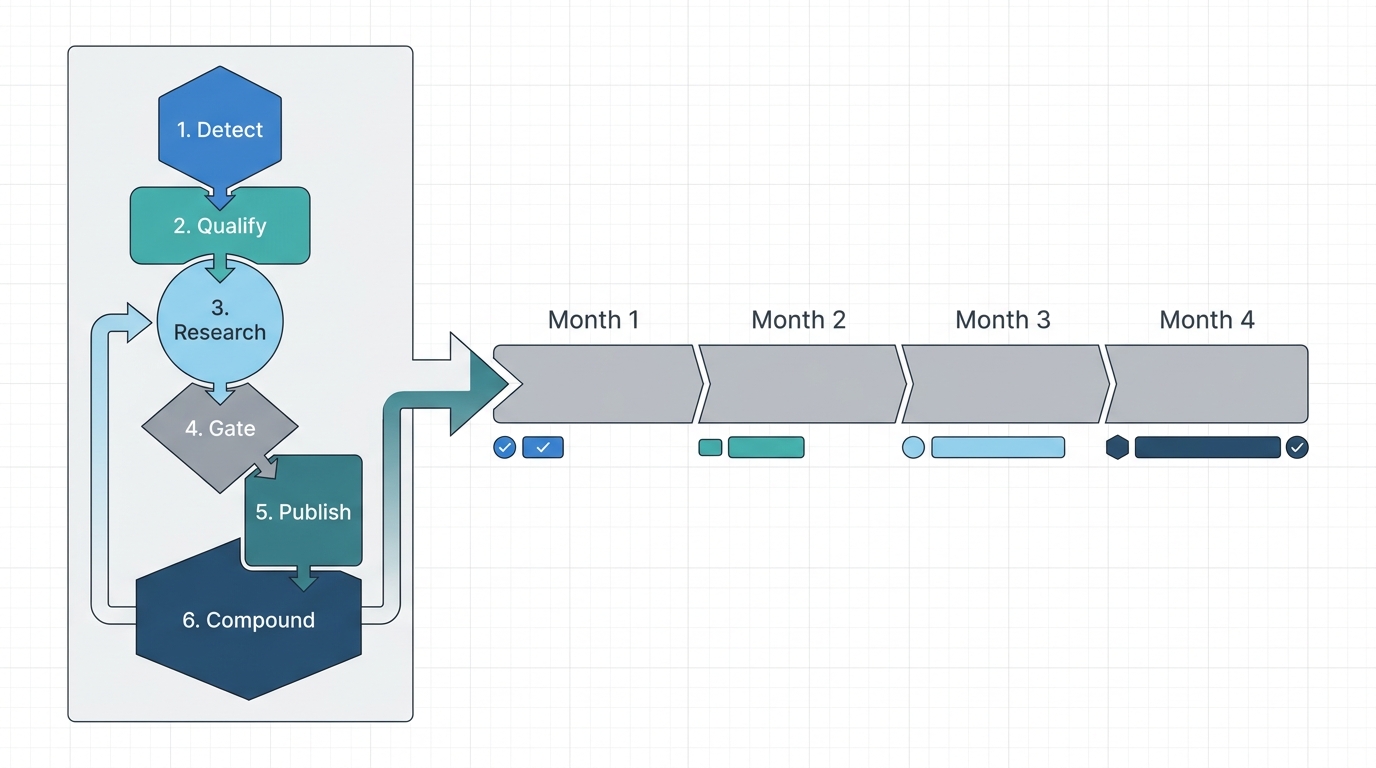
Our recommendation is to launch through a five-stage engine: Detect -> Qualify -> Research -> Gate -> Publish and Compound. The work spans four months, but the sequence matters more than the calendar. Each stage removes a different form of risk before the business commits more time, brand equity, and operating attention.
This is the approach we ran for an anonymized property entering an established problem category. The four-month outcome was not “instant authority” or a promise of equivalent rankings to older competitors. It was parity in operating readiness: the new domain had a validated market position, an indexed and credible site foundation, a publishing rhythm tied to real demand, and multiple discovery paths beyond a one-time announcement. At that point, the domain was no longer a speculative launch asset. It had become a functioning distribution asset.
What You Are Actually Trying to Build
Founders often frame a new domain as a branding decision: “What should we call this product?” The harder and more valuable question is: “Can this domain become a credible destination for the people and problems we intend to serve?”
A domain can be technically available and still be strategically weak. It may be difficult to say aloud, confusing to spell, too close to an existing brand, or disconnected from how customers describe the problem. It may also be built around a topic with plenty of search volume but little commercial urgency.
We would not green-light a domain until it can support three jobs at once:
- It gives the business a distinct and credible identity.
- It gives prospective customers a clear reason to understand what the company does.
- It gives search engines, AI systems, partners, and publishers enough context to classify the business accurately.
That third job is the one founders underestimate. Discovery is now a business function. If your company cannot be easily understood by a customer, a crawler, an AI assistant, or a potential partner, the brand has a distribution problem before it has a marketing problem.
The Five-Stage Engine for a Fresh Domain
The four-month plan is not a linear content calendar. It is a set of gates. We earn the right to move forward by proving that the previous decision was sound.
- Detect: confirm there is genuine demand before building too much.
- Qualify: make sure the name and domain can carry the company safely.
- Research: define the audience, market language, and content targets.
- Gate: prepare the technical and operational foundation before public distribution.
- Publish and compound: launch with coordinated assets, then turn visibility into a repeatable system.
Most weak launches reverse this order. They publish first, discover the market language later, and try to repair trust after the domain has already created confusion. That is backwards. The domain should enter the market with a clear reason to exist and a system behind it.
Month One: Detect Demand Before You Build the Site
Difficulty: Medium. The first month is for evidence, not production. Before investing in a large site, a visual identity, or a full editorial plan, we would test whether the problem is real enough to justify a dedicated domain.
The fastest useful signal is not broad market enthusiasm. It is whether people use specific language to describe a problem, whether other companies visibly serve that demand, and whether the problem connects to a real budget.
Start with exact-phrase searches around the job the customer is trying to complete. The purpose is not to chase a keyword list. It is to see whether the market already has language for the pain, the desired outcome, and the category of solution.
Then look for competitor presence. Competition is not automatically bad news. For a fresh domain, visible competitors can validate that buyers understand the category and that the problem is important enough to attract commercial attention. The real concern is entering a category with no clear demand signal and no evidence that anyone allocates budget to solve the problem.
Our working standard would be:
- People can describe the problem in words close to the words you plan to use.
- Existing companies, products, or services indicate that the category is commercially active.
- The problem is connected to a meaningful operational, financial, or strategic cost.
- The domain can support a durable point of view beyond one launch announcement.
Do not build a large content library to manufacture demand. A new domain cannot compensate for a weak market signal by publishing more articles. Content without distribution is expensive inventory. Content without demand is even worse: it trains the team to confuse output with traction.
The decision at the end of this stage is simple: proceed only if the domain is attached to a problem customers already recognize and a market the business can credibly serve.
Month One: Qualify the Name Before It Becomes Expensive
The name is not a creative flourish added after strategy. It is infrastructure. A poor name creates friction in every future channel: direct traffic, word of mouth, sales calls, PR, creator mentions, search behavior, email, and referrals.
We would qualify a candidate name against three practical risks before committing to the domain.
- Trademark risk: A name that collides with an existing brand can become a legal and operational distraction after the business has already invested in the identity.
- Pronunciation risk: If a founder says the name once and the listener cannot repeat or spell it, the domain will lose value in conversations that should create direct demand.
- Existing .com occupancy risk: The .com is not the only valid domain, but an occupied .com can introduce confusion, misdirected attention, and credibility friction. It deserves a deliberate decision, not an afterthought.
The usual mistake is using availability as the qualification standard. Availability only tells you that a string can be registered. It does not tell you whether the market can remember it, whether the company can own the meaning around it, or whether it will be confused with another entity.
We would choose the name that makes the company easier to discover and easier to trust-not the name that merely sounds clever in an internal meeting.
Month Two: Research the Audience Before You Publish
Once demand and naming are qualified, the next job is to translate market evidence into a publishing and positioning system. This is where the new domain stops being a label and starts becoming a useful destination.
Research should clarify three things:
- The ICP: who has the problem, who owns the budget, and who needs proof before acting.
- The market: what language the category uses, what alternatives customers compare, and where credibility comes from.
- The content targets: which pages, tools, evidence, and explanations will help the business become discoverable for real customer intent.
We would not begin with an arbitrary target number of blog posts. That produces a content plan shaped by publishing capacity rather than by customer demand. The better approach is to map the domain around the decisions a buyer must make.
That includes the commercial pages that explain the offer, the evidence pages that establish legitimacy, and the problem-solving assets that meet users where they are. In some markets, a free single-purpose tool-a calculator, converter, generator, or template—can be more useful than another informational article because it answers a “do” query directly.
We would treat those tools as distribution assets, not novelty features. A useful tool creates a concrete reason to visit, return, share, and mention the domain. It also gives the business an asset that is harder to replicate than generic commentary.
That said, do not build a tool simply because free tools can perform well. The tool must solve a real, recurring task connected to the buyer’s problem and the company’s authority. A calculator that does not lead naturally into the product, service, or expertise is an isolated traffic experiment, not a growth system.
This stage must also account for AI search. AI Overviews and SEO AI workflows reward clear, structured, evidence-led explanations. The domain needs pages that make its claims understandable, not pages that hide value behind vague category language. A founder should be able to point to any core page and answer: “What is the claim, what supports it, and why should someone trust us?”
Month Two: Gate the Launch With Technical Readiness
A domain should not be publicly pushed until the technical basics support the business you are about to create. This is not glamorous work, which is exactly why teams skip it and pay later.

The launch gate has two parts: site readiness and communication readiness.
- Site readiness: the core site is live, the company proposition is clear, and search systems can access the pages intended for discovery.
- Communication readiness: DNS and email authentication are prepared before the business depends on outreach, partner communication, or launch-related email activity.
Google Search Console belongs in this stage because a new domain needs an operating view of search visibility from the beginning. The goal is not to obsess over daily movement. The goal is to make sure the company can observe whether its core pages are being discovered and whether indexing or technical issues require attention.
Do not use launch week as a technical test. If the first meaningful audience encounters broken site paths, unclear messaging, or email delivery problems, the business wastes the attention it worked to earn. New domains do not get unlimited second chances with the first people willing to pay attention.
The judgment call here is firm: delay the public push rather than distribute a property that cannot yet represent the company properly. A few extra days of preparation are cheaper than trying to rebuild credibility after a poor first impression.
Month Three: Publish a Controlled Distribution Burst
Launch day should not be a single social post or a single announcement. It should be a coordinated burst of assets that make the domain useful, understandable, and referable from multiple angles.
The core principle is that PR and SEO should not operate as separate activities. Both are authority-building systems. Shared research can become clear on-site pages, credible external commentary, expert quotes, reviews, backlinks, brand mentions, and press releases. These signals reinforce each other when they are coordinated around the same market position.
Press releases deserve more strategic respect than they often receive. A well-formed release can exist as a standalone crawlable asset and contribute to the evidence surrounding a company. Press release citations in LLMs grew fivefold between July and December 2025, which makes the quality and clarity of these assets more important than simply sending an announcement into the world.
The important distinction is between publishing a release and building legitimacy. A release without a meaningful claim, useful evidence, or coordinated distribution is just another page. The asset becomes valuable when it helps third parties and AI systems understand why the company matters, what it does, and where its authority comes from.
For the anonymized property, the launch burst focused on establishing a coherent footprint rather than chasing a spike. The domain had to present the same core story across its site, its externally visible materials, and the conversations designed to create third-party signals. That consistency is what makes a fresh brand easier to recognize and cite.
Do not bet the launch on one channel. A single platform can create attention, but it cannot create a durable discovery system by itself. Single-channel growth is fragile because platform conditions, reach, and audience behavior can change without warning. The domain must be able to earn visibility through search, referrals, citations, owned email, direct visits, and credible third-party mention.
Months Three and Four: Compound Instead of Restarting Every Week
The launch itself is not the system. The system begins after launch, when the business has enough live material to learn from and improve.
For lean teams, we prefer a disciplined weekly review rather than a sprawling SEO program that never receives founder attention. A time-boxed routine can focus on four decisions:
- Review the organic pulse in Google Search Console.
- Improve the pages closest to commercial value.
- Fix one technical or indexing issue that could block discovery.
- Add internal links that make important pages easier to find and understand.
This is not busywork. It is how a new domain turns scattered assets into a connected system. Internal links are not merely navigation details; they communicate which pages matter and how the company’s ideas fit together. Improving money pages matters because visibility without a credible path to the offer does not build a business.
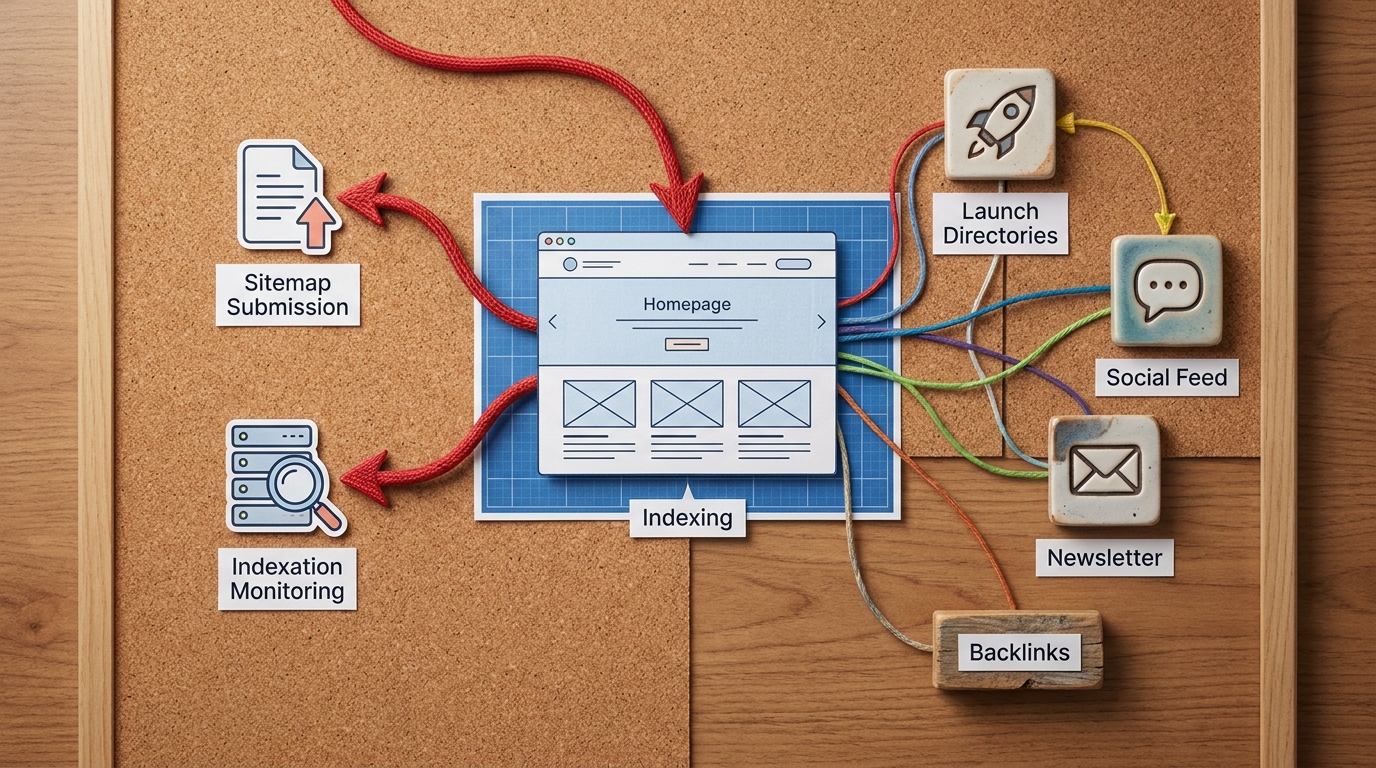
The same discipline applies to authority work. Each new piece of research, customer insight, tool, quote, review, or external mention should strengthen the existing narrative. The point is not to accumulate activities. The point is to make the domain increasingly easy to discover, understand, and trust.
By the end of month four, parity means the domain can be run as an operating asset. It has a clear customer-facing position, a usable set of core pages, a technical monitoring loop, a repeatable authority approach, and more than one way to reach the market. It does not mean the work is complete. It means the work has moved from launch mode into compounding mode.
Where New-Domain Launches Usually Break
The failure modes are predictable. Most are not caused by a lack of effort. They are caused by effort being applied in the wrong order.
Failure Point: Building Before Demand Is Clear
If the team is debating page volume, design details, and launch copy before it can explain the problem-budget fit, the project is too far downstream. Return to exact-phrase demand, competitor presence, and the economic importance of the problem. A beautiful domain cannot rescue a weak reason to exist.
Failure Point: Treating the Domain Name as a Cosmetic Choice
If the name is difficult to pronounce, carries avoidable trademark risk, or creates confusion around an existing .com, fix it before the launch creates more dependencies. Renaming later costs more because it affects every page, mention, conversation, and authority signal already created.
Failure Point: Publishing Content Without a Distribution Role
Every major asset should have a reason to exist: capture a commercial decision, solve a practical task, establish expertise, support a third-party mention, or connect visitors to the next useful page. If an asset does none of those things, it is likely content for content’s sake.
Failure Point: Measuring Only Clicks
AI Overviews change the relationship between visibility and clicks. A company still needs to care about traffic, but it also needs to care about whether it is understood, cited, and present around the problems it wants to own. Authority is an asset precisely because it creates opportunities that do not always show up as a single direct click.
Failure Point: Launching Without an Operating Cadence
A launch without a weekly review becomes a one-time campaign. The team loses the connection between what customers search for, what the site communicates, what search systems index, and what needs to improve. Systems outperform manual effort because the work continues even when launch excitement fades.
The Advanced Move: Turn Every Launch Asset Into Evidence
The better way to think about a new domain is as an evidence engine. The site should not only state what the company believes; it should organize the proof that supports the company’s right to be believed.
That means using shared research across the site, authority assets, and distribution efforts. It means creating useful resources rather than publishing generic commentary. It means making sure a press release, a product page, a free tool, a review, and an expert quote reinforce a common position instead of telling five unrelated stories.
This is the difference between launching a domain and launching a visibility system. The first produces a URL. The second produces a business asset that becomes more discoverable and more credible over time.
TL;DR: The Four-Month New-Domain Plan
- Month one: detect real demand through exact market language, competitor presence, and problem-budget fit; then qualify the name for trademark, pronunciation, and .com risk.
- Month two: research the ICP, market, and content targets; build the core site around commercial clarity, useful problem-solving assets, and evidence.
- Before launch: gate the domain with site readiness, DNS and email authentication, and Google Search Console visibility.
- Month three: launch through a controlled distribution burst that coordinates on-site assets, authority signals, credible mentions, and crawlable materials.
- Month four: compound through a weekly operating rhythm: review organic visibility, improve money pages, address one technical issue, and strengthen internal links.
- The strategic rule: do not treat the domain as a publishing destination. Treat it as owned infrastructure for discovery, authority, and distribution.
Done right, a new domain does not depend on one announcement, one platform, or one lucky ranking. It becomes a system the company owns—and visibility compounds from there.
Leave a Reply