A Four-Month-Old Site Did Not Wait for Permission to Compete
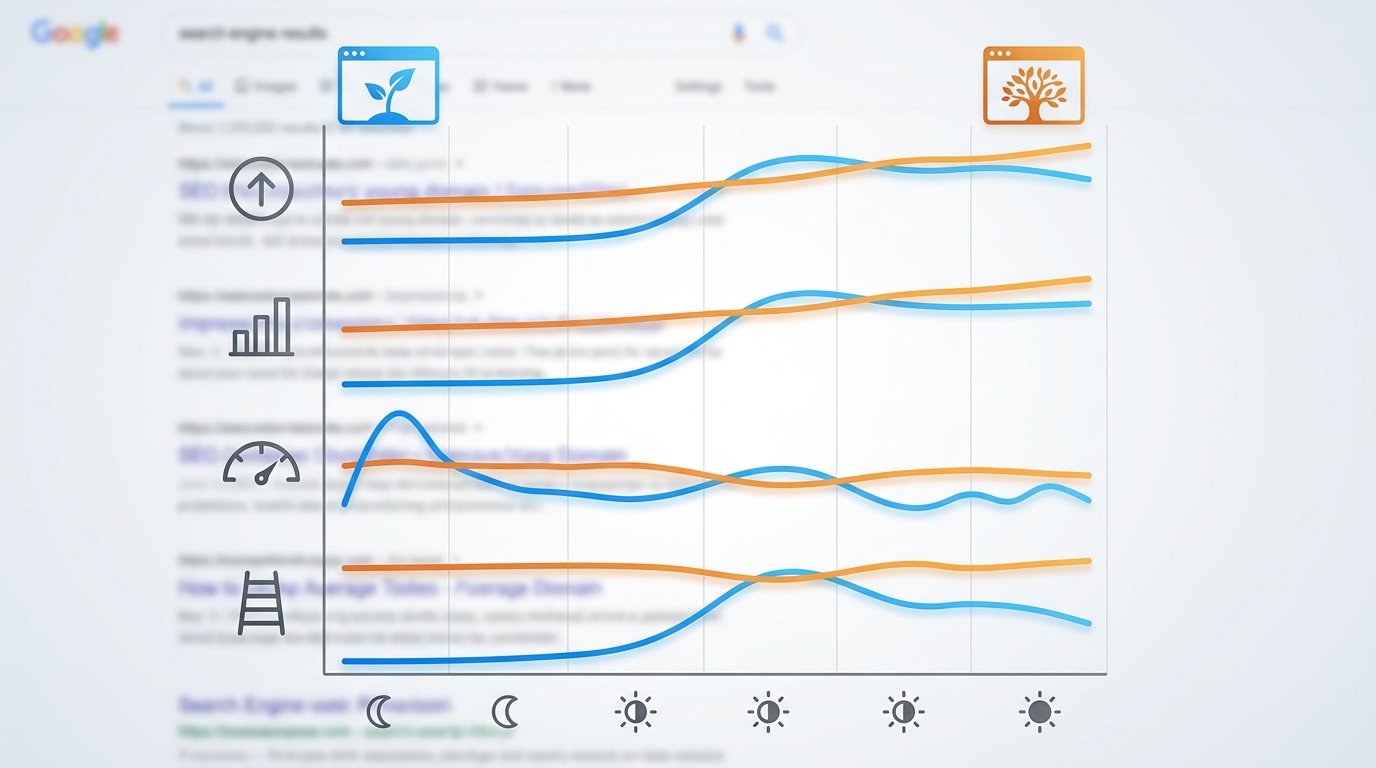
The domain-age excuse is one of the most expensive stories a founder can tell themselves. A site hits an organic traffic ceiling, the pipeline slows, and the explanation arrives almost automatically: competitors have been around longer. They have more history. Google trusts them more. The company then waits, publishes intermittently, and mistakes inactivity for patience. This comparison between two anonymized sites makes that logic difficult to defend. One domain was four months old. The other had existed for 10 years. At the four-month mark, the newer site had matched and slightly exceeded the older one on the metric that matters most to an operating business: clicks from Google.
[INFO_TABLE]
Product/Service: Organic discovery system
Comparison: Two anonymized websites
New domain age: 4 months
Established domain age: 10 years
Source of truth: Google Search Console
Price: Execution cadence, not domain tenure
[/INFO_TABLE]
This is not an argument for treating domain age as irrelevant context. A ten-year-old site can have accumulated brand recognition, links, historic content, direct traffic, and institutional knowledge that a new business has not earned. It is an argument against confusing age with a growth system. A domain that has sat online for a decade without a clear discovery strategy is not automatically more useful than a new property built around demand, relevance, and repeatable publishing decisions.
Google has been unusually direct on this point. Google Search Advocate John Mueller’s answer to whether older domains receive a ranking advantage was simple: “No, domain age helps nothing.” Google does not treat a registration date as a ranking signal. It also evaluates a site’s age from discovery and crawling rather than the date printed in a WHOIS record. Founders buying old domains for perceived SEO authority are often buying a narrative instead of an advantage.
The Google Search Console Snapshot
| Google Search Console metric | 4-month-old domain | 10-year-old domain |
|---|---|---|
| Clicks | 3.56K | 3.35K |
| Impressions | 87.6K | 113K |
| Click-through rate | 4.1% | 3.0% |
| Average position | 8.4 | 9.3 |
The newer site had fewer impressions: 87.6K versus 113K. That matters, because impressions represent the available search surface. The older site was shown more often. But it converted less of that visibility into visits. The four-month-old domain generated 3.56K clicks against 3.35K, with a 4.1% CTR versus 3.0%. It also held a stronger average position, 8.4 compared with 9.3. This is what a better discovery system looks like before it becomes an obvious traffic gap: less total exposure, more effective exposure.
Founders regularly overvalue impressions because they are large, comforting numbers. Impressions tell you that Google is testing, surfacing, or recognizing pages across queries. They do not tell you that the searcher found the result compelling enough to visit. A business does not pay salaries with impressions. It earns the right to build a durable acquisition channel when visibility converts into qualified attention. The newer domain did that more efficiently.
Average position deserves equally careful treatment. It is not a permanent ranking assigned to the whole site, and it is not a promise that every keyword ranks in the same place. It is a blended Search Console measure across the queries and impressions in the reporting period. Still, the direction is clear. The newer site was not merely receiving accidental exposure. It was earning enough relevance across its query set to hold a better aggregate position and attract more clicks.
The Four-Month Operating Sequence That Matters
The data establishes the outcome, not a fictionalized diary of every page, keyword, or backlink behind it. Publishing invented month-by-month traffic totals would add false precision and teach the wrong lesson. The useful month-by-month view is operational: what a company must establish in the first four months if it intends to give Google a coherent, useful, and commercially relevant body of work to surface.
| Month | Operating priority | What the business is building |
|---|---|---|
| Month 1 | Discovery foundation | A clear topic structure, technically accessible pages, and a measurement baseline in Google Search Console. |
| Month 2 | Intent coverage | Useful pages tied to real customer questions, commercial problems, and category language. |
| Month 3 | Internal distribution | Connections between related pages so authority and attention can move through the site. |
| Month 4 | Feedback and refinement | CTR, impressions, position, and query patterns turned into the next publishing and optimization decisions. |
Month one is where many companies sabotage themselves. They launch a polished homepage, a few broad service pages, and perhaps a news announcement, then wait for Google to infer the company’s relevance. Google cannot build a category map from a brand slogan. The first month should establish a crawlable, coherent knowledge base around the problems the business intends to own. That does not mean publishing for the sake of volume. It means deciding which searches the company should be discoverable for and giving each important subject a durable place on the site.
Month two is about intent coverage. Most stalled sites have content, but their content is too generic, too detached from buying decisions, or too repetitive to create meaningful differentiation. A founder should be able to look at every important page and identify its job: capture a demand signal, educate a high-value prospect, support a product decision, establish category authority, or move a visitor to the next relevant page. If the answer is “it is good for SEO,” the page does not have a job. It has a hope.
Month three is where a collection of pages becomes a system. Internal links are often treated as housekeeping. They are more important than that. They tell search engines and visitors how the company’s expertise connects. A strong explanation page should lead naturally to the deeper implementation page. A category page should route attention toward product proof. A product page should not be isolated from the educational material that creates demand for it. This is distribution inside the asset you own, not a pile of disconnected articles competing for attention.
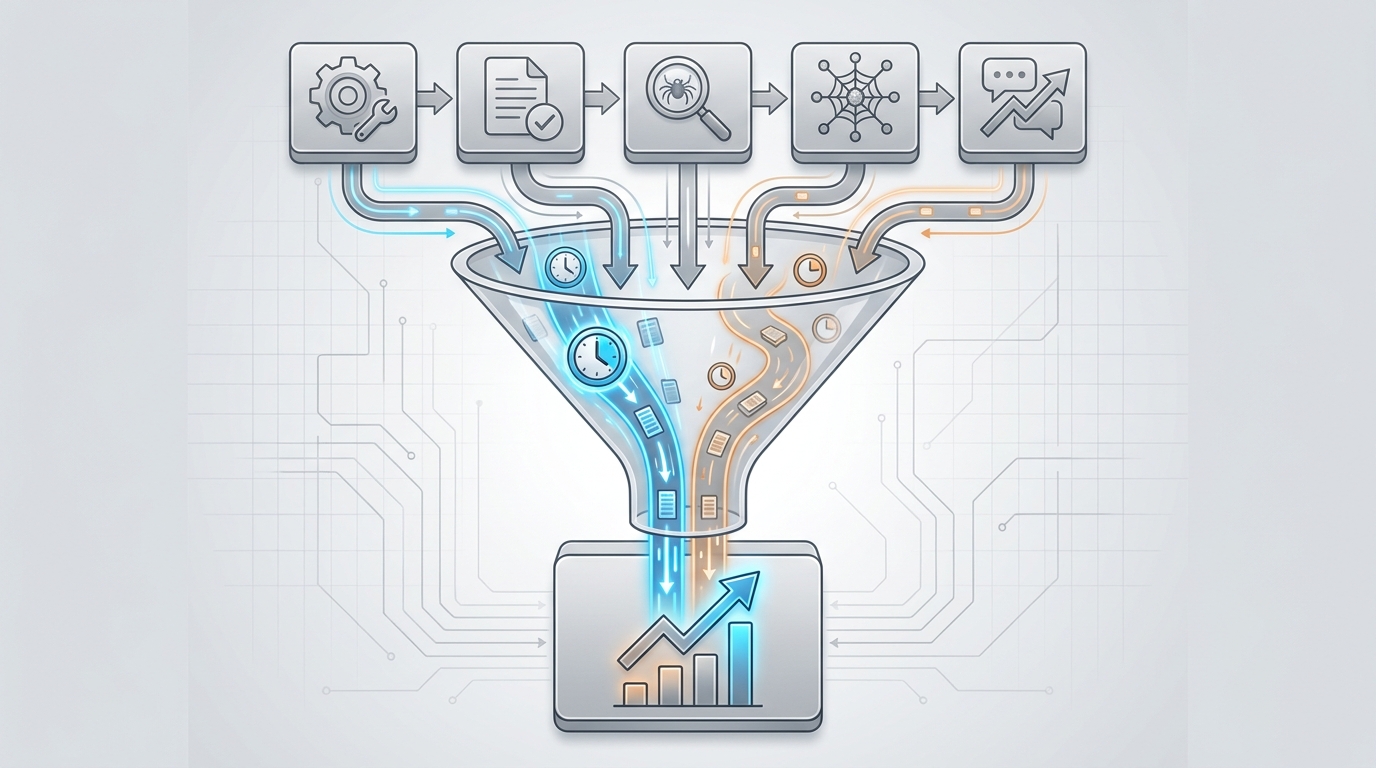
By month four, the company should stop debating abstract SEO theory and start reading its own feedback loop. Google Search Console shows whether pages are being surfaced, whether searchers choose them, and where the gap between visibility and clicks is opening. Ahrefs can help teams map the broader keyword terrain and competing content surface, but Search Console remains the operating record for what Google is actually showing from the business’s own site. The goal is not to celebrate a dashboard. The goal is to choose the next action with less guesswork.
Why the Older Site Did Not Automatically Win
The older site’s 113K impressions show that tenure can create a larger search footprint. But a footprint is not a strategy. If that visibility is spread across weakly aligned queries, poorly differentiated pages, or results that fail to earn the click, the business has reach without leverage. The newer domain’s stronger CTR is the important signal here. It suggests a tighter fit between what searchers wanted and what Google chose to show. Relevance is not a decorative quality. It is the mechanism that turns discovery into traffic.
This is also why content volume alone is a misleading growth metric. Publishing more pages can increase impressions while lowering the strategic quality of the site’s search presence. Teams then celebrate visibility, even as click-through rates flatten and commercial pages remain invisible. The company has built output, not distribution. The better question is whether every new page strengthens a topic, earns a specific query set, and gives the reader a logical path toward the next useful action.
Do Not Replace the Domain-Age Myth With a New-Domain Myth
The four-month result does not mean every new domain will outrank every established competitor. It does not mean founders should abandon proven brands, ignore authority, or expect Google to reward a new site simply for moving quickly. It means that age is not the deciding system variable many operators pretend it is. New sites still need a clear proposition, a technically sound foundation, useful content, internal distribution, and disciplined measurement. What they do not need is permission from the calendar.
That distinction matters because it changes the budget conversation. A business with a traffic ceiling can spend months pursuing cosmetic SEO work, buying an old domain, or commissioning broad content that nobody is accountable for distributing. Or it can build an operating cadence: identify search demand, publish the best available answer for a defined commercial problem, connect it to the wider site, measure the response, and improve the next decision. One approach purchases activity. The other compounds visibility.

Search Is One Discovery Layer, Not the Entire Growth System
Google Search remains a critical discovery channel, including traditional results, AI Overviews, and AI Mode. But founders should not build a company whose entire visibility depends on one surface. ChatGPT, Gemini, Perplexity, YouTube, Google Search, and direct audience channels all shape how buyers encounter and evaluate a brand. A self-promotional page may secure an AI citation, particularly for a new brand that closely fits a prompt, without earning a durable recommendation or reliable traffic. Citation visibility is useful evidence of discoverability. It is not a substitute for an owned audience or a measured acquisition path.
This is where audience ownership matters. Every search visit should have a next step that reduces future dependence on the algorithm: an email subscription, a product trial, a useful resource, a direct relationship, or a return path to the brand. Organic search can create the first encounter. The company’s own system must create the second and third. Single-channel growth is fragile, even when the channel is working. Search visibility compounds best when it feeds assets the business controls.
✓ PROS
+
Proves domain age is not a ranking moat
+
Prioritizes clicks and CTR over vanity impressions
+
Creates a measurable four-month discovery cadence
✗ CONS
–
Does not guarantee outcomes for every new domain
–
Requires consistent publishing and measurement discipline
–
Search alone cannot replace an owned audience
The Operator Verdict
9/10
VERDICT
Build on execution cadence, search intent, and audience ownership-not the belief that an older domain deserves to win.
The most useful takeaway from this head-to-head is not that a young site beat an old one. It is that the older site was beatable at all. A four-month-old domain produced 3.56K clicks against 3.35K because Google rewarded the quality of the current search experience, not the age printed on a domain record. For founders stuck at a traffic ceiling, that should be clarifying. The constraint is rarely that the domain has not existed long enough. The constraint is that discovery is not yet being run as a business function with a system behind it.
Leave a Reply