Category: Distribution Systems

  • Instagram Is Not Your Growth Engine. It’s Your Biggest Distribution Risk

    Instagram Is Not Your Growth Engine. It’s Your Biggest Distribution Risk

    We have sat in too many planning meetings where the room keeps circling back to one question: what worked on Reels last week? Not what the customer needed to understand. Not what moved qualified demand. Not what asset the company built that will still matter six months from now. Just what the platform rewarded most recently.

    That is the moment the Instagram dependency trap becomes visible. A brand starts by using Instagram for discovery. Then Instagram becomes the content brief, the reporting layer, the emotional barometer, and eventually the operating system. Once that happens, a reach dip is no longer a channel issue. It becomes a business scare.

    Instagram is a useful channel, but a terrible operating system

    Our view is simple: the problem is not Instagram itself. The problem is building your company’s visibility, content production, and internal decision-making around a rented feed. That is a fragile way to grow. It confuses visibility with resilience, engagement with demand, and platform success with business health.

    We are not anti-Instagram. We are anti-fragility. Instagram can be excellent for discovery, cultural relevance, and social proof. But the minute your brand treats it as the center of gravity, you stop building a distribution system and start servicing someone else’s incentives.

    Key takeaways

    • Single-channel growth is fragile. The more your pipeline depends on Instagram staying generous, the more exposed the business becomes to algorithmic volatility.
    • Platform-native metrics create false confidence. Views, reach, saves, and shares feel like progress even when they do not translate into durable demand or revenue.
    • Content gravity distorts strategy. Once one Instagram format performs, teams start forcing every idea through the same template, even when other channels need different creative.
    • The goal is not to leave Instagram. The goal is to make Instagram replaceable by transferring attention into assets you own.

    Why smart teams fall into the trap

    The trap rarely begins with bad judgment. It usually begins with success. A format hits. Reels performance jumps. The team gets immediate feedback. Reporting looks healthy. Leadership sees movement. Then the channel that was supposed to support growth quietly becomes the thing that defines it.

    Across the businesses we have observed, the pattern is consistent: Instagram does not become dominant because someone formally decided it should run the strategy. It becomes dominant because it is the easiest channel to feel. The feedback loop is fast, visible, and emotionally rewarding. Revenue is slower. Brand lift is harder to isolate. Owned audience growth is less glamorous. So the team optimizes for the dashboard that reacts in real time.

    There is a useful analogy in research on compulsive Instagram use at the individual level. The practical lesson is not about diagnosis. It is about behavior. Repetition, affirmation, and perceived necessity can keep people using something even when the consequences worsen. In marketing, the organizational version sounds like this: “we have to post,” “we have to stay visible,” and “our numbers only count if they move on Instagram.” Perceived necessity becomes strategy.

    Metric reinforcement makes bad strategy feel good

    Reels views, reach, saves, and shares are immediate. They provide constant reinforcement. Teams naturally start optimizing for platform-native success, even when the commercial translation is weak or unclear. This is how a brand can look busy, visible, and highly engaged while its downstream economics stay fuzzy.

    That is why this trap is so dangerous at the operator level. If a channel is sending more than 40% of top-of-funnel traffic, but nobody can clearly explain that traffic’s conversion quality by cohort, the business does not have strength. It has opacity. The dashboard says one thing, but the system underneath remains underbuilt.

    Metric reinforcement makes bad strategy feel good

    Content gravity turns one winning format into company policy

    Once a brand finds a format that performs on Instagram, that format starts pulling everything toward it. Production gets built around it. Creative briefs assume it. Editorial planning serves it. Soon the question is no longer “what does the customer need to know?” It becomes “how do we make this work as a Reel?”

    This is one of the clearest signs that content has stopped serving distribution strategy and started serving platform incentives. Other channels often need different creative. Search needs durable explanations. Email needs directness and conversion intent. Higher-consideration channels need depth and credibility. When Instagram’s production logic becomes the default for all of them, the company flattens its message to fit the feed.

    Attention dependency replaces planning with constant motion

    The third loop is cultural. Brands begin to interpret silence as failure. Every drop in reach triggers immediate production changes. Every quiet period feels risky. The team starts reacting instead of planning. The result is an always-on content machine that produces activity without architecture.

    This is the operational version of dependency: not just overuse, but an inability to disengage long enough to build something more durable. Discovery is a business function. It cannot be reduced to feeding one platform at a higher frequency.

    The real cost is not lower reach. It is lower resilience.

    Most companies misunderstand the cost of over-dependence. They think the danger is losing impressions. That is not the real problem. The real problem is that one channel starts controlling too much of the business’s discovery, creative logic, and reporting confidence at the same time.

    • You lose pricing power over distribution. When your audience mostly lives inside Instagram’s feed and recommendation systems, the platform decides how much of your own audience you can reach for free.
    • You create fragile attribution. Instagram often assists discovery, but it rarely explains the full commercial outcome cleanly on its own. If in-app engagement becomes the main proof of success, teams overestimate what the channel is actually doing.
    • You distort creative strategy. The safest way to win the feed is to make content that is instantly legible, highly visual, short-form, and algorithm-friendly. That can improve platform performance while weakening brand distinctiveness.
    • You burn out the operating model. Constant posting pressure creates reactive workflows, creative fatigue, and a culture where the team feels behind whenever it is not publishing.
    • You make your audience less portable. If followers are loyal to the format rather than the brand, the community value stays trapped inside the app instead of becoming email subscribers, repeat visitors, customers, or advocates elsewhere.

    This is why audience ownership matters so much. Visibility compounds only when it gets transferred into something the company can reach again without asking the platform for permission. Otherwise, attention evaporates as quickly as it arrives.

    Most brands confuse visibility with resilience

    Instagram is very good at visibility. For visually expressive categories, creator-led brands, and fast-moving campaign cycles, it can outperform almost any other discovery surface. But visibility is not the same thing as resilience. Resilience comes from a distribution architecture that can survive a platform change.

    That distinction matters because a lot of brands are not actually measuring whether Instagram is building a stronger company. They are measuring whether Instagram is staying exciting.

    Signs your brand is already in the trap

    • Instagram drives more than 40% of top-of-funnel traffic, but the team cannot explain that traffic’s conversion quality by cohort.
    • The content calendar starts with “what works on Reels” instead of “what does the customer need to know?”
    • A drop in reach triggers immediate production changes, but nobody examines whether the content mix itself is strategically healthy.
    • Engagement growth gets celebrated without portability metrics like email signups, repeat site visits, or CRM capture.
    • The best-performing content is platform-perfect but brand-weak, meaning it performs in the feed but does little to build a durable message architecture.
    • The team talks about “the algorithm” as if it were the market, rather than one distribution mechanism among many.

    If even a few of these are true, the issue is not content quality. The issue is company design. The brand has outsourced too much of its discovery function to one platform.

    The strongest counterargument still misses the point

    The strongest defense of heavy Instagram dependence is easy to understand: attention is there, discovery is there, creators are there, and for many categories the platform still moves product. All of that is true. Instagram still wins when the job is product discovery, creator-led trust building, fast campaign iteration, lifestyle positioning, and lightweight social proof.

    But that is an argument for using Instagram aggressively, not for letting it govern the business. Discovery matters too much to be treated as an app feature. A company that can only stay visible while one feed stays favorable does not have a durable growth engine. It has rented momentum.

    Treat Instagram as an input, not the system

    The healthier model is straightforward: Instagram can start attention, but it should not be where the strategy ends. Distribution beats content when the system is built properly. A single post is not the asset. The asset is the chain of movement that post creates.

    • Instagram seeds attention and social proof.
    • Email captures demand and creates direct reach.
    • Search and a content hub capture intent and preserve intellectual property in a durable form.
    • LinkedIn or YouTube support higher-consideration explanation and credibility.
    • Community and CRM create repeat touchpoints that do not depend on feed visibility.
    • Sales enablement turns attention into revenue-bearing conversations.

    This is where authority becomes an asset instead of a vibe. Explainers, case studies, tutorials, comparison pages, and opinion pieces do not just fill a content calendar. They create durable message architecture the company can reuse across search, email, sales, and retention. Instagram is often the spark. It should not be the warehouse.

    The measurement model has to change as well. Stop treating follower growth as the main signal. Track transfer metrics instead: email signups per post, qualified site visits per reach, assisted conversions from Instagram-sourced sessions, branded search lift after campaigns, and follower growth relative to owned-audience growth. If Instagram is growing but owned audience is not, the brand is buying attention without building asset value.

    Every serious team also needs a failover plan. No single node should be able to disable the whole machine. If Instagram underperforms for 30 days, the company should already know how to shift topics into email, redistribute creator assets into other channels, retarget engaged users through owned lists, and keep campaign momentum alive without relying on feed reach.

    A practical 90-day escape plan

    Days 1-30: Diagnose the dependency

    • Measure how much traffic, leads, and revenue Instagram actually contributes.
    • Identify the top posts by saves, shares, and downstream actions, not just reach.
    • Audit how much of your current social output can be reused outside the platform.
    • Separate performance vanity from commercial value in reporting.

    Days 31-60: Reallocate effort toward owned assets

    • Move one major content theme into a durable format on your site or in email.
    • Create an opt-in path from every high-performing Instagram asset.
    • Remove at least one low-value recurring format that exists only to keep the feed busy.
    • Rewrite creative briefs so every strong social idea also creates something reusable elsewhere.

    Days 61-90: Diversify discovery

    • Launch or strengthen one additional discovery channel.
    • Build a consistent owned-audience publishing cadence.
    • Establish transfer metrics as part of weekly reporting.
    • Define what happens operationally if Instagram reach drops sharply for a month.

    None of this requires abandoning Instagram. It requires demoting it from operating system to channel. That is a healthy move for any business that wants growth to compound instead of swing.

    What this means for operators

    If your team is trapped, the answer is not more content. It is better distribution design. The companies that win over time are not the ones that get the most platform-native applause. They are the ones that turn attention into owned audience, reusable authority, and a system that survives volatility.

    That is the real strategic mistake behind the Instagram dependency trap. Brands keep acting as if the most visible channel is the most valuable one. Usually it is not. The most valuable channel is the one that compounds, converts, and remains reachable when the algorithm changes its mind.

    TL;DR

    Instagram is excellent for discovery and terrible as a company’s center of gravity. When your content calendar, success metrics, and emotional confidence all start with the feed, you do not have a marketing system. You have dependency. Use Instagram aggressively, but build for transfer: into email, search, site content, CRM, and sales. The winning move is not to beat Instagram. It is to make Instagram replaceable.

  • Most Content Dies on Publication Because Teams Mistake Publishing for Distribution

    Most Content Dies on Publication Because Teams Mistake Publishing for Distribution

    We care about this topic because we keep seeing the same expensive mistake in otherwise smart companies: the team spends weeks creating something useful, hits publish, posts it once or twice, and then quietly moves on as if the job is complete. A month later, the asset is flat, nobody can explain why it underperformed, and the conclusion is usually wrong. The content gets blamed. The system almost never does.

    Across the businesses we have studied and worked with, that diagnosis is backwards more often than operators want to admit. Most content does not die because it was too weak to deserve attention. It dies because publication was treated as the finish line instead of the handoff to distribution. The article existed. The operating system around it did not.

    The marketing problem is not creation. It is distribution.

    That is the real argument here. Publishing is not distribution. Creation gives you an asset. Publication makes it public. Distribution is the system that keeps the asset visible, discoverable, reusable, and commercially relevant after day one. When companies confuse those three things, most content has a lifespan of 24 to 72 hours, and then everyone acts surprised that authority is not compounding.

    • Most content underperforms because the post-publication system is missing, not because the initial asset was worthless.
    • Distribution is an always-on function, not a launch-day burst. It includes reuse, channel fit, internal linking, email, paid support, refreshes, and ownership after publish.
    • Content only compounds when it can be found, adapted, and resurfaced. If there is no reuse path or retrieval system, the asset is already decaying.
    • Operators should reduce creation volume and increase distribution depth. Systems outperform manual effort, and visibility compounds only when the business treats discovery as a function.

    Why this keeps happening inside content teams

    The reason this problem is so persistent is simple: most organizations are structured to celebrate production, not distribution. There is a brief, a draft, a review cycle, a publish date, and a visible moment when the work is “done.” Distribution is messier. It requires cross-functional ownership, multiple channels, follow-through, repackaging, measurement, and decisions that happen after the applause moment has passed.

    That bias shapes the whole operating model. Teams get staffed to create. Calendars get built around output. Success gets narrated around volume. Then leadership wonders why the business has a lot of content but not much visibility. The answer is usually sitting in plain sight: the company built a production machine and mistook it for a growth machine.

    We would frame the distinction this way:

    • Creation is the asset.
    • Publication is the handoff.
    • Distribution is the operating system.

    Once that becomes the mental model, a lot of content performance suddenly makes more sense. A useful article with no second-wave distribution, no search plan, no internal linking, no repurposing, and no refresh trigger is not an underperforming asset. It is an unfinished one.

    What “dies on publication” actually looks like in practice

    This phrase can sound dramatic until you look at how content operations actually fail. In real companies, content dies on publication when one or more of the following are true:

    • No channel fit: the piece was written for “everyone,” so it truly fits no channel’s format, cadence, or audience expectation.
    • No reuse path: the article cannot become a short-form post, a newsletter section, a webinar talking point, a landing-page module, or a sales-enablement asset.
    • No retrieval system: the business cannot find its own best work later, so teams keep recreating the same ideas from scratch.
    • No refresh loop: the asset stays live after it becomes stale, which slowly erodes trust, relevance, and click-through performance.
    • No audience segmentation: one generic version gets pushed to every buyer, regardless of stage, pain point, or intent.
    • No attribution model: nobody can tell which distribution motions actually drove consumption, return visits, or pipeline influence.

    None of those are creative failures. They are systems failures. That distinction matters because creative problems invite endless subjective debate. Systems problems can be fixed.

    Distribution is the operating system, not the promotion line item

    One of the laziest ideas in content marketing is that distribution is just “promotion” after the real work is done. That framing is exactly why so much content goes nowhere. Distribution is not a final checklist item. It is the structure that determines whether the asset earns attention once, or keeps earning attention over time.

    The strongest content organizations do not merely publish more. They route each asset through a network with multiple jobs to do:

    Visual metaphor for how content loses relevance after publication.
    Visual metaphor for how content loses relevance after publication.
    • Acquisition: search, social, email, partnerships, creators, community, and paid support.
    • Conversion: landing pages, lead magnets, product calls to action, and sales pathways.
    • Retention: newsletters, customer education, member content, and lifecycle flows.
    • Reactivation: reposts, updates, new angles, seasonal hooks, and repackaging.
    • Archival: internal search, topic clusters, content libraries, and old-post refreshes.

    This is why so much content appears to “fail” on day one. Teams only build the acquisition function. They ignore the other four, so the content has no way to deepen, resurface, or compound. Visibility compounds only when the system is designed to keep an asset moving long after the publish notification disappears.

    Design the asset for distribution before anyone writes it

    One of the most practical ways to stop content from dying is to reverse the order of operations. Instead of writing first and asking how to distribute it later, the team should define the reuse path before the draft begins. We would not approve an important asset without that plan.

    A durable asset usually has a modular structure that makes reuse obvious:

    • Core claim: one sentence that captures the argument.
    • Supporting proof: one data point, one example, and one objection it can answer.
    • Visual hook: one chart, quote, screenshot, or comparison the team can lift into other formats.
    • Derivative formats: a post, carousel, newsletter section, script, slide, FAQ answer, and sales snippet.

    If an article cannot be broken into at least several downstream assets, it is too brittle for modern distribution. The problem is not that every piece must become everything. The problem is that too many pieces are born with no second life at all.

    Build a release arc, not a publish date

    Most teams have a publish date. Far fewer have a release arc. That difference is not semantic. It determines whether the business is launching an asset or merely posting one.

    A practical post-publication sequence can look like this:

    • Day 0: primary publication on the owned channel.
    • Day 1: email to the core list with a specific angle.
    • Day 2: founder or operator post built around the most contrarian insight.
    • Day 4: a narrower short-form breakdown for a more specific audience segment.
    • Day 7: internal sharing for sales or customer-success enablement.
    • Day 14: a second public post with a different hook, chart, or framing.
    • Day 30: refresh, repackage, or retire based on what the performance data says.

    This is where a lot of teams leave value on the table. Content rarely gets enough second and third exposures to prove whether it had real potential. One weak launch window becomes the final verdict, even though the business never really distributed the asset in the first place.

    Map content to intent, not just to topic

    Another reason content dies early is that it gets planned around a topic alone. Topic matters, but intent is what determines discoverability and usefulness. A single idea can serve multiple kinds of demand:
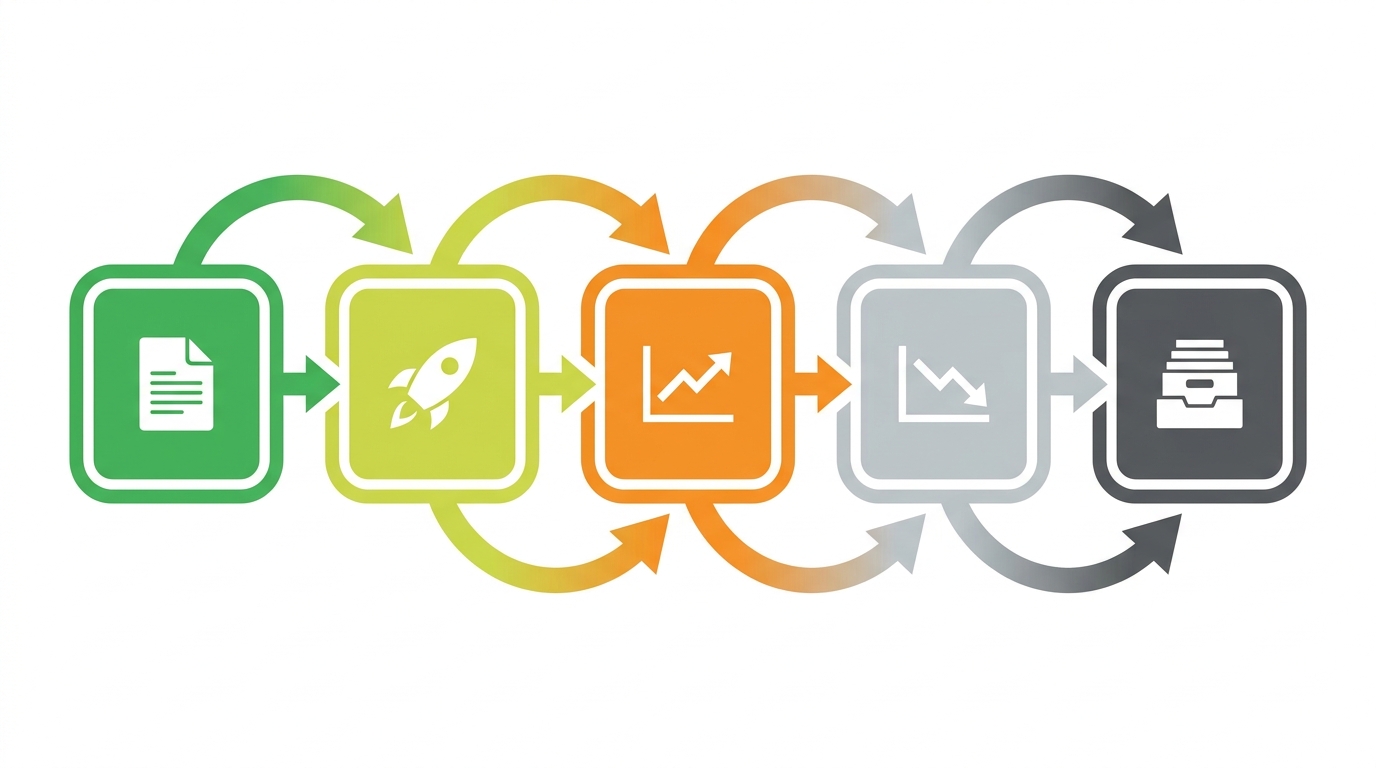
    Clear lifecycle diagram of content decay.
    Clear lifecycle diagram of content decay.
    • Informational: what the idea means.
    • Comparative: why one approach beats another.
    • Operational: how to implement it.
    • Diagnostic: how to tell whether the problem exists.
    • Commercial: how to choose or buy a solution.

    When a company only answers one of those intents, the asset has a very narrow entry point. When it is built to serve several, it can travel across more channels and support more stages of the buyer journey. Discovery is a business function, and intent mapping is one of the disciplines that keeps discovery from becoming accidental.

    Every evergreen asset needs an expiry date

    There is another mistake we see all the time: teams understand that content should last, but they mistake longevity for permanence. Those are not the same thing. Durable content still needs stewardship.

    A sensible refresh policy can be brutally simple:

    • High-impact evergreen: review and refresh every 90 to 180 days.
    • Trend-sensitive content: review every 30 to 60 days.
    • Event-based content: archive or redirect when the moment has passed.
    • Sales-enablement content: update when product claims, pricing, or positioning changes.

    Without that discipline, the business creates a slow authority leak. Old content remains indexed, still gets occasional traffic, and gradually becomes less credible. That does more damage than most teams realize. Authority is an asset, and stale content quietly devalues it.

    Measure the afterlife, not just the spike

    The teams that misread content performance usually have one thing in common: they measure publication, not distribution. They look at views, maybe clicks, maybe a social spike, and then decide whether a piece “worked.” That is a terrible way to evaluate a system meant to compound.

    The more useful measures tend to happen after the initial click:

    • First-24-hour traffic velocity
    • 7-day engagement depth
    • Return visits
    • Scroll completion
    • Email click-through
    • Social saves and shares
    • Search impressions over time
    • Assisted conversions
    • Content-assisted pipeline

    If you only measure spikes, you will overvalue novelty and undervalue compounding assets. That is one of the biggest reasons leadership teams lose faith in content. They are often staring at the wrong scoreboard.

    The strongest counterargument is real, but it is still incomplete

    The obvious pushback is that some content really is weak. That is true. Distribution cannot rescue an irrelevant idea, a confused argument, or a piece that says nothing worth remembering. We are not arguing that every underperforming asset deserved more life.

    But across the programs we have observed, the more common failure is misdiagnosis. Teams assume the idea was bad when the real problem was simpler and more fixable:

    Show expert/analyst perspective on content longevity.
    Show expert/analyst perspective on content longevity.
    • the headline did not match the audience’s language,
    • the content was published on the wrong owned channel,
    • distribution stopped after the first post,
    • the call to action was too weak or too generic,
    • or the asset was never refreshed to match current search demand.

    That is why “make better content” is often bad advice. It sounds strategic, but it usually distracts from the operational fix the business actually needs. A better distribution stack beats a higher volume content calendar almost every time.

    What we would change in most 2024-2025 content programs

    The distribution environment is too crowded for publish-once behavior to keep working. The companies that will build durable visibility are the ones that treat each asset like something with an afterlife, not a one-day event. If we were tightening a content program around that belief, we would insist on a simple checklist before any important asset goes live:

    • Write the core claim in one sentence.
    • Define three audience segments the asset serves.
    • Prebuild five derivative formats before launch.
    • Assign a second-wave publish date.
    • Add internal links to related assets.
    • Include a conversion path for different intent levels.
    • Set a refresh trigger based on time or performance.
    • Decide who owns the asset after week one.

    If a team cannot answer those items, the content is not really ready for scale. It may be ready to publish. That is not the same thing.

    A better operating model: create, launch, amplify, adapt, refresh, archive, resurrect

    One useful way to stop this problem at the organizational level is to give content a clear lifecycle instead of a single deadline. The stages are not complicated:

    • Create
    • Launch
    • Amplify
    • Adapt
    • Refresh
    • Archive
    • Resurrect

    Then assign ownership by stage rather than pretending one person can carry the full afterlife alone:

    • Creator: defines the core idea.
    • Editor: improves clarity and modularity.
    • Distribution lead: maps channels and cadence.
    • SEO lead: handles discoverability and internal linking.
    • Lifecycle lead: reuses the asset in email and nurture.
    • Sales enablement lead: turns it into frontline talking points.
    • Analyst: measures performance after publication.

    When one person owns the whole lifecycle, content tends to die after launch. When multiple functions each own a stage, the content has a chance to compound. This is one of the clearest examples of systems outperforming manual effort in modern marketing.

    TL;DR

    Most content dies on publication because companies still behave as if publishing is the job. It is not. Publication is a handoff. Distribution is the job. The businesses that win do not just create assets; they build systems that keep those assets visible, discoverable, reusable, and commercially useful over time. That is how visibility compounds. That is how authority becomes an asset. And that is why the real content problem is almost never “we need more.” It is “we need a distribution engine worthy of what we already know.”


  • Visibility Is Replacing Advertising, and Most Companies Are Still Buying the Wrong Thing

    Visibility Is Replacing Advertising, and Most Companies Are Still Buying the Wrong Thing

    We care about this shift because we keep watching companies spend harder on advertising while becoming easier to ignore. They buy impressions, launch campaigns, report reach, and still struggle to stay present in the market’s mind. At the same time, quieter operators keep showing up in organic search, AI-generated answers, short-form clips, niche communities, podcasts, creator reposts, review surfaces, and the owned channels they control. That difference is no longer a marketing style choice. It is a structural advantage.

    That is why our view is blunt: visibility is replacing advertising as the primary engine of discovery. Not because advertising has stopped working, but because buyers increasingly find, validate, and remember brands through distribution systems that sit upstream of the ad. If your company is easy to encounter in the places where people form beliefs, the sale starts to feel inevitable. If your company only appears when you pay to interrupt someone, every quarter begins from zero.

    Visibility is replacing advertising because discovery now happens before the ad

    The strongest version of this argument is not “ads are dead.” That is lazy. The real shift is more important than that. Advertising is no longer the main way many categories are discovered and evaluated. Search visibility, AI summaries, social feeds, community conversations, creator recommendations, review environments, and authority signals now do a huge amount of the work that ads used to dominate.

    Advertising still matters. What changed is its role. In the strongest companies, paid media is increasingly an accelerant inside a visibility system, not the system itself. That distinction changes budget allocation, operating cadence, and how leadership should think about marketing as a business function.

    Key takeaways

    • Advertising buys access, but visibility builds preference. A paid impression can create awareness, but repeated discovery across trusted surfaces builds memory and trust.
    • Visibility is a distribution problem before it is a content problem. Publishing more does not help if the market never encounters a coherent idea in the right places.
    • Single-channel growth is fragile. Brands that depend on one paid platform are exposed; brands visible across search, social, community, authority, and owned channels are more resilient.
    • Owned audience matters more than ever. If all discovery happens on rented platforms, you do not own demand. You are leasing access to it.

    The expensive mistake is confusing marketing activity with market visibility

    One of the most common operator mistakes is treating visibility like a content calendar issue. The team posts more, repurposes more, launches more, and mistakes output for presence. That creates motion, but not always discovery. In many companies, more activity actually reduces visibility because it produces noise instead of a clear pattern the market can remember.

    Visibility is not the same thing as being busy. It is not even the same thing as reach. A brand can generate plenty of impressions and still fail the basic market test: the right audience does not understand who the company is for, what it does, and why it is credible. When that happens, the business has exposure without recall, activity without leverage, and spend without durable return.

    Across the businesses we study, the better operators understand a simple truth: visibility is what makes future marketing cheaper. When your company keeps appearing in the environments where buyers search, learn, compare, and ask peers for validation, every later conversion mechanism works better. Paid media performs better. Referrals travel further. Branded search increases. Sales conversations begin with more context. Authority compounds.

    This is why visibility deserves to be treated as a business system, not a brand vanity metric. Discovery is not a side effect of marketing anymore. Discovery is a business function.

    Advertising has not disappeared. It has been demoted.

    There is still a place for paid media. The mistake is treating paid media like the whole operating system. When advertising is the only place people ever see your company, you are paying to restart the relationship every time. The brand has no memory outside the campaign window. No accumulated trust. No ongoing discoverability. No surface area.

    Advertising has not disappeared. It has been demoted.

    The better model is straightforward: use advertising to seed, reinforce, and accelerate messages that are already gaining traction through broader visibility. If organic search is surfacing your thinking, if social content is getting reposted, if communities are discussing your category, if authority placements are increasing credibility, and if your owned audience is growing, paid media has something real to amplify. Without that foundation, paid is often just subsidized forgetting.

    That is the strategic demotion. Ads still help. They just no longer deserve to sit at the center of the plan.

    Visibility is a distribution system, not a content strategy

    This is the part most teams still get wrong. They think the answer is to make more content. It usually is not. Visibility is created when a coherent idea is distributed repeatedly across the places where buyers already pay attention. Content is one input. Distribution is the mechanism.

    A real visibility system defines four things very clearly:

    • Where the market will encounter the brand
    • Why the market will notice it there
    • Why the context will make the message believable
    • Why the audience will remember it later

    If those four conditions are not designed on purpose, the company does not have a visibility strategy. It has an output strategy. Those are not the same thing. One compounds. The other burns effort.

    That is also why we keep saying distribution beats content. Ten disconnected assets rarely outperform one strong point of view distributed coherently across the buyer journey. One idea carried through search, short-form video, community participation, authority placements, email, and paid reinforcement will usually beat a pile of unrelated posts built to satisfy a publishing target.

    The market remembers patterns, not production volume.

    The new visibility stack is bigger than most teams admit

    Modern discovery is multi-surface by default. Buyers rarely move in a straight line from first impression to purchase. They encounter a brand, forget it, see it again, hear it from someone else, search for it, read around it, and only then start to form a stable opinion. That means visibility has to be engineered in layers.

    For most companies, the visibility stack now includes at least these surfaces:

    • Search visibility: organic search, AI summaries, and answer engines
    • Social visibility: short-form video, creator reposts, and shareable posts
    • Community visibility: niche groups, forums, Slack and Discord environments, and Reddit-like spaces
    • Authority visibility: podcasts, guest posts, expert commentary, PR, and conference appearances
    • Product visibility: marketplaces, app stores, review sites, and directories
    • Owned visibility: newsletter, blog, SMS, and customer education
    • Paid amplification: search ads, social ads, retargeting, and sponsorships

    The important point is not that every company needs every channel. The point is that buyers are already forming beliefs across several of them whether your team is participating or not. Visibility is about being present where belief formation happens.

    The latest development making this shift even more obvious is AI-mediated discovery. When search becomes an answer layer instead of a list of links, being visible is no longer only about ranking a page. It is about being included in the broader web of mentions, references, citations, reviews, and discussions that these systems pull from. That increases the value of authority, community presence, and consistent narrative even more. Visibility is not just about being published. It is about being present in the market’s trusted source graph.

    Layered visibility beats isolated campaigns

    The most durable discovery advantage is layered visibility. A buyer sees a short-form clip, later notices the company in search, hears a podcast mention, finds a community thread, gets retargeted with a familiar message, and then subscribes to the newsletter or books the call. No single touchpoint does all the work. The layers reduce uncertainty until action feels reasonable.

    That layered model matters because it reveals why campaign-only thinking underperforms. Campaigns are temporary by design. Visibility systems are cumulative by design. Campaigns produce bursts. Visibility produces inevitability. Strong businesses still run campaigns, but the campaigns sit on top of a system that keeps distributing the same core narrative through multiple surfaces over time.

    This is also where authority becomes an asset rather than a branding nice-to-have. A company that is repeatedly cited, invited, mentioned, quoted, and discussed becomes easier to trust everywhere else. Authority lowers friction across the rest of the funnel. It makes search stronger, social more believable, and conversion cheaper. That is not public relations theater. It is infrastructure for discovery.

    What to stop doing if you want visibility that compounds

    • Stop publishing disconnected content. If each post, ad, email, and appearance tells a different story, the market cannot build a stable memory of your brand.
    • Stop treating trends like strategy. Chasing platform behavior without a clear audience problem to solve creates motion and very little leverage.
    • Stop measuring output instead of market effect. Volume is not the goal. Repeat exposure, branded search, assisted demand, and trust signals matter more.
    • Stop separating paid and organic messaging. If your ads say one thing and the rest of your presence says another, you are paying to confuse people.
    • Stop relying on one channel. Single-channel growth always looks efficient until it breaks.

    The deeper issue behind all of this is message entropy. Many brands are saying too many things in too many places with too little consistency. Visibility improves when a company says fewer things, more clearly, across more of the right surfaces.

    What we would build instead

    If the goal is to replace ad dependency with a visibility system, the operating sequence is not complicated. It is disciplined.

    1. Define the audience and the belief that needs to change.
    2. Map the few surfaces where that audience actually discovers and validates options.
    3. Build one core narrative with a sharp point of view, not ten vague angles.
    4. Adapt that narrative into native formats for search, social, community, authority, and owned channels.
    5. Use paid media only where it reinforces a message already proving relevant.
    6. Measure repeated exposure, branded search, assisted conversion, and share of conversation.
    7. Audit recent assets regularly and cut anything that adds noise instead of memory.

    Notice what is missing from that list: “post more.” More output is sometimes necessary, but it is never the strategy. The strategy is repeated, credible discovery in the places that shape demand.

    And this is where audience ownership matters. If every meaningful encounter depends on a rented platform, the company is still fragile. Owned media – especially newsletter, customer education, direct audience channels, and the content infrastructure that compounds in search – turns visibility from borrowed exposure into an asset the business actually controls.

    What this means for founders and operators

    This shift should change how leadership thinks about growth. Visibility is no longer a creative side project that sits downstream from product and sales. It is upstream of both. If the market cannot repeatedly find you, place you, and trust you, the rest of the commercial engine works harder than it should.

    Operators should also stop treating discovery as something the marketing team figures out after the core business is built. Discovery is part of the business model. A company with weak visibility has weak distribution. A company with strong visibility can turn the same product, team, and spend into more leverage simply because the market encounters it more often in more credible contexts.

    That is the strategic implication behind the phrase visibility is replacing advertising. It does not mean budgets disappear. It means the businesses that win will stop thinking in terms of isolated campaigns and start building systems for being discovered, trusted, and remembered. Visibility compounds. Advertising alone rarely does.

    TL;DR

    Visibility is replacing advertising because discovery now happens across search, AI answers, social feeds, communities, authority surfaces, product ecosystems, and owned channels before a paid message ever gets a chance to work. Advertising still has a role, but it performs best inside a broader distribution system. The companies that keep winning are not simply buying more attention. They are building repeated, credible, multi-surface visibility that the market cannot easily ignore. In practical terms, that means fewer disconnected campaigns, more coherent distribution, stronger owned audience assets, and a leadership team that treats discovery as a business function rather than a marketing afterthought.

  • Content Is the Asset. Discovery Is the Growth System Most Companies Ignore

    Content Is the Asset. Discovery Is the Growth System Most Companies Ignore

    We care about this distinction because we keep seeing operators approve bigger content calendars for what is really a visibility problem. The business is not short on articles, videos, landing pages, case studies, or explainers. It is short on mechanisms that get the right asset in front of the right person at the right time.

    Across the companies we study, this mistake is expensive. Teams produce more because production feels tangible. Discovery gets treated as “promotion” and pushed to the end of the workflow. Then the content underperforms, leadership concludes the market did not care, and another round of asset production begins. The real issue often has nothing to do with whether the content was useful. The issue is that the market barely encountered it.

    Content is the asset. Discovery is the system.

    This is the cleanest operator-grade way to separate the two. Content is what you make. Discovery is how people find, encounter, and move toward it.

    That sounds obvious, but most marketing organizations still blur the line. They speak about content as if publishing alone creates demand, reach, trust, and conversion. It does not. Content creates the object. Discovery creates the encounter. Distribution makes that encounter repeatable at scale.

    In other words, content is the asset. Discovery is the attention-routing layer around the asset. If you run the business, that distinction matters because it changes where you place budget, how you structure teams, what you expect from performance, and how you diagnose failure.

    Key Takeaways

    • Most “content problems” are actually discovery problems: the asset exists, but the market is not reaching it in the right context.
    • Content-led growth and discovery-led growth are different bets. One bets on assets attracting attention over time; the other bets on routing existing demand effectively.
    • Discovery is no longer a single-channel exercise. Search, feeds, recommendation systems, syndication, commerce surfaces, and internal retrieval all matter now.
    • The winning model is not more content. It is a system that designs assets, discovery surfaces, and measurement together.

    Most companies are solving the wrong problem

    When a company says, “Our content is not working,” we do not automatically believe them. We have seen too many cases where the message was strong enough, the insight was useful enough, and the offer was clear enough, but the discovery layer was weak. No search visibility. No feed-native packaging. No syndication. No internal routing. No meaningful next step once attention landed.

    This matters because misdiagnosis creates bad strategy. If you think the problem is content, you hire more writers, shoot more videos, and build a bigger editorial machine. If the real problem is discovery, that extra production only increases the pile of underperforming assets. You are filling a warehouse without building logistics.

    That is the opinionated version of the argument: a library no one can find is not a moat. It is trapped inventory.

    Content-led growth and discovery-led growth are different bets

    One reason this topic gets muddled is that people use “content” to mean every form of modern marketing. That is sloppy thinking.

    Content-led growth and discovery-led growth are different bets

    If your growth model is content-led, you are betting that useful assets will attract, educate, and convert people over time. The underlying belief is that if you publish enough substance, organic attention and trust will accumulate. There is truth in that. Useful content can absolutely compound. Authority is an asset, and visibility compounds when the market repeatedly encounters strong ideas.

    If your growth model is discovery-led, you are making a different bet. You are assuming the market already contains latent demand, partial awareness, adjacent curiosity, or commercial intent. Your job is not merely to publish something valuable and wait. Your job is to surface the right asset to the right person in the right environment at the right moment through search, feeds, recommendations, commerce placements, communities, and routing logic.

    In crowded categories, that second model is often closer to reality. The market is noisy. Attention is fragmented. Most companies are not operating in a vacuum where quality alone wins. They are competing inside algorithmic systems. Discovery is not a nice-to-have layer on top of content. It is part of how demand gets captured in the first place.

    Discovery is not “promotion later”

    This is where many teams still lag. They build the asset first and ask how to distribute it afterward. That sequence feels natural and is usually wrong.

    Discovery should shape the asset before the asset is made. If the piece needs to win in search, the structure, language, and information architecture matter from the start. If it needs to travel in feeds, the hook, framing, and packaging matter from the start. If it needs to work through syndication or community distribution, it needs standalone clarity from the start. If it needs to be found inside an internal library, metadata, tagging, and retrieval logic matter from the start.

    That is why we treat discovery as a business function, not a promotion task. It sits upstream. It informs creative decisions. It determines where an asset can travel, how it will be ranked, what audience it will reach, and whether the business learns anything durable from the result.

    What discovery actually includes

    • Search visibility and query alignment
    • Social feed ranking and recommendation mechanics
    • Content syndication and third-party placements
    • Commerce and product-led surfaces where users browse before they search
    • Community distribution in places where trust already exists
    • Internal retrieval systems such as help centers, knowledge bases, and content libraries
    • Routing users from rented attention into owned destinations

    Once you see discovery this way, another truth becomes clear: single-channel growth is fragile. A company that depends on one search engine, one social platform, or one referral source does not have a content engine. It has channel risk.

    That is one of the biggest shifts shaping 2024 and 2025. Discovery is getting more algorithmic and more fragmented at the same time. The audience might encounter your brand in search, then again in a feed, then again inside a recommendation module, then again on a commerce surface, then finally on an owned page. Discovery is now a sequence of encounters, not a single moment.

    The strongest counterargument still misses the operating reality

    The best version of the opposing view is simple: great content should spread on its own. We understand why that idea remains attractive. Sometimes it is true. Truly differentiated work can earn attention, links, shares, referrals, and repeat visits without heavy intervention.

    But that belief becomes dangerous when teams use it as an excuse to underinvest in distribution systems. Great content can improve conversion, retention, brand trust, and authority once people arrive. It does not guarantee arrival. In most serious categories, the market is too crowded, the platforms are too mediated, and the competition for attention is too intense to rely on merit alone.

    Our position is not that content quality does not matter. It matters enormously. Weak content cannot sustain performance for long. Discovery can amplify weak assets for a while, but it cannot rescue bad positioning, poor usefulness, or a message that does not match intent. The point is different: content quality and discovery quality are separate variables. Confusing them leads to bad decisions.

    How to tell whether you have a content problem or a discovery problem

    Operators need a practical diagnostic, not a philosophical one. This is the working model we use.

    • If the message is weak, vague, or undifferentiated, you have a content problem.
    • If the message is strong but almost nobody qualified sees it, you have a discovery problem.
    • If people discover it but do not engage, you likely have a relevance, format, or intent-fit problem.
    • If people engage but do not move forward, the issue is often the offer, CTA, or journey design.
    • If one channel performs and another does not, the problem is usually channel-specific discovery mechanics, not the asset itself.

    This diagnostic seems simple, but it prevents a lot of waste. Too many teams look at weak traffic and decide the market rejected the idea. That conclusion is often premature. The market cannot reject what it barely encountered.

    What we would build instead

    If we were designing this from the operator seat, we would not start with a content calendar. We would start with a discovery map.

    • Map where demand already shows up: search, feeds, communities, partner surfaces, commerce environments, support flows, and owned channels.
    • Decide which discovery surfaces matter before production begins.
    • Create assets for the surface they need to win on, instead of forcing one format everywhere.
    • Separate measurement for content quality from measurement for discovery performance.
    • Route rented attention into owned destinations so visibility compounds instead of resetting every week.

    That last point is critical. Audience ownership matters. Discovery often begins on rented platforms, but durable growth requires turning those encounters into owned relationships. An email list, customer database, subscriber base, community, or direct traffic habit is not a vanity layer. It is protection against platform volatility. Discovery creates the first encounter. Ownership makes the value durable.

    Design by discovery surface, not by content type

    • Search discovery favors intent-matched, structured, query-aligned assets.
    • Feed discovery favors strong hooks, immediate relevance, and packaging that works natively in scroll environments.
    • Syndication discovery favors standalone usefulness and fast comprehension.
    • Internal discovery favors tagging, metadata, categorization, and retrieval logic.

    This is why systems outperform manual effort. A team that treats every asset as a custom one-off will always lose to a team that understands how discovery works, instruments the process, and improves routing over time.

    What this changes for the business

    If you run the company, this distinction should change three things immediately.

    First, it should change budgeting. Content production and discovery infrastructure are not the same line item, and they should not be evaluated as if they are. A bigger editorial budget without discovery capability is often just a more expensive version of the same problem.

    Second, it should change team design. The companies with the best visibility do not treat writers, channel operators, SEO, lifecycle, product marketing, merchandising, and analytics as isolated functions. They connect asset creation to findability, routing, and learning. Discovery is not somebody else’s job at the end of the process.

    Third, it should change what you mean by authority. Authority is not created by publishing volume. Authority is built through repeated, relevant encounters with useful assets that the market can actually find. That is why distribution beats content as a business principle. Not because content is unimportant, but because invisible content cannot compound.

    The strongest brands understand this instinctively. They do not just create assets. They create discoverable systems. That is how visibility becomes leverage instead of labor.

    TL;DR

    The difference between content and discovery is the difference between making something and making it reachable. Content is the asset. Discovery is the mechanism that gets the asset encountered in the right context. Most companies overinvest in production and underinvest in discovery, then misread invisibility as irrelevance. The better model is to design assets, discovery surfaces, and owned capture together. Publish less blindly, route attention more deliberately, and treat discovery as a core business function. That is how visibility compounds, authority turns into an asset, and growth stops depending on one fragile channel.

  • SEO Isn’t a Content Game Anymore. It’s a Distribution System.

    SEO Isn’t a Content Game Anymore. It’s a Distribution System.

    We care about this shift because it changes where companies waste money. Across the businesses we study, the same failure pattern keeps showing up: a team publishes a solid article, optimizes the page, waits for rankings, and calls that an SEO strategy. Then growth stalls, discovery stays narrow, and leadership assumes the problem is content volume. In most cases, it is not a content problem. It is a distribution problem.

    That distinction matters more now than it did a few years ago. Visibility is no longer determined only by what lives on your site. It is increasingly determined by how widely your ideas, brand signals, and expertise are distributed across the web, across communities, across partner surfaces, and inside AI-powered answer systems. A ranking page still matters. It is just no longer the whole system.

    SEO has become a distribution function, not just a publishing function

    Our view is simple: if discovery depends on many surfaces, then SEO cannot be run like a page-by-page optimization task. It has to be run like a visibility system. That means content, channel strategy, PR, community presence, structured answers, partner pages, and owned audience assets all have to work together. Companies that still treat SEO as “publish and rank” are building on a model that is getting weaker.

    Key takeaways

    • A blog post alone is not a distribution strategy, and a ranking page alone is not a visibility system.
    • Search and answer engines can draw from a wider mix of sources, which makes single-surface SEO increasingly fragile.
    • The content that wins now is content that gets repurposed, cited, mentioned, and encountered across multiple channels.
    • The companies that will outperform are the ones that build distribution systems, not just content calendars.

    The old SEO model assumed discovery happened on your site

    Traditional SEO was built around a relatively clean equation: publish a page, optimize for a query, earn links, improve rankings, collect traffic. That model was never as simple as people made it sound, but it was stable enough that many companies built their entire search strategy around it.

    That is the model breaking now.

    Search is more fragmented. Discovery happens across more surfaces. AI answer systems can pull from a broader set of pages, mentions, citations, summaries, and structured answers rather than only relying on the classic list of blue links. The practical effect is obvious: it is harder to predict exactly where visibility will come from, and much easier to disappear if your expertise only exists in one place.

    This is why we keep coming back to the same operator-level conclusion: SEO performance is increasingly downstream of distribution quality. If your company has a weak footprint across the web, weak presence in the channels where your audience already spends time, and weak off-site authority signals, the page itself has to work far too hard.

    Why this is happening now

    There are three forces behind the shift.

    • AI search is source-diverse. Answer systems can synthesize from many types of pages and references, which reduces the advantage of treating your own site as the only surface that matters.
    • Attention is already distributed. Your audience is not sitting on your blog waiting for your next post. They are in inboxes, feeds, podcasts, communities, YouTube, LinkedIn, Reddit-style forums, and niche spaces that rarely show up on a standard content calendar.
    • Authority is increasingly earned off-site. Mentions, citations, reviews, partner references, and repeated brand presence across trustworthy contexts all help search systems understand who should be surfaced.

    None of this means on-site SEO is dead. It means the center of gravity has moved. Content is still the raw material, but distribution determines how much surface area that content actually earns.

    A distribution problem is really an operating problem

    Most companies hear “distribution” and think “promotion.” That framing is too small. A distribution problem is not solved by posting a link on launch day and hoping the algorithm does the rest. It is solved by designing how an idea moves through a system of channels, formats, audiences, and trust signals over time.

    That is why this is not just a marketing-tactics issue. It is an operations issue. Discovery is a business function. If the value of a content asset depends on how well it gets moved into the places where people and machines can find it, then distribution has to be planned before the asset is created, not after it is published.

    In practice, that shifts the questions leadership should be asking.

    • Where does our market already spend attention?
    • Which surfaces are most likely to create citation, retrieval, and branded recall?
    • How can one idea show up in multiple contexts without becoming lazy duplication?
    • What measurement loop tells us which channels create visibility, not just impressions?

    That is a very different management problem from “how many posts did we publish this quarter.” It is also a much better one.

    A distribution problem is really an operating problem

    Content still matters, but it is no longer the whole asset

    One of the laziest responses to this shift is to pretend content quality no longer matters. That is wrong. Weak content distributed widely is still weak. But strong content that never leaves the blog is under-leveraged.

    The companies adapting well are creating assets that are designed to travel. That usually means the core piece is:

    • easy to repurpose into multiple formats
    • easy to summarize and cite
    • easy for machines to parse
    • easy for humans to discover in more than one place

    This is where structure starts to matter differently. Clean headings, concise definitions, FAQ-style sections, direct answers, and clear formatting are not just good editorial hygiene. They improve the odds that your content can be surfaced, quoted, adapted, and retrieved across more environments.

    That is the deeper reason a single long-form article is no longer enough. The article may hold the original thinking, but the visibility comes from the network you build around it.

    What strong teams do differently

    They build a distribution map before they build a content calendar

    The starting point is not “what should we publish.” The starting point is “where can this idea win attention repeatedly.” That is a far more useful planning lens because it forces the team to look at the real distribution environment before writing the first draft.

    A serious distribution map usually includes four buckets.

    • Owned channels: blog, newsletter, resource center, docs, podcast, video, sales collateral
    • Earned channels: editorial mentions, PR, guest contributions, reviews, community citations
    • Shared channels: LinkedIn, YouTube, Reddit-style communities, podcasts, niche groups, social conversations
    • Partner channels: integrations, vendors, agencies, affiliates, customers, ecosystem pages

    Most companies are weaker than they think in at least two of those four. That weakness becomes an SEO weakness, even when the site itself is technically sound.

    They create one strong asset, then atomize it

    This is the part too many teams still treat as optional. It is not optional anymore. One original idea should become many discoverable entry points:

    • a long-form article
    • a concise LinkedIn post
    • a founder or operator viewpoint
    • a customer-facing FAQ
    • a newsletter segment
    • a webinar talking point
    • a community discussion prompt
    • a short video script
    • a partner page angle
    • a PR-worthy point of view

    Done badly, that becomes spam. Done well, it becomes a visibility engine. The difference is whether each format is adapted to the channel and audience instead of mechanically copied. Strong distribution is not content duplication. It is context-specific packaging of the same underlying expertise.

    They optimize for mentions and retrieval, not just clicks

    Another outdated habit is using traffic as the only scoreboard. Traffic still matters. Revenue matters more. But in the current environment, visibility often shows up first as mention volume, branded recall, citations, community discussion, and answer-engine presence before it shows up as a clean last-click SEO win.

    That means the measurement model has to expand. Rankings and sessions are still useful, but they are not enough on their own. Stronger indicators include:

    • growth in branded search
    • citations and mentions in authoritative contexts
    • referral traffic from distributed assets
    • engagement in communities and owned channels
    • assisted conversions from multi-touch journeys

    If a company is visible in more places, it becomes easier for both people and systems to trust that company as a relevant source. That is why visibility compounds. Each credible mention makes the next one easier.

    They treat off-site authority as core SEO infrastructure

    Reviews, directory consistency, partner references, integration pages, industry mentions, and structured data all look like separate workstreams when teams are siloed. They are not separate in effect. They are authority infrastructure.

    For local and multi-location businesses, this has been obvious for a while. Visibility depends on business profiles, local reviews, location-specific pages, maps presence, and consistent information across listings. That is already a distribution model. The same logic is now spreading far beyond local SEO.

    Authority is an asset. The mistake is treating it like an accidental byproduct of good content. The better approach is to deliberately build it across the web.

    The counterargument sounds reasonable, but it is too narrow

    The strongest pushback is straightforward: none of this matters if the site is weak, the pages are poorly structured, or the technical SEO is broken. We agree with that. Baseline SEO still matters. Crawlability, content quality, schema, internal linking, page structure, and intent alignment are table stakes.

    What we do not agree with is the leap many teams make from that truth to the old operating model. Table stakes are not the whole game. A technically sound site with no distribution system is like a well-built store in a location nobody passes through. It may be excellent. It is still hidden.

    The other common mistake is hearing “multi-channel” and deciding the answer is to be everywhere. That is just another version of lazy thinking. Strategic breadth does not mean channel sprawl. It means identifying the channels with the biggest gap between audience value and current presence, then building repeatable leverage there first.

    Single-channel growth is fragile. Indiscriminate multi-channel activity is chaotic. The winning model sits between those two mistakes: focused distribution systems built around the few surfaces that matter most.

    What this changes for operators

    If SEO is becoming a distribution problem, then leadership has to manage it differently.

    • Budget differently. Stop funding content creation in isolation. Fund packaging, repurposing, outreach, partnerships, and owned audience channels alongside it.
    • Organize differently. SEO, content, PR, social, partnerships, and product marketing cannot operate as isolated functions if discovery is shared across surfaces.
    • Measure differently. Do not judge search performance only by rank tracking and sessions. Track whether authority, mentions, branded demand, and assisted conversion are improving.
    • Plan differently. Editorial calendars should include distribution paths from day one, not as an afterthought after publication.

    This is the operator-level takeaway most companies miss: the issue is not whether SEO still works. It does. The issue is whether your company is treating SEO as a narrow optimization tactic when the market now rewards coordinated visibility across an ecosystem.

    In that environment, audience ownership matters more too. Email, community, docs, direct traffic, and repeat visitors are not side benefits. They reduce dependence on one discovery surface and make your distribution system more resilient.

    TL;DR

    SEO is becoming a distribution problem because discovery no longer happens only on your site or only in a simple ranking model. Visibility now depends on how broadly and credibly your expertise is distributed across the web, across communities, across partner surfaces, and inside AI answer systems. The companies that keep treating SEO as a page-publishing exercise will keep wondering why their rankings do not turn into durable growth. The companies that win will build systems for distribution, authority, and audience ownership.

    That is the real shift. Distribution beats content when content is trapped. Visibility compounds when ideas travel. And SEO, increasingly, is the outcome of how well your business gets discovered everywhere else.

  • Running Five Distribution Experiments at Once Reveals Whether You Have a System or a Mess

    Running Five Distribution Experiments at Once Reveals Whether You Have a System or a Mess

    We care about this topic because we have watched too many companies confuse motion with learning. The pattern is familiar. The team publishes more, posts more, tests more, and reports more activity. Then a month later, nobody can clearly say what changed, what worked, what failed, or what deserves more budget. Running five distribution experiments at once does not fix that problem. It exposes it. In our view, that is exactly why it matters.

    Across the businesses we study, parallel experimentation is not mainly a growth tactic. It is a stress test for the operating model behind visibility and discovery. If five live tests produce five incompatible dashboards, five creative arguments, and zero allocation decisions, the business does not have a distribution engine. It has content chaos with a spreadsheet attached.

    Five simultaneous experiments are a systems test, not a growth hack

    That is the core stance. Running five distribution experiments in parallel only becomes valuable when the company treats distribution as a managed portfolio of bets with shared measurement, clear decision rules, and documented next actions. The point is not to look busy across channels. The point is to increase learning rate without sacrificing rigor.

    • Most teams do not have a content problem. They have a decision-making problem disguised as a content problem.
    • A losing test is often more valuable than a winning one because it removes bad assumptions and protects future budget.
    • Five experiments without one measurement framework create noise, not insight.
    • The real output of a distribution sprint is not a few better posts. It is a better system for discovery, allocation, and repeatable visibility.

    Output volume is a vanity metric if the learning loop is broken

    The most useful idea in the experimentation literature is also the one content teams ignore most often. A test is only valuable if it advances understanding tied to a real business goal. Optimizely is blunt about this. A winning test is not inherently better than a losing test. Both matter if they teach the organization something meaningful. LaunchDarkly makes a similar point from an operating perspective: maintain a backlog, instrument the change, run the experiment, monitor it, present findings, roll out what wins, and iterate.

    That framing matters far more in distribution than many teams admit. Distribution is where content either becomes a business asset or dies in a folder. It is the function that determines whether ideas get discovered, whether authority reaches the market, and whether visibility compounds over time. If discovery is a business function, then experimentation inside distribution cannot be managed like a loose creative workshop. It has to be run like a decision system.

    In practical terms, every experiment needs four things before it goes live:

    • a business goal,
    • a measurable success metric,
    • a defined decision window,
    • and a documented next action regardless of outcome.

    Miss one of those, and the experiment tends to become theater. The team debates opinions, celebrates temporary spikes, and quietly moves on without changing anything structural. That is not experimentation. That is expensive indecision.

    What five distribution experiments should actually test

    One of the laziest mistakes teams make is calling five random tests a portfolio. A real portfolio separates distinct distribution levers so the business can identify what moved and why. The most useful five-test setup usually spans different levels of the stack rather than five variations of the same idea.

    • Hook testing on social creative
    • Headline or title testing on owned channels
    • Format testing across short-form video, carousels, threads, and long-form posts
    • Timing and cadence testing
    • Audience segmentation testing by persona, industry, or lifecycle stage

    That mix matters because it prevents the team from reaching oversized conclusions from undersized tests. If a channel underperforms, the problem may be the hook. If a hook wins attention but creates weak downstream behavior, the problem may be the audience fit. If the audience is right but the asset dies after one touch, the problem may be cadence. Distribution improves when teams stop treating all underperformance as a content problem and start locating the actual constraint.

    This is also where audience ownership becomes strategically important. Testing headlines and titles on owned channels is not just a convenience. It gives cleaner feedback loops than relying entirely on rented distribution. Social reach can be useful for fast signal collection, but owned channels are where signal quality improves and long-term leverage compounds. Single-channel growth is fragile. A real experiment portfolio should remind the company of that every week.

    The first lesson: tie every test to allocation, not preference

    We have little patience for experiments framed as creative taste debates. “Which post looks better” is not a serious business question. “Which angle drives more qualified traffic” is. “Which channel creates stronger downstream sign-up behavior” is. “Which format lowers the cost of engaged visits” is. Serious distribution experiments are not about aesthetics. They are about resource allocation.

    The first lesson: tie every test to allocation, not preference

    This is the divide between content teams that stay tactical and companies that build authority systematically. If a test cannot be connected to the North Star metric, the team is not learning how to grow. It is learning how to justify preferences. That distinction sounds small until it consumes a quarter.

    Winning less can teach you more

    One of the most important lessons from Optimizely’s guidance is that there is nothing inherently superior about a winner. In distribution, that idea is liberating. Clean losses are valuable because they reduce uncertainty and protect attention. They show which channels flatter vanity metrics but fail downstream. They expose headline styles that attract the wrong audience. They reveal cadence patterns that produce clicks while degrading trust. They stop the business from scaling the wrong thing.

    Too many teams still treat losses as embarrassment. That instinct is costly. A losing test that closes off a bad path is an asset. It saves future budget, future time, and future political debate. In a portfolio of five experiments, decisive losses are often the most useful outputs because they narrow the field for the next round.

    The second lesson: shared measurement matters more than creative brilliance

    Five tests do not make a company sophisticated. Five tests with different definitions of success make it blind. This is where LaunchDarkly’s emphasis on consistent, comparable dashboards becomes non-negotiable. If one team uses click-through rate, another highlights time on page, another celebrates sign-ups, and another points to downstream revenue, the company is not comparing experiments. It is collecting separate stories.

    The fix is not complicated, but it requires discipline. Standardize one primary metric per experiment. Standardize a shared set of guardrails. Standardize the reporting template. Standardize the decision rubric. Once that exists, experiments become comparable enough to support real allocation decisions instead of post-hoc rationalization.

    A practical framework looks like this:

    • one primary metric that reflects the direct goal of the test,
    • one or two secondary metrics that add context,
    • guardrails that prevent local wins from damaging the broader system,
    • and a fixed review cadence so interpretation does not drift.

    Without that structure, noisy early signals start driving decisions they do not deserve to drive. Teams overfit to a few days of response, confuse activity with significance, and make strategic claims from small slices of behavior. That is not a harmless mistake. It is how businesses build fragile distribution habits that collapse the moment reach gets more expensive or attention gets harder to earn.

    The third lesson: measure the program, not just the experiments

    Another useful idea from Optimizely is that experimentation programs should be judged on velocity, quality, and scope together. That principle translates cleanly into distribution.

    • Velocity tells you how quickly the team can launch, interpret, and act.
    • Quality tells you whether the tests are instrumented well enough to support interpretation.
    • Scope tells you whether the portfolio covers meaningful channels, audiences, and creative systems rather than trivial tweaks.

    This matters because parallel testing creates a dangerous illusion of maturity. A company can look very busy while learning almost nothing. The better test of maturity is whether the program is increasing decision speed without degrading rigor. If it is not, five experiments at once are merely five new ways to waste attention.

    This is also where systems outperform manual effort. Manual experimentation depends on memory, enthusiasm, and whoever happens to be driving the dashboard that week. Systems create compounding value. They turn every result into a reusable input for the next cycle. Visibility compounds only when learning compounds with it.

    The fourth lesson: broader exploration beats narrow A/B comfort

    One of the more practical points in the source material is easy to miss: test three to five solutions per problem, not just one variation against another. That is especially important in distribution because teams often run tests that are too narrow to be useful. If the real problem is weak attention from the right buyers, a single creative comparison rarely explores enough of the problem space.

    A stronger approach is to test multiple solution types around the same core problem. For example, a team might compare a direct pain-point hook, a contrarian hook, a proof-driven hook, a narrative hook, and a tactical checklist hook. That wider exploration does two things. It expands the search space, and it prevents one weak execution from poisoning the conclusion about an entire channel or audience.

    This point is bigger than copy testing. It is about intellectual honesty. “The channel does not work” is often just shorthand for “our first expression of the idea was underpowered.” Running five experiments at once should help the team separate channel truth from creative weakness.

    The fifth lesson: parallel testing increases the risk of fooling yourself

    The Statsig and Bell Statistics discussion on scaling experimentation includes a warning more distribution teams need to hear: interaction effects are real, and sloppy statistical behavior gets worse as portfolios expand. When five experiments are live at once, one test can influence another. Shared audiences, overlapping timing windows, and adjacent creative treatments can blur attribution fast.

    That creates three common failures. Teams misattribute lift to the wrong variable. They become overconfident in results that only make sense in combination with another live test. They generalize findings that do not hold when the experiment is scaled independently. The practical response is not paralysis. It is design discipline. Tests should be isolated when possible, intentionally orthogonal when not, and interpreted as portfolio signals when precision is limited.

    This is one more reason not to overfit to noisy early data. Early movement can be directionally useful, but direction is not the same as proof. Mature operators know the difference.

    The real asset is the repository, not the result deck

    The World Bank’s review of experimentation practices points to a habit that separates durable programs from one-off efforts: a centralized repository of past tests. This sounds procedural. It is actually strategic. If five experiments finish and the findings live in scattered slides, buried threads, or somebody’s private notes, the organization has failed to capture its own learning.

    A serious distribution repository should log the hypothesis, audience, channel, creative variant, launch date, metric definitions, observed result, decision, and next test. That is how experimentation becomes cumulative rather than episodic. Authority is an asset because it compounds. Distribution learning works the same way. The more discoverable the learning, the more reusable the judgment.

    We would go further. The real deliverable of a five-experiment sprint is not a list of winners. It is an upgraded decision environment. It should make the next sprint faster to design, easier to measure, and harder to politicize. If it does not, the team ran campaigns, not experiments.

    What this means for operators

    Founders and operators should take a hard line here. Do not reward volume without decision quality. Do not let teams claim sophistication because several tests launched in the same week. Ask for the portfolio logic. Ask for the shared metric framework. Ask what will happen if each test wins, loses, or lands inconclusively. Ask how the learning will be stored and reused. Those are not process questions. They are growth questions.

    Distribution beats content because content without distribution is trapped potential. But distribution beats content only when distribution itself is managed like an operating system. That means portfolio thinking, clear measurement, owned-channel learning loops, and a bias toward compounding visibility rather than chasing isolated spikes.

    What we would do differently in most companies is simple. Fewer cosmetic tests. More high-uncertainty, high-impact tests. One common dashboard. One review cadence. One repository. One documented next move regardless of outcome. The goal is not to run more experiments forever. The goal is to build a company that gets smarter every time it publishes, promotes, and measures.

    TL;DR

    Running five distribution experiments at once is useful for one reason above all others: it reveals whether your company has a real distribution system. The winners matter, but not as much as the operating discipline behind them. Tie every test to a business goal. Use one measurement framework. Treat losses as assets. Avoid overfitting to early noise. Capture learning in a repository. Promote the next action, not just the result. The companies that do this well do not just create more content. They build discovery as a business function, and that is what turns visibility into leverage.

  • Single-Channel Growth Makes Your Dashboard Look Smart and Your Business Fragile

    Single-Channel Growth Makes Your Dashboard Look Smart and Your Business Fragile

    We have sat through enough growth reviews to recognize the pattern early: one channel is doing most of the work, the dashboard looks unusually clean, and the company starts calling that focus. Then the hidden bill arrives. Margin starts leaking through commissions or discounting. Forecast accuracy gets worse the moment that channel softens. Internal teams spend more time reconciling exceptions than building new demand. What looked efficient was not a system. It was concentration risk with prettier reporting.

    We care about this because this is where otherwise solid businesses lose leverage. A single channel can make growth look easier to explain, easier to scale, and easier to attribute. It can also quietly turn into the business’s bottleneck, tax collector, and single point of failure. That is the part too many operators notice late.

    Single-channel growth is not efficiency. It is borrowed performance.

    The strongest version of the argument for single-channel growth is obvious: concentration creates focus, focus creates speed, and speed creates early wins. All true. The problem is that early channel efficiency is often misread as durable advantage. In practice, one dominant channel does more than produce revenue. It starts shaping pricing, message, attribution, customer ownership, and operating model. Once that happens, the business is no longer optimizing for long-term economics. It is optimizing for the convenience of the channel.

    Key takeaways

    • Single-channel growth often hides margin leakage, pricing concessions, and operating overhead that do not show up clearly in top-line reporting.
    • Clean attribution from one motion can create false certainty, causing teams to overfund the channel that closes demand and underfund the systems that create it.
    • When one channel dominates, it starts controlling more than demand. It shapes packaging, discounting, customer access, and internal process design.
    • Durable growth comes from a multi-motion distribution system with channel-specific economics, integrated operations, and clear diversification targets.

    Why single-channel growth looks good before it goes bad

    Single-channel strategies are attractive for reasons that are completely rational at the start. They are easier to explain to a team. They create cleaner dashboards because most of the data sits in one place. They make early wins easier to repeat because the organization is only mastering one motion. For a while, that can look like operational maturity.

    But that simplicity is often cosmetic. It tells you where revenue is landing, not what it is costing. A business can report impressive growth while commissions, bonus structures, discount pressure, partner demands, manual admin work, and support overhead quietly expand underneath it. When leaders look at gross bookings and not channel-shaped contribution margin, they can end up rewarding a growth motion that is operationally expensive and strategically brittle.

    There is another trap here: false repeatability. One channel can perform well because of temporary conditions rather than true system strength. Low competition, algorithmic favor, a hot category, or a favorable incentive structure can make a channel feel like a durable edge. Teams then build forecasts, headcount plans, and pricing expectations around an arbitrage that was never guaranteed to last.

    This is why we keep returning to the same Codolie principle: single-channel growth is fragile. Not because one channel is inherently bad, but because overreliance on one channel causes the business to confuse a tactic with an infrastructure layer.

    The hidden costs most teams undercount

    1) Margin leakage gets normalized

    Channel-led growth almost always carries direct compensation costs. In SaaS channel models, commissions are commonly estimated in the 15% to 40% range of deal value, and average total partner compensation can reach 38% of contract value once all elements are included. That is already a serious haircut before the business accounts for indirect cost.

    Indirect cost matters more than most operators want to admit. Another estimate puts indirect channel costs in the additional 8% to 12% range once administrative overhead, dispute handling, and deal acceleration expenses are counted. That is the hidden part of the P&L. The channel can look healthy in the revenue report while extracting an expanding share of the value created.

    Once this becomes normal, teams start celebrating volume that is not translating cleanly into operating leverage. That is not efficient growth. That is growth with an increasingly expensive middle layer.

    2) Pricing power erodes quietly

    One of the ugliest side effects of channel dependence is that the business stops pricing for the market and starts pricing for the channel. If the dominant motion requires discount authority, promotional flexibility, or partner-friendly exceptions to keep deals moving, those exceptions do not stay exceptional for long. They become the operating default.

    That does real damage. It trains the market to expect lower prices. It compresses margin. It makes premium packaging harder to test. It weakens brand positioning because the business is no longer teaching customers how to value the product on its own terms. It is teaching them what concessions are available through the dominant path.

    2) Pricing power erodes quietly

    Operators should treat this as a systems issue, not a sales issue. When one channel shapes price, that channel is already running more of the business than the dashboard suggests.

    3) Manual process debt compounds

    Another cost gets buried because it shows up as team effort rather than a clean line item: manual operating drag. Hidden channel costs often come from wasted resources, labor, time constraints, poor implementation, and the simple fact that people are moving information between systems by hand. That may feel manageable while the channel is still small. At scale, it becomes a tax on the whole organization.

    The danger is not only efficiency loss. It is opportunity loss. Every hour spent reconciling commissions, resolving disputes, handling partner-specific exceptions, or cleaning reporting is an hour not spent on segmentation, experimentation, retention, or new demand creation. Systems outperform manual effort, and single-channel growth tends to hide the exact manual debt that blocks the next phase of scale.

    4) Attribution starts lying by omission

    One channel usually produces cleaner attribution than many channels. That is precisely why it is dangerous. Clean is not the same as true. If a company gives full conversion credit to one dominant motion, it can easily undercount everything that shaped demand earlier in the journey: content, email, referrals, events, retargeting, or category visibility built over time.

    That leads to bad budget decisions. Teams overinvest in the motion that closes the deal and underinvest in the system that created the qualified demand in the first place. The result is a narrow pipeline that looks efficient right until volume softens. This is one reason we say distribution beats content only if you understand the full statement properly: content without distribution underperforms, but distribution without an upstream demand system distorts measurement and eventually starves itself.

    5) Creative and audience fatigue arrive with no backup plan

    In paid and content-led environments, one channel also creates saturation risk. Effective social spend, for example, requires testing, post-click optimization, explicit cut-off rules, and tighter exclusions. Without that maintenance, teams waste budget on redundant impressions and weak experiments. The broader lesson goes well beyond paid social: any single acquisition path eventually fatigues.

    If the business has not built adjacent motions, fatigue becomes a crisis instead of a signal. One engine slows down and nothing else is ready to absorb the pressure. That is the real cost of channel dependence. The business has no second answer.

    The real problem is distribution-systems design

    Most teams talk about channels as if they are isolated sources of traffic or revenue. That framing is too shallow. Channels are systems. They determine how demand is captured, how offers are packaged, how performance is measured, and who owns the relationship with the customer.

    When one channel dominates too early, four critical functions tend to get centralized inside it:

    • Demand capture
    • Pricing logic
    • Customer relationship ownership
    • Performance measurement

    That is why the hidden cost is not just “more risk.” It is system-level distortion. The company starts organizing around the mechanics of the channel instead of the path the customer actually takes to trust, consideration, purchase, and retention.

    This matters because audience ownership matters. If one platform or one partner layer effectively owns access to demand, the company is renting discovery. It does not control the terms of reach, the economics of conversion, or the feedback loop that improves future performance. That is not a durable growth asset. It is dependency wearing the clothes of traction.

    The businesses that compound visibility over time do something different. They build a portfolio of motions that support one another. Paid captures intent. Organic content builds trust. Email compounds owned attention. Partners extend reach into segments the company cannot enter efficiently on its own. Sales closes complexity. No single motion needs to do every job, which is exactly why the system holds up when one piece weakens.

    How to diagnose whether your growth is already too concentrated

    Founders and operators do not need a theory session here. They need a way to tell whether the current engine is becoming a liability. We would start with four checks.

    Measure net revenue by motion, not just bookings

    Treat each major motion as its own economic unit: direct sales, partner-sourced deals, partner-influenced deals, paid media, organic inbound, lifecycle and expansion. Include media or partner cost, personnel time, enablement, tooling, support burden, dispute resolution, retention effects, and margin impact. If one channel is carrying bookings but consuming disproportionate value along the way, it is not your strongest growth engine. It is your most flattering one.

    Track concentration risk explicitly

    Most teams monitor revenue by channel. Fewer monitor dependency by channel. The latter is what matters. At minimum, track:

    • % of pipeline from the top channel
    • % of closed-won revenue from the top channel
    • % of active spend or labor allocated to that channel
    • % of forecast variance explained by that channel

    If one motion can break your quarter by itself, concentration is already shaping the business more than strategy is.

    Audit hidden friction inside the operating model

    Look for slow approval loops, manual handoffs, duplicate systems, exception-heavy workflows, partner-specific processes, and commission disputes. These are not small operational annoyances. They are indicators that the channel is becoming structurally inefficient. Scale should reduce friction through process and tooling. If scale is increasing exception handling, the system is decaying.

    Test whether your price is channel-shaped

    One of the cleanest diagnostic questions is also the most uncomfortable: are your list price, discount bands, and packaging designed around customer willingness to pay, or around what keeps the dominant channel productive? If the answer points to the channel, margin discipline has already been compromised.

    What we would do instead: build a multi-motion distribution system

    The answer is not to abandon a productive channel. The answer is to stop letting one channel stand in for strategy. For most companies, the better move is a multi-motion distribution system with clear roles, clear economics, and shared measurement.

    Split growth into complementary jobs

    Different motions should do different work. Paid media can capture active demand. Organic content can educate and build trust. Lifecycle email can improve conversion and retention. Partners can open segments that are inefficient to reach directly. Sales can handle complex or high-value purchases. This is how visibility compounds: not through one heroic channel, but through repeated exposure across multiple owned and rented touchpoints.

    Set channel-specific economics before scale forces the issue

    Do not let commissions, discounts, and exceptions emerge informally. Define minimum margin by channel, maximum allowable discount by channel, compensation tiers by deal role, and renewal economics by motion. That creates guardrails before volume turns bad habits into policy.

    Invest in integrations early

    If a channel depends on repeated manual work, fix the plumbing before adding more volume. Integrated reporting and unified operating systems reduce waste, improve consistency, and make multi-channel growth manageable. Without that foundation, diversification can become chaos. With it, diversification becomes leverage.

    Build variation into the system

    Creative fatigue and channel fatigue are not edge cases. They are normal. The right response is not to push harder on the same motion. It is to broaden hooks, offers, formats, audiences, and routes to discovery. Discovery is a business function, not a campaign setting. Treat it that way.

    What this changes for operators

    The practical takeaway is simple: stop evaluating growth channels as isolated revenue taps and start evaluating them as economic systems. The wrong channel mix does not just hurt acquisition. It weakens margin, corrupts pricing, narrows visibility, and makes the forecast more fragile than the dashboard suggests.

    For founders and CEOs, this means growth strategy belongs in the same conversation as unit economics and operational design. For heads of marketing and revenue, it means channel reporting is not enough; you need channel P&Ls, diversification targets, and explicit rules for when a motion is helping the system versus hijacking it.

    Across the companies we have observed, the durable advantage rarely comes from squeezing one channel harder than everyone else. It comes from building distribution that can survive a platform shift, a pricing reset, a creative slowdown, or a partner conflict without putting the whole forecast at risk. That is what resilience looks like in practice.

    TL;DR

    The hidden cost of single-channel growth is not simply dependence. It is that one channel starts taxing margin, bending pricing, distorting attribution, and dictating how the business operates. It makes growth look efficient while making the company more fragile. The fix is not more reporting on the same motion. The fix is a real distribution system: multiple complementary channels, channel-specific economics, integrated operations, and clear ownership of discovery. In other words, stop confusing one good motion with a durable growth model.

  • Why One Viral Post Is Usually a Distraction, Not a Business Model

    Why One Viral Post Is Usually a Distraction, Not a Business Model

    We have watched the same pattern play out across modern companies more times than founders want to admit. One post breaks out. The team celebrates the reach. Profile visits spike. Followers jump. For 48 hours, it feels like the market has finally noticed. Then the graph falls off a cliff, sales barely move, and everyone is left pretending the brand is now “on the map” when the business itself has not materially changed.

    That moment matters to us because it exposes one of the most expensive misunderstandings in growth today: operators keep mistaking attention for distribution. They are not the same thing. A viral post can create awareness. It does not, by itself, create qualified traffic, audience ownership, repeatable demand, or revenue. In other words, it does not build a business.

    Virality is an event. Growth is a system.

    Our stance is simple. One viral post is top-of-funnel noise unless there is a capture, nurture, and conversion system beneath it. If the profile is unclear, the landing page is weak, the follow-up content does not exist, and there is no path into an owned audience, the market may notice you once and forget you immediately. That is not momentum. That is a spike.

    Key takeaways

    • A viral post proves that one message, format, or timing combination resonated. It does not prove you have a business engine.
    • Without profile alignment, a landing page, follow-up content, and a clear next step, virality produces attention but not durable value.
    • Audience ownership matters more than platform applause. Followers are rented reach; subscribers and customers are real assets.
    • The right goal is not to avoid virality. It is to route it into a distribution system that compounds after the spike fades.

    What a viral post actually proves, and what it does not

    A lot of companies talk about “going viral” as if it confirms product-market fit, brand strength, and strategic momentum in one shot. That reading is almost always too generous. What virality usually proves is narrower and much less flattering: a specific piece of creative broke through a platform at a specific moment.

    Maybe the hook was unusually sharp. Maybe the topic hit a live nerve. Maybe the format matched what the algorithm wanted that week. Maybe the content was funny, surprising, dramatic, controversial, or simply timed well. All of that can produce reach. None of it guarantees buyer intent.

    This is the first thing founders need to get straight. Reach and relevance are not interchangeable. A post can attract a broad audience for reasons that have little to do with what your business sells. If the content earns attention from people who were never likely to buy, the views look impressive while the pipeline stays thin.

    That is why we care far more about audience quality than raw impressions. Five thousand high-intent people who clearly understand the problem you solve are often more valuable than a hundred thousand casual viewers who liked the punchline and moved on.

    The real failure is not the post. It is the missing system underneath it.

    Across the businesses we study, viral moments usually fail for operational reasons, not creative ones. The post did its job. The company did not.

    The common breakdown looks like this:

    • The post creates curiosity.
    • People click through to the profile.
    • The profile does not clearly explain what the company does, who it serves, or what the next step should be.
    • There is no landing page aligned with the promise of the post.
    • There is no follow-up content to deepen the idea.
    • There is no capture mechanism such as email, SMS, or trial signup.
    • There is no nurture path to move casual interest toward trust and purchase.

    At that point, the viral post becomes a dead end. It generated discovery, but discovery was never connected to an owned growth system. This is the entire argument in one line: discovery is a business function, not a vanity metric. If you do not know where discovered demand is supposed to go, the market just leaks out of your funnel.

    That is also why we keep repeating a point many teams still resist: distribution beats content. The breakout post is not the real asset. The real asset is the machine that can absorb the attention and turn it into traffic, subscribers, opportunities, and repeat purchases.

    The real failure is not the post. It is the missing system underneath it.

    Why virality is a terrible foundation for a business strategy

    There are four reasons operators get themselves into trouble when they treat virality as the plan.

    First, it is unpredictable. You cannot build a reliable operating model around a thing you cannot consistently force. If success depends on another breakout post, you do not have a strategy. You have hope.

    Second, it often attracts the wrong audience. Broad content tends to pull in broad attention. The wider the appeal, the more likely the traffic is to be unqualified. This is where brands accidentally optimize for applause instead of economics.

    Third, it distorts judgment. Once a team gets rewarded for one high-performing format, it often starts chasing more of the same. The content gets louder, broader, and more platform-native, while the brand message gets fuzzier. That feels like momentum inside the app and looks like drift everywhere else.

    Fourth, single-channel growth is fragile. If the only thing connecting you to the market is one algorithm and one content format, your growth is rented. The platform can change. Reach can decay. Audience behavior can shift. Businesses that rely on one breakout mechanic tend to discover too late that they never actually owned the relationship.

    This is why we do not think the lesson is “virality is useless.” The lesson is harsher and more useful. Virality is an amplifier, not an operating system. If the underlying business is weak, a spike just reveals the weakness faster.

    The infrastructure that makes a viral post worth having

    If a business wants one breakout post to matter, several pieces need to exist before the post takes off, not after.

    • A clear profile: the bio, header, pinned content, and positioning should immediately tell visitors what the business is, who it is for, and what to do next.
    • A matching destination: the landing page or product page should continue the exact promise that earned the click.
    • A low-friction capture mechanism: email signup, SMS opt-in, free trial, lead magnet, waitlist, or another way to move attention into an owned audience.
    • Prepared follow-up content: at least a few adjacent posts that expand, clarify, prove, and monetize the original idea.
    • A nurture sequence: some form of ongoing messaging that builds trust after the first moment of interest.
    • A conversion path: the viewer should not have to guess how to become a customer.

    When these elements are missing, founders blame the audience, the offer, or the platform. In reality, the business simply was not ready to receive the demand it claims it wanted.

    We would put it even more plainly. If a company cannot answer the sentence “someone sees this post, and then they do what” in one clean motion, it is not ready for virality. It is ready for disappointment.

    The four-layer framework founders should use instead

    The cleanest way to think about a breakout post is as the first layer of a larger distribution system. We use four layers.

    • Discovery: the post earns attention through a strong hook, clear framing, and platform-native packaging.
    • Capture: the viewer is moved into a trackable or owned environment such as a profile, landing page, email list, SMS list, community, or retargeting audience.
    • Nurture: follow-up content, email, proof, education, and positioning deepen trust and make the business legible.
    • Conversion and retention: the offer closes the loop, and the post-purchase experience turns one-time attention into repeat demand.

    This framework matters because it forces discipline. Most teams stop at discovery and then wonder why the results feel thin. But the business is not built in discovery alone. It is built in what happens after someone notices you.

    That is one of the most important operator truths in modern marketing: visibility compounds only when it is connected to ownership and systems. Otherwise, it evaporates.

    The strongest counterargument, and why we still disagree with it

    The obvious pushback is that some companies really do change after one breakout moment. That is true. A viral post can accelerate growth, compress time, and open doors that were closed the day before. It can bring partnerships, press, followers, and a wave of new demand.

    But that does not actually weaken our case. It strengthens it.

    When a viral moment truly changes a company, it is usually because the company was already structured to capture and convert the attention. The message was clear. The offer was ready. The profile matched the promise. The landing page made sense. The follow-up sequence existed. The business could route the spike into email, trials, demos, or sales.

    In those cases, the post was the spark. The system was the fuel. Founders often credit the spark because it is visible. Operators should credit the system because that is what actually carried the value.

    What we would do differently if a post started taking off today

    For an operator, the right response to a breakout post is not celebration first. It is routing. The work is to direct the attention into assets the business can keep and use again.

    • Align the profile immediately so the message on the page matches the message in the post.
    • Point traffic to a landing page that continues the same promise instead of dropping visitors into generic brand copy.
    • Publish three to five follow-up assets that deepen the topic and move people toward a clear action.
    • Offer one low-friction capture mechanism tied to the original interest.
    • Retarget viewers and engagers instead of assuming they will remember you on their own.
    • Measure profile visits, click-throughs, signups, trials, inquiries, and sales, not just views.
    • Repurpose the winning idea into additional channels so the business is not dependent on one platform moment.

    That last point matters more than most teams realize. Single-channel growth is fragile. If a topic resonates, distribute it everywhere that makes sense. Turn it into email. Turn it into search-friendly content. Turn it into a sales asset. Turn it into a nurture sequence. Turn it into a repeatable theme. A breakout insight should become a system, not a souvenir.

    What this means for founders and operators

    The most dangerous thing about a viral post is not that it fails. It is that it can convince smart people they are closer to durable growth than they really are. That false confidence delays the work that actually matters: sharpening positioning, building capture infrastructure, strengthening nurture, improving conversion, and owning the audience relationship.

    Founders should treat virality as useful feedback, not as strategy. It can tell you which language resonates, which pain point gets attention, which format earns engagement, and which segment wakes up. That is valuable. But the correct move is to feed those signals back into the system. The correct move is not to build the company around repeating the spike forever.

    After studying this pattern across businesses, our view is firm: authority is an asset, discovery is a function, and systems outperform manual effort every time. The companies that win are not the ones with the single loudest moment. They are the ones that can consistently turn moments into owned demand.

    TL;DR

    One viral post does not build a business because a business is not built on attention alone. It is built on what happens after attention: capture, nurture, conversion, retention, and repeatable distribution. If the viral post is the only thing working, nothing durable is working. The smart play is not to chase spikes. The smart play is to build the system that makes a spike worth having.

  • Build a B2B Content Distribution Engine That Drives Pipeline

    Build a B2B Content Distribution Engine That Drives Pipeline

    Stop treating distribution like an afterthought

    The mistake that kills most B2B content programs is simple: teams spend weeks making the asset, then decide how to distribute it after it goes live. That is how you get the same link posted everywhere, a brief traffic spike, and almost no pipeline to show for it.

    The better approach is to build a real distribution engine: a repeatable system that matches each asset to the right buyer stage, uses a mix of owned, earned, paid, and partner/community channels, and gives sales a concrete job in the process. That beats “publish and pray” because it respects the fact that awareness content, consideration content, and decision content do not need the same distribution pressure.

    My recommendation: start with buyer-journey mapping, make LinkedIn and email your core channels, layer in paid LinkedIn and retargeting on a schedule, and treat sales enablement and repurposing as part of distribution, not nice-to-haves. If you only have a content calendar, you do not have an engine yet.

    What this engine should do

    Done right, your distribution engine should do three things at once:

    • Put awareness assets in front of the right people consistently.
    • Move consideration assets into deeper engagement through more targeted follow-up.
    • Help decision-stage assets support conversion, not just generate views.

    This is why a single “post it everywhere” workflow underperforms. A blog post or short snippet meant to create discovery should not be handled the same way as a case study, webinar, demo, testimonial, or one-pager that is supposed to help close.

    Difficulty: Medium. The tactics are not exotic. The hard part is running them as a system and keeping marketing, paid, and sales aligned for a full cycle.

    What you need before you start

    • A clear map of your buyer journey stages: awareness, consideration, and decision.
    • At least one asset labeled by stage, such as a blog post or snippet for awareness, a case study or webinar for consideration, or a demo, testimonial, or one-pager for decision.
    • A defined channel mix across owned, earned, paid, and partner/community distribution.
    • Sales-ready support materials: pre-written social posts, email snippets, and objection-handling one-pagers.
    • A measurement plan tied to channel performance and conversion outcomes, not just reach.

    Step 1: Map every asset to a buyer stage first

    Most guides start with channels. I would not. Start with stage. The channel decision gets easier once you know whether the asset is trying to create discovery, earn deeper interest, or help a buyer say yes.

    • Awareness: blog posts, snippets, and discovery-oriented content.
    • Consideration: case studies and webinars.
    • Decision: demos, testimonials, and one-pagers.

    Why this matters: each stage carries different intent and different conversion pressure. Awareness content needs distribution that widens reach without forcing the ask too early. Decision content needs narrower, more personal distribution because the goal is movement toward pipeline, not broad exposure.

    Common mistake: calling every asset “top of funnel” because it feels safer. That usually leads to under-distributing the pieces that could actually help pipeline.

    Step 2: Build a channel mix that works like a system

    The strongest B2B models are not single-channel programs. They combine owned, earned, paid, and increasingly partner/community distribution into one operating model. That is the right structure because no one channel does every job well.

    Step 2: Build a channel mix that works like a system
    • Owned gives you a stable home for the asset and a direct audience you control.
    • Earned extends credibility and reach beyond your own audience.
    • Paid gives you controlled amplification when a message is working.
    • Partner/community helps you reach niche B2B audiences in ways brand channels often cannot.

    If you want a practical starting point, make LinkedIn and email your core distribution layer. They continue to fit B2B buyer behavior especially well, and they reward direct relationship distribution. Just do not make the lazy move and cross-post identical copy everywhere. Segmentation, personalization, and platform-specific formatting matter.

    What not to do: lock yourself into an exact channel budget split because you saw one tidy framework. One source offers a 40% owned / 30% paid / 20% earned / 10% partner mix, but that is best treated as an opinionated heuristic, not an industry rule.

    Step 3: Run a 30-day distribution cadence

    This is where the engine becomes operational instead of theoretical. The most useful cadence in the source material is a 30-day sequence. I like it because it forces discipline without assuming that one launch day does all the work.

    1. Day 1 - Owned launch - Publish to your owned channels
      Start with the channels you control so the asset has a canonical home and you can observe early engagement before adding spend.
    2. Days 3 to 5 - Paid LinkedIn - Amplify the asset
      Use paid LinkedIn after the initial launch window. That sequencing is important: paid should scale a message that is already landing, not rescue a weak one.
    3. Day 7 - Sales outreach - Put the asset into personalized hands
      Arm sales with the right snippet, message, or one-pager so distribution reaches accounts and conversations marketing alone will miss.
    4. Day 14 - Repurpose - Rebuild the asset into new formats
      Repurposing is not a cost-saving trick. It is how one strong idea keeps working across channels and buying stages.
    5. Day 30 - Retargeting - Re-engage interested visitors
      Retarget engaged visitors so the people who already showed intent get a second, more conversion-minded touch.

    The judgment call here is pacing. Do not burn every channel on day one. Sequencing gives you feedback, extends the life of the asset, and creates multiple chances to move someone forward.

    Step 4: Give sales a real distribution role

    Sales enablement is one of the most underused distribution levers in B2B. That is a miss. Sales reps already have the relationships, timing, and account context marketing usually wants but does not fully have.

    The fix is straightforward: do not just “tell sales the content is live.” Give them distribution assets they can actually use.

    • Pre-written social posts
    • Email snippets for personalized outreach
    • Objection-handling one-pagers
    • Decision-stage assets they can drop into active deals

    Why this works: it extends reach beyond marketing-owned channels and turns content into something that supports revenue conversations directly. If your best case study never gets into a seller’s hands, it is not really distributed.

    Step 5: Repurpose for platform fit, not for volume

    Repurposing is essential, but most teams still do it badly. They chop a long asset into smaller pieces without changing the format, framing, or expectation for the platform. That creates more content, not better distribution.

    The better move is to adapt the same idea to the way people discover and consume content on each channel.

    • Short-form clips under 60 seconds can support top-of-funnel reach on LinkedIn and YouTube Shorts.
    • How-to videos in the 8 to 12 minute range fit YouTube search discovery.
    • Masterclasses of 20+ minutes are better for trust-building.
    • Email and LinkedIn should get tailored copy, not pasted text from another platform.

    This is one of the clearest newer shifts in distribution: YouTube and short-form video are no longer side projects. They increasingly sit close to the top of the discovery stack.

    Step 6: Treat search and AI citation as part of distribution

    The newest thinking in the source material is that search distribution is no longer just traditional SEO. Teams are starting to optimize content so it can rank in search and also be more likely to be cited by AI systems.

    The practical move is to look for question-based queries, then update and structure your posts so they answer those questions clearly. This is not separate from distribution. It is another path to discovery, and it compounds over time better than one-off social pushes.

    Common mistake: treating search as “evergreen later” work while social gets all the attention. If a post is already performing, refreshing it can keep it alive much longer.

    Step 7: Measure pipeline contribution, not just exposure

    The consistent advice across the material is to track channel performance and conversion outcomes, then double down on what works, cut what does not, and refresh high-performing content. That sounds obvious, but a lot of teams still stop at impressions, clicks, or vague “awareness.”

    Your KPIs should match the job of the asset and the stage it serves. An awareness asset and a decision asset should not be judged by the same standard. What matters is whether the right channels are moving the right people toward conversion.

    Where this usually breaks

    • You distribute by channel instead of by stage.
      The fix: label the asset first, then choose the channel mix.
    • You post identical creative everywhere.
      The fix: tailor formatting and messaging to LinkedIn, email, YouTube, and any other channel you use.
    • Sales is informed, but not enabled.
      The fix: give reps ready-to-use posts, email snippets, and one-pagers.
    • Repurposing is treated as optional.
      The fix: schedule it into the 30-day cycle from the start.
    • You overvalue paid amplification and undervalue partners or community.
      The fix: test partner/community distribution deliberately, especially for narrower B2B audiences.
    • You obsess over a perfect budget split.
      The fix: optimize based on performance and conversion outcomes, not someone else’s neat ratio.

    The advanced move: build collaboration into the asset before launch

    One of the smarter shifts in current distribution thinking is treating expert collaboration as a distribution multiplier, not just a content-quality play. In practice, that means involving experts early, using real quotes or data, choosing contributors with overlapping but distinct audiences, and making sharing easy when the piece goes live.

    This works because it improves two things at once: the asset becomes more credible, and the distribution surface grows. In B2B, that combination is usually stronger than trying to buy your way to attention after the fact.

    TL;DR: the key moves that actually build pipeline

    • Do not start with channels. Start with buyer-stage mapping.
    • Build a system across owned, earned, paid, and partner/community distribution.
    • Use LinkedIn and email as your core B2B channels, but tailor the message to each.
    • Run a 30-day cadence: owned launch, paid LinkedIn, sales outreach, repurposing, then retargeting.
    • Treat sales as a distribution channel, not just a downstream stakeholder.
    • Repurpose aggressively, especially into short-form video, YouTube how-tos, and trust-building long-form formats.
    • Optimize high-value content for search and AI citation, not just social promotion.
    • Measure channel performance by conversion outcomes and refresh the winners.

    Done right, a B2B content distribution engine does not look flashy. It looks disciplined. One strong asset gets matched to buyer intent, distributed in sequence, adapted by platform, carried by sales, and measured by its contribution to pipeline. That is the standard to aim for.