At €20,000 a month, distribution is no longer optional
At €20,000 in monthly revenue, the business has already proved that somebody will pay for what it sells. The next constraint is usually discovery: too few of the right people know the company exists, understand its authority, or encounter it in the channels that shape buying decisions.
The wrong response is to buy “content” as a production line. A pile of articles, social posts, or SEO tasks is not a distribution system. It only becomes one when someone owns the strategy, publishes consistently, measures discovery by channel, and improves what is already live. Visibility compounds; disconnected deliverables do not.
Our view is direct: do not choose between an agency, a freelancer, or tools based on the cheapest monthly fee. Choose based on the bottleneck in the business. An agency buys breadth and coordination. A freelancer buys focused capability. Tools buy leverage for an operator who already has the time and judgment to use them. The cash cost matters, but founder time, reporting quality, and handover risk matter just as much.
TL;DR: At this stage, the decision is really about who will own distribution discovery. Agencies are strongest when the work spans strategy, publishing, SEO, reporting, and channel coordination. Freelancers are strongest when the scope is narrow and someone internal can direct the work. Tools are strongest when an internal operator already knows what to measure, what to publish, and how to turn data from Search Console, Google Ads, Ads Manager, YouTube, the App Store, or Google Play into action.
The real cost comparison: cash, founder time, and dependency
The figures below are typical market ranges, not quotes. Some agency benchmarks are commonly stated in dollars, while revenue in this decision is framed in euros. Where possible, it is cleaner to compare the operating models with euro-denominated hourly benchmarks and then calculate what share of a €20,000 month each option consumes.
| Model | Typical monthly cash cost | What the founder still owns | What breaks when the operator leaves |
|---|---|---|---|
| Agency | Typical small-to-mid-size content retainers: $2,000-$10,000. Typical B2B retainers: $5,000-$15,000. | Business context, approvals, customer insight, strategic direction, and regular review calls. | The team can be replaced internally by the agency, but switching agencies creates a strategy and onboarding reset. |
| Freelancer | Typical freelance content marketing rates: $50-$150 per hour, with mid-level work often at $50-$100 and experienced operators at $100-$150+. | Editorial direction, channel strategy, analytics, prioritisation, and much of the coordination. | One person’s knowledge, workflow, and capacity can disappear at once. |
| Tool-led | Typical stack: $100–$500 for SEO, content optimisation, and analytics subscriptions. | Almost everything: research, planning, writing, editing, publishing, distribution, measurement, and iteration. | The company keeps the subscriptions and data, but the incoming operator must reconstruct the system. |
A typical agency retainer in the $2,000–$6,000 band can represent a meaningful share of monthly revenue at this stage. That is a serious operating decision, not a line item to approve because a proposal contains a reassuring number of deliverables.
The more useful comparison is this: tools are cheap in cash but expensive in execution time; freelancers can be cost-efficient but increase founder dependency; agencies reduce execution burden but can become expensive before the company has a clear distribution thesis. That comparison becomes clearer when you express the choice against the same €20,000 revenue base.
A practical €20k/month view in euros
For a side-by-side comparison, use one simple operating assumption: 160 billable hours in a month. At that level, €20,000 equals €125 per hour. If you prefer a leaner assumption of 140 hours, the ceiling is about €143 per hour. The point is not that every provider works hourly; it is that this gives you a comparable way to judge how much of a €20,000 month each model is likely to consume.
| Model | Euro benchmark | Approx. monthly cost at 160 hours | Share of €20,000 revenue |
|---|---|---|---|
| Freelancer | European freelancer average around €103/hour, with broader specialist ranges around €60-€180/hour depending on field and seniority | About €16,480 at the average; roughly €9,600-€28,800 across the broader range | About 82.4% at the average; roughly 48%-144% |
| Agency | European agency benchmarks around €70-€135/hour, with a median around €105/hour | About €11,200-€21,600; about €16,800 at the median | About 56%-108%; about 84% at the median |
| Mid-tier agency band | Common B2B/SaaS agency range around €100-€149/hour | About €16,000-€23,840 | About 80%-119.2% |
| Tool-led | Software cash cost is usually far below labour cost; the real spend is internal operator time | Cash outlay is often modest relative to staffing, but total cost rises fast once an internal operator is spending meaningful hours every week | Cash-only share is usually low; total share depends on how much internal time is committed |
This is why the cheapest-looking option can be the most expensive one operationally. A founder who buys tools but then spends the equivalent of a part-time operator’s week inside them has still made a major distribution investment. Likewise, a freelancer or agency that looks expensive on paper may be efficient if it removes founder bottlenecks and produces a system the company can keep.
Choose an agency when the work genuinely needs a team
An agency is the right call when the company needs several functions working together: strategy, editorial planning, writing, design, SEO, publishing support, and reporting. That bundled capability is what the retainer buys. It is not simply a more expensive writer.
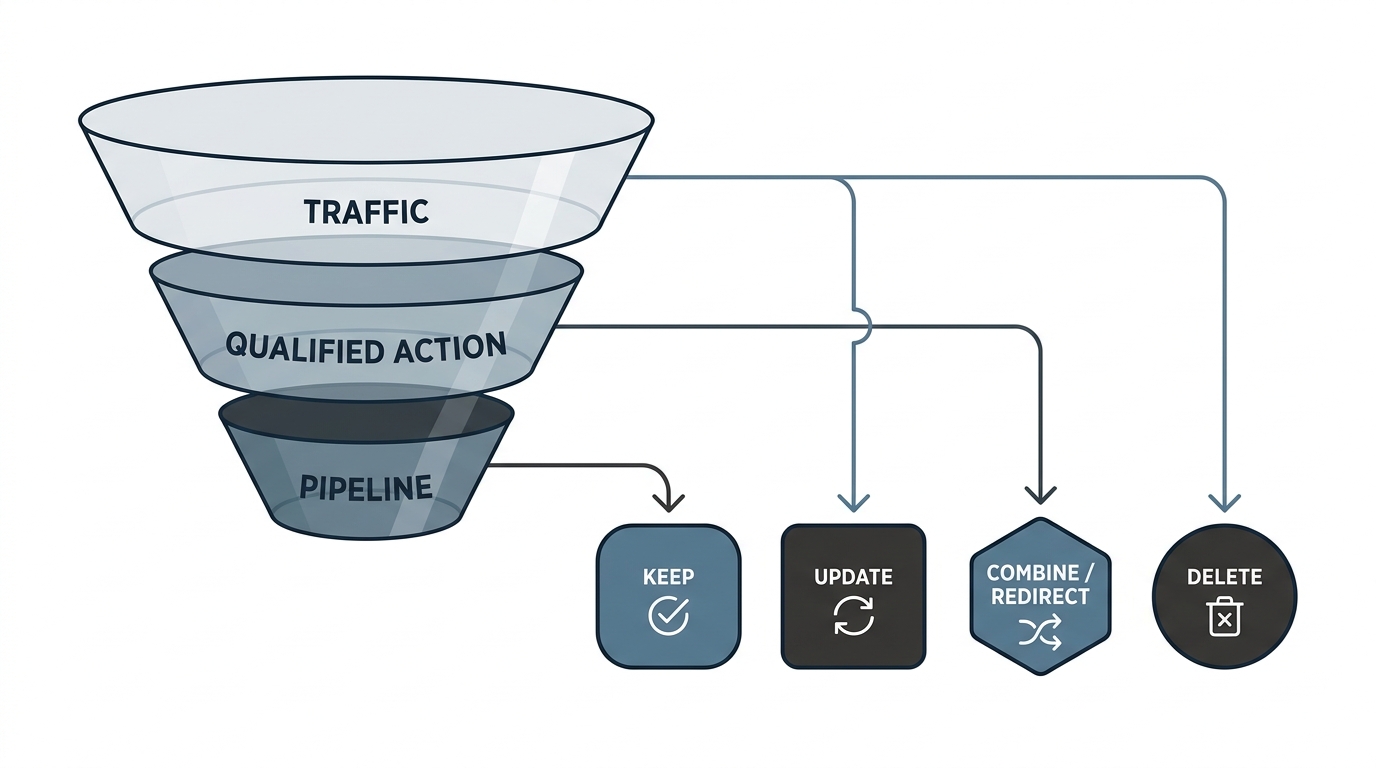
Typical boutique retainers in the $3,000–$6,000 range often cover four to eight pieces of content each month. Typical mid-size agency retainers in the $6,000–$12,000 band often support eight to sixteen pieces. Those output figures are useful only if they are connected to a distribution plan: which buyer problem each page addresses, which channel will surface it, and what evidence will determine whether the work should be expanded, improved, redirected, or removed.
That last point matters because discovery is broader than blog production. If your visibility problem spans search, paid acquisition, landing pages, remarketing, and reporting, an agency can coordinate across channels more easily than a solo operator. It is also the more realistic option when the company needs one system that joins Search Console, analytics, Google Ads, Ads Manager, CRM outcomes, and publishing workflow instead of treating each as a separate task.
The mistake we see most often is hiring a full-service agency to compensate for an undefined internal strategy. That creates polished activity but weak ownership. The founder still needs to supply product context, customer language, priorities, approvals, and sharp feedback. Agency engagements commonly involve weekly or bi-weekly calls, plus asynchronous reviews. The agency can reduce execution time; it cannot eliminate the need for executive judgment.
Do not pay an agency premium merely to receive a calendar of generic topics. Pay for an operating system that makes the company easier to discover and harder to ignore across more than one channel. Single-channel growth is fragile, particularly when a company is still building its authority.
Choose a freelancer when the constraint is narrow and well defined
A freelancer is usually the strongest value when the company already has someone internally who can set priorities and make decisions, but lacks a specific capability. That could be disciplined editorial production, SEO-led writing, campaign execution, or specialist channel knowledge.
Typical freelance content marketing rates sit between $50 and $150 per hour. Mid-level work is commonly priced at $50–$100 per hour, while experienced operators often charge $100–$150+. The economics work best when you know exactly what you are buying: for example, a writer who can execute a search-led brief, a specialist who can improve YouTube titles and metadata, or a contractor who can clean up underperforming landing pages rather than invent the whole system from scratch.
The headline fee can look attractive beside an agency retainer. The hidden cost is management. Without an account manager, strategist, designer, and analyst around the freelancer, the founder or small marketing team often becomes the editorial director, distribution lead, and performance reviewer. If the business has that capacity, this is efficient. If it does not, the freelancer becomes a producer waiting for instructions.
This is also where discovery use case matters. A freelancer can be excellent when the problem is narrow: organic search content, App Store listing copy, Google Play metadata, competitor page analysis, email distribution, or a defined paid campaign. The model becomes weaker when the company needs cross-channel discovery management across website SEO, paid, social, app-store optimisation, and reporting at the same time.
The other cost is concentration risk. A good freelancer can become deeply embedded in customer language, search intent, and the logic behind a content roadmap. If that person leaves, the business retains paid-for assets but can lose the operating knowledge behind them. Avoid that by requiring company-owned access, a visible editorial backlog, documented publishing standards, and monthly reporting that lives outside the freelancer’s private workspace.
Choose tools only when somebody internally owns the work
A tool-led approach is not a lower-cost agency. It is an in-house commitment. SEO, analytics, content optimisation, and planning platforms can reduce research time and make performance more visible. They do not decide which buyer problem matters, write credible expertise, publish pages, earn attention, or turn data into a distribution decision.
A typical stack of one to three tools costs $100–$500 per month. That is materially lower than agency or freelancer spend, but it shifts the real bill into founder or team time. Tool-led programs often require three to ten hours each week for planning, drafting, optimisation, publishing, and performance review.
Tools are most useful when they are matched to a specific discovery use case. If the problem is SEO gaps, use tools to compare topics, pages, and queries the market is already winning. If the problem is YouTube visibility, use them to monitor competitor publishing patterns and video discovery signals. If the problem is app discovery, the work is closer to ASO, or app store optimisation: watching how the product appears in the App Store on iOS and in Google Play, reviewing listing changes, and connecting that visibility to channels such as Apple Search Ads or paid acquisition.
This is where software can genuinely help, but only if the operator knows what to do with it. Tools such as App Radar, Sensor Tower, Google Play Console, or SplitMetrics Optimize can support app-store discovery work; Search Console and broader SEO tooling can support website discovery; and paid interfaces such as Google Ads or Ads Manager can show how competitors frame offers and where your own message is underperforming. The software does not replace judgment. It narrows the search space so a human can make better decisions.
This route works when there is a capable internal operator with protected time and authority to act. It fails when the company buys dashboards instead of building a cadence. A dashboard full of keyword positions, page metrics, or AI Mode observations is not progress if no pages are being improved, no distribution experiments are running, and no one can explain why a page exists.
The advantage is audience and operational ownership. The company retains access to the data and subscriptions if a staff member leaves. The weakness is that the next operator still needs to understand the strategy, reporting logic, page inventory, and publishing workflow. Systems outperform manual effort only when the system is documented well enough to survive a personnel change.
Our recommendation at this stage: buy accountable operating judgment
At this revenue level, we would not default to a large full-service agency and we would not default to DIY tools. We would first establish a narrow, accountable visibility system: clear ownership, company-controlled data, a realistic publishing cadence, and reporting tied to discovery rather than content volume.
For companies at €20,000 a month revenue or more, our own range is €1,500 to €5,000 a month. It sits between tool-only spending and broader agency retainers because the purpose is not to manufacture content at scale. The purpose is to create a durable discovery system the business can inspect, understand, and retain.
What a serious operator shows every month
Monthly reporting is where weak providers reveal themselves. A report that lists completed articles, ranking screenshots, or broad traffic totals is not enough. It tells the founder that activity occurred, not whether the company’s visibility is becoming an asset.
A serious operator should show the same core view every month:
- Clicks by channel: organic search, paid channels, email, social, app-store traffic where relevant, and other meaningful sources should be separated. A blended total conceals where discovery is strengthening or weakening.
- Impressions: show the scale of opportunity and whether the company is appearing more often before a prospect clicks.
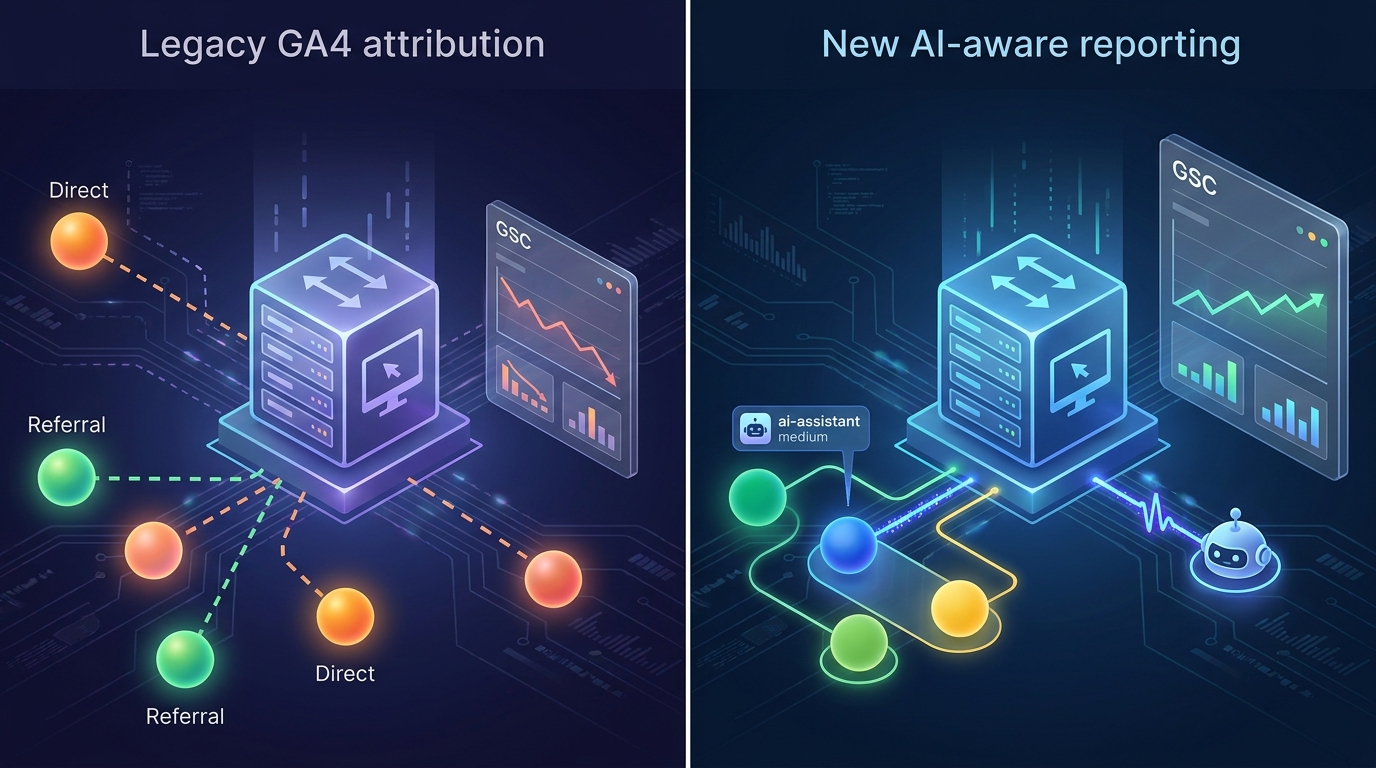
- AI citations as a separate unit: citations are appearances or references in AI-generated answers. They are not clicks, sessions, or traffic, and they should never be added into click totals.
- Pages added and removed: show new pages published, substantial updates completed, and pages removed or redirected. This is the operational record of how the site is changing.
- Outcomes: show the relevant leads, signups, or conversions alongside the pages and channels contributing to them.
- The next plan: explain the coming topics, distribution experiments, technical changes, and the reason each one deserves attention.
This reporting standard matters because discovery is a business function. It lets a founder see whether the business is earning more visibility, building authority in the right subjects, and reducing dependence on a single acquisition channel.
The due-diligence test before signing
Use this exact question with any agency, freelancer, or consultant: “Show me a site you run and its Search Console.”
A serious provider can walk through a real operating view, with identifying details redacted where necessary, and explain clicks by query, impressions, average positions, page performance, and coverage issues. The point is not to demand confidential client information. The point is to distinguish someone who has operated a live discovery system from someone who can only describe one.
Before committing, require clarity on reporting cadence, metric definitions, treatment of AI citations, ownership of analytics access, page-change records, and handover expectations. If the provider leaves, the company should keep its pages, data access, measurement history, editorial logic, and operational documentation. Authority is an asset only when the business owns the system that creates it.
The practical decision
- Choose an agency when multi-disciplinary execution is the actual bottleneck and the company can fund a genuine distribution program.
- Choose a freelancer when the scope is focused and someone internally can own strategy, decisions, and measurement.
- Choose tools when an internal operator has protected time to turn data into publishing and distribution work.
- Reject any provider that sells output without channel-level clicks, impressions, separate AI citation reporting, and a visible record of pages added and removed.
- Build the work in company-owned systems from the beginning, so visibility compounds for the business rather than walking away with a vendor.
At €20,000 a month, this is less a content purchase than an operating-model choice. The right answer depends on whether your real bottleneck is breadth, specialist execution, or internal ownership. Make the decision against discovery outcomes, reporting quality, and handover resilience, not against a comforting list of deliverables.